




Fair Credit Reporting Act Affects Driver Hiring
Last May, the Federal Motor Carrier Safety Administration began its pre-employment screening program service, or PSP. The PSP service compiles information regarding driving records of commercial drivers for use by motor carriers in making employment decisions
Last May, the Federal Motor Carrier Safety Administration began its pre-employment screening program service, or PSP. The PSP service compiles information regarding driving records of commercial drivers for use by motor carriers in making employment decisions.
Operated by National Information Consortium Technologies, the PSP gives carriers a glimpse into a driver's roadside inspection history, specifically hours of service violations, overweight violations and equipment violations.
However, motor carriers should develop processes and procedures to ensure that obtaining and using this information to make hiring and training decisions that are consistent with the Fair Credit Reporting Act.
FCRA should be nothing new to motor carriers, as many current databases and reports are subject to this law, such as most MVRs. FCRA applies to "consumer reports" generated by a "consumer reporting agency." The FCRA does not require employers to conduct background checks, but it does set authorization and disclosure requirements for obtaining the records.
Under the FCRA, before obtaining a consumer report like the PSP, a motor carrier must first make a written disclosure to the driver that the carrier intends to obtain a consumer report, and must obtain written authorization from the prospective driver to do so. This disclosure and authorization must be clear and conspicuous, and must be on its own separate document - not part of the employment application. The form provided by PSP for this purpose should be sufficient.
The motor carrier also must certify to the consumer reporting agency that the motor carrier will comply with the FCRA. The FMCSA does this using the Monthly Account Holder FCRA Employer Certification form included in the PSP application.
Interestingly, the trucking industry obtained an exemption from the requirement that the disclosure and the authorization have to be written when a driver applies for a job. Rather, the disclosure and authorization could be by oral or electronic means. The exemption applies to applications for positions "over which the secretary of transportation has the power to establish qualifications and maximum hours of service pursuant to the provisions of section 31502 of title 49, or a position subject to safety regulation by a state transportation agency," and only if the driver applies by some means other than in person. This exception would appear to cover reports under the PSP system, as almost all such reports would be on driver applicants who are governed by the secretary of transportation. Presumably, this exemption was in recognition of the fact that truck drivers are often on the road and have limited access to mail or fax machines.
However, even more interesting is that the FMCSA unilaterally dispensed with the statutory exemption by contractually requiring that the motor carrier obtain a written authorization from the driver to obtain a PSP report. Therefore, even if a motor carrier previously relied on oral authorization to pull a driver's MVR, in order to obtain a PSP report, motor carriers must get written consent. Furthermore, pursuant to the same contract, the written consents must be kept on file and are subject to audit by the FMCSA (or its designees) at any time.
Generally, prior to taking any adverse action against the driver (for instance, deciding not to hire the driver, or assigning the driver for remedial training in orientation) that is based in whole or in part on information obtained from the consumer report, a motor carrier must first provide a "pre-adverse action" notice to the driver. This notice must provide a copy of the consumer report and a description of the driver's rights under the FCRA in a form promulgated by the Federal Trade Commission. This notice allows time for the driver to challenge or correct any errors in the consumer report before final adverse action is taken.
If after providing the pre-adverse action notice, the motor carrier does, in fact, take adverse action against the driver based on the consumer report, then the motor carrier must provide notice of the adverse action within three business days of taking such action. This notice must contain the following:
* The name, address and telephone number of the consumer reporting agency;
* A statement that the agency did not make any decision and cannot provide any reasons why the adverse action was taken;
* Provide notice of the driver's right to obtain a free copy of the consumer report; and
* Provide notice of the driver's right to dispute the accuracy or completeness of the information in the report.
Although the adverse action notice can be oral, written or electronic, it is recommended that a written notice be used to document that all necessary information was conveyed.
As with the written consent requirement, the trucking industry obtained a special exemption for taking adverse action. Motor carriers may dispense with the pre-adverse action requirement if the driver applies by means other than in person. Instead, the motor carrier can simply proceed with the adverse action and send the adverse action notice. If the driver requests a copy of the consumer report from the motor carrier, however, the motor carrier must comply with the request within three business days, as well as provide a copy of the FTC's notice of consumer rights form (which should be provided by the agency when the report is sent.)
Unlike the written consent requirement, FMCSA does not require motor carriers to contract out of the adverse action statutory exemption in order to participate in the PSP program. Therefore, if the driver does not apply in person, the pre-adverse action notice is not required when taking the adverse action (such as not hiring the applicant) based on the PSP report. If the driver does apply in person, the pre-adverse action notice is required, including a copy of the PSP report and a copy of the FTC notice of rights. And if adverse action is taken, the same notice is required, along with an extra requirement that the driver be informed of their right to obtain a copy of the PSP report from the FCMSA as well.
What about independent contractors? Independent contractors are included in the federal definition of "employee" under 49 CFR 390.5. Because motor carriers, generally, are responsible for safety compliance of independent contractors, we recommend using PSP to screen contractor applicants but changing the authorization and notices to delete references to "employee" to eliminate confusion.
In conclusion, in obtaining access to the PSP database, a motor carrier must have authorization from the driver. We suggest using the authorization provided by PSP. If the motor carrier is using the PSP to take a negative action against the applicant, then the pre-adverse action must be given, but only if the driver applied in person. Finally, after the adverse action is taken, the motor carrier must provide an adverse action notice. PSP does not provide forms for the pre-adverse action notice nor the adverse action notice. Therefore, motor carriers should work with counsel to develop these along with policies and procedures for FCRA compliance.
From the April 2011 issue of HDT.
More Safety & Compliance
How Waste Connections is Using Data, Telematics, and AI
How do you manage and maintain more than 18,000 connected trucks? Data. Lots of it.
Read More →
Fleet Advantage: Top Logistics Fleets Outperform National Safety Benchmarks
Fleet Advantage's latest TRUST Safety Index found leading logistics fleets maintained significantly lower out-of-service rates and stronger safety scores than national averages, while highlighting persistent challenges related to tires, brakes, and unsafe driving behaviors.
Read More →
Why Fleet Data Matters More Than Ever at Waste Connections [Watch]
Waste Connections' Chuck Palmer explains how telematics, predictive maintenance, safety analytics, and AI help keep vehicles on the road and drivers safe in this episode of HDT Talks Trucking.
Read More →
Short Takes: How K&B is Using AI
Fleets need to "get on board the train" with AI, says Lance Evans of K&B Transportation in this HDT Talks Trucking Short Takes episode.
Read More →
Short Takes: Inside K&B’s Truck Safety Tech
Listen to learn how K&B Transportation uses cellphone-blocking technology, speed management systems, weather geofencing, bridge avoidance tools, and more to improve driver safety.
Read More →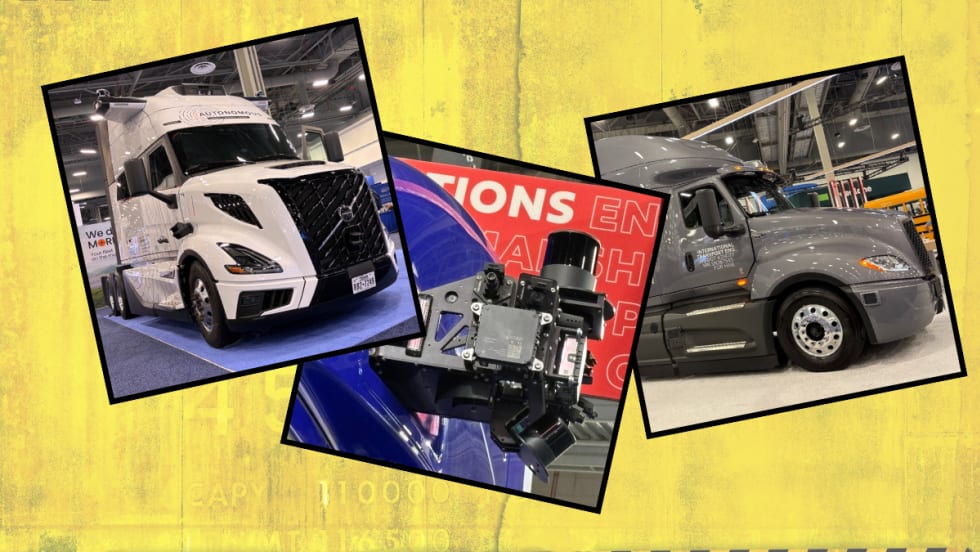
The Biggest Gap in Driverless Trucking Isn’t Tech. It’s Safety Validation
Nauto’s Stefan Heck says autonomous trucks are advancing quickly but proving they’re safe enough for large-scale deployment may be the industry’s hardest challenge.
Read More →
Truck Crash Rates Are Down. So Why Do Insurance Costs Keep Rising?
ATRI’s latest research points to litigation, social inflation, and soaring claims costs as key drivers behind record-high liability premiums for trucking fleets. But there are things motor carriers can do.
Read More →
FMCSA Removes More Than a Dozen ELDs from Registered List
The FMCSA continues its efforts to fight electronic logging devices that don't meet federal requirements, removing more than a dozen from the registered ELD list in May.
Read More →
How the Supreme Court Broker Liability Ruling Could Reshape Trucking’s Safety Landscape
The Supreme Court’s May 11 broker-liability ruling may not radically rewrite transportation law overnight. But industry experts say it will intensify pressure on brokers, carriers, and shippers to prove they are prioritizing safety.
Read More →
Recall of Fontaine Fusion Flatbeds Warns Owners Not to Use the Trailers
Some Fontaine Fusion flatbed trailer manufactured between February 2025, and March 2026 could have mainbeams weakened by hydrogen embrittlement because of a problem in the galvanizing process.
Read More →