




Maryland Demonstrates Drivewyze Wireless Bypass Service
Federal and industry luminaries gathered at a Maryland truck weigh station Monday to observe the latest in wireless bypass technology. The state implemented the Drivewyze system last September and has found that it helps focus its enforcement efforts.


Captain Norman Dofflemyer, commander of the Maryland State Police Commercial Vehicle Enforcement Division, speaking at the Maryland Drivewyze demonstration. (Photo: Oliver Patton)
Federal and industry luminaries gathered at a Maryland truck weigh station Monday to observe the latest in wireless bypass technology.
Maryland implemented the Drivewyze system last September and has found that it helps focus its enforcement efforts, said Captain Norman Dofflemyer, commander of the Maryland State Police Commercial Vehicle Enforcement Division.
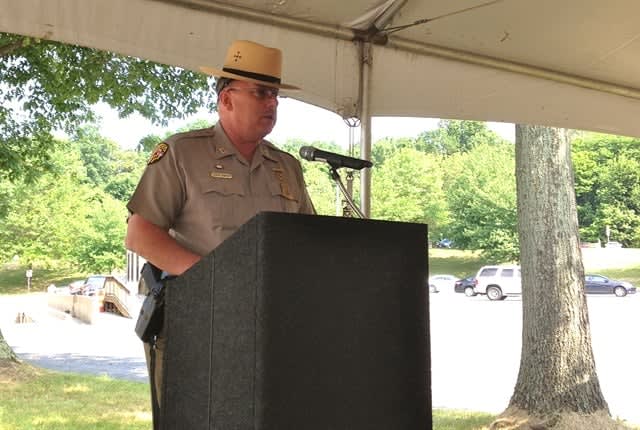
Captain Norman Dofflemyer, commander of the Maryland State Police Commercial Vehicle Enforcement Division, speaking at the Maryland Drivewyze demonstration. (Photo: Oliver Patton)
With the system, officers can wave through trucks and drivers that are safe and concentrate on those that need to be inspected, Dofflemyer said.
And small intrastate carriers can get quicker treatment and avoid repeat inspections, he said.
“Our only wish is that more trucks were equipped with the bypass system,” he said.
On hand for the demo were Anne Ferro, chief of the Federal Motor Carrier Safety Administration, and Victor Mendez, chief of the Federal Highway Administration.
Also, Bill Graves, president and CEO of American Trucking Association, Stephen Keppler, executive director of the Commercial Vehicle Safety Alliance, and Thomas Kern, executive vice president of the Intelligent Transportation Society of America.
They watched a demonstration of the wireless Drivewyze service, in which several trucks and a bus were screened against federal databases and weighed in motion as they approached the station.
When the checks came up clean, the vehicles were given the all-clear to drive past.
The service is provided wirelessly through a variety of onboard or mobile communications devices that function as Commercial Mobile Radio Service transponders.
With the system’s GPS “geo-fence” trigger, subscribers get an automatic check a couple of miles before they reach the facility.
The check can include a variety of data points, such as carrier information, vehicle identification, inspection history and the driver hours of service status as well as weight compliance.
The check is handled automatically at the weigh station through a secure cloud-based interface that IBM and Drivewyze offer state agencies at no charge.
“If the carrier or the driver has a solid safety record, and is not overweight, we can wave them through,” Dofflemyer said.
“If we see a borderline case, or poor CSA score, we may inspect driver information and logbooks, plus do a vehicle inspection.”
He added that access to the system, and the data itself, is controlled by the state agency.
Drivewyze president Brian Heath described the service as a “technology ecosystem” that offers the trucking industry an alternative to the PrePass clearance system.
While PrePass requires carriers to be vetted before they can subscribe, Drivewyze is open to all, Heath said.
It is up to the state agencies to decide what range of services they may provide Drivewyze subscribers, based on their safety data, including CSA scores, he said.
“The idea is to offer this capability to all,” Heath said.
The monthly per-driver subscription cost ranges from $12.99 for multi-state access to $7.99 for single-state access, said Tanya Roberts, vice president of marketing for Drivewyze.
“We now have 16 states participating and are working on getting more,” she said.
She also said that owner-operators as well as fleets are interested in the service.
That makes sense to Christian Schenk, senior vice president of XRS Corp., one of the Drivewyze partners on hand at the event.
“The technology levels the playing field,” he said. “Owner-operators can enjoy the benefits of bypass as easily as fleets can.”
Other technology partners at the event were PeopleNet and Zonar.
More Drivers

Platform Science Adds Dispatch and Safety Tools
Four additions to PS Fleet help fleets monitor loads, manage driver coaching, share truck locations and adjust video system settings.
Read More →
When Language Stops the Truck: The Return of ELP Out-of-Service Orders
English language proficiency rules for commercial drivers aren’t new, but renewed out-of-service enforcement has raised the stakes. Here’s what carriers need to know before a driver reaches a roadside inspection.
Read More →
Samsara Launches Custom AI Agent Builder
Agent Studio lets fleets create AI tools for hours-of-service monitoring, reporting and driver support, including agents that communicate by phone.
Read More →
Trucker Path Expands Reserved Parking Network
Trucker Path has added close to 6,000 more truck parking spaces to its Trucker Path Reserved Parking Network with the addition of Safe Truck Parking.
Read More →
EEOC Sues Texas Trucking Company Over Driver Age Limits
The agency says Trancasa USA rejected applicants over 65 and applied tougher driving-record standards to those over 60.
Read More →
Nussbaum, Roehl Announce Second Driver Pay Increase This Year
This year has seen a swath of major truck driver pay increases as freight capacity has tightened.
Read More →
From One Generation to the Next: How Mentorship Builds Safer Truck Drivers
After three decades in trucking, Harold Perry shares what he's learned about driver safety, mentorship, and helping the next generation build confidence behind the wheel.
Read More →
Truck Drivers Need More Than Another Alert
Fleets have more visibility into truck health, safety events, and driver activity than ever. The next challenge is turning all that information into useful guidance for the person who has to decide what to do next.
Read More →
FMCSA Removes 110 Truck Driver Training Schools from Certified ELDT List
Federal regulators also are targeting more than 160 additional training providers and launching a nationwide audit of third-party CDL skills testers as part of a broader crackdown on trucking fraud.
Read More →
Hours of Service Pilot Programs: FMCSA Readies for 2027 Rollout
Two pilot programs could eventually reshape hours-of-service rules, giving truck drivers options to pause their 14-hour clock or use longer split sleeper rest periods.
Read More →