




U.S., Canada Announce Binational Border Infrastructure Plan
Officials with the United States and Canada have announced a binational border infrastructure plan to expedite traffic and freight movements between the two countries. It outlines the approach that the U.S. and Canada will take to coordinate plans for physical infrastructure upgrades at small and remote ports of entry.
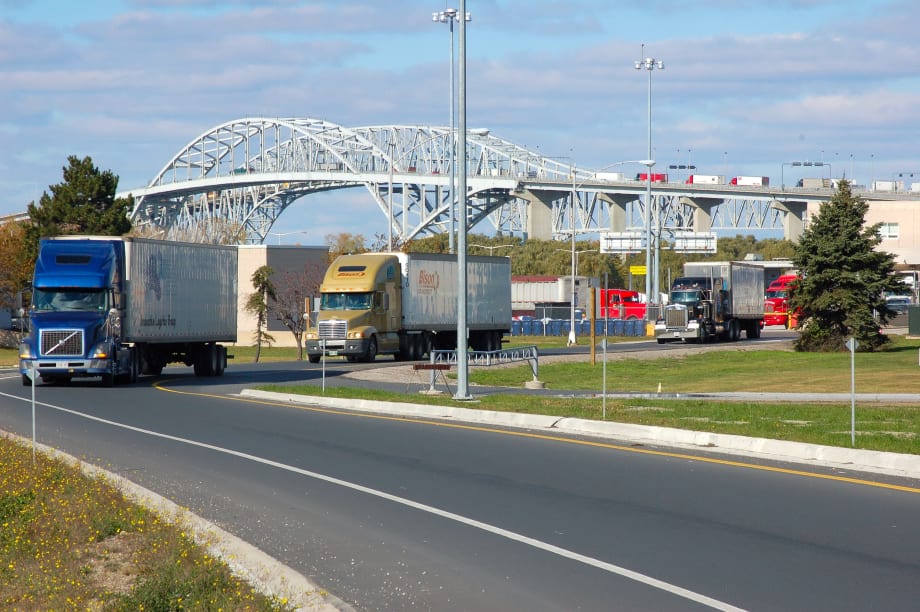
The Canadian and U.S. governments are working to make trade flow more smoothly at the border. (Photo by Jim Park)
The Canadian and U.S. governments are working to make trade flow more smoothly at the border. (Photo by Jim Park)
Officials with the United States and Canada have announced a binational border infrastructure plan to expedite traffic and freight movements between the two countries.
The BIIP is an interagency and binational planning mechanism developed to establish a mutual understanding of recent, ongoing and potential border infrastructure investments. It outlines the approach that the U.S. and Canada will take to coordinate plans for physical infrastructure upgrades at small and remote ports of entry. This initiative will be updated and disseminated annually.
An integrated, bilateral approach to border investment is critical to both the U.S. and Canadian economies," said DHS Secretary Janet Napolitano. "The BIIP offers enhanced security along our shared U.S.-Canadian border, while reducing wait times at major border crossings—increasing the flow of traffic across the border while ensuring safe and secure trade and travel."
This first-ever joint U.S.-Canada Border Infrastructure Investment Plan fulfills a commitment made under the 2011 Canada-United States Beyond the Border Action Plan.
The BIIP follows recent announcements by the Government of Canada of significant investments at four initial priority land ports of entry identified by Canada in the Action Plan: Lacolle, Quebec; Lansdowne, Ontario (Thousand Islands Bridge); Emerson, Manitoba; and North Portal, Saskatchewan. The modernization of major border crossings will reduce wait times, increase reliability of just-in-time shipments, and decrease fuel consumption and greenhouse gas emissions.
Canada and the United States have the world's largest trading partnership, with two-way merchandise trade totaling $570 billion in 2012.
In addition, the government of Canada announced, in July 2012, the installation of technology to measure and report border wait times at the Peace and Queenston-Lewiston Bridges. The $1.7 million project was completed in partnership with the U.S. Customs and Border Protection, U.S. Federal Highway Administration and the Canada Border Services Agencies.
"Our two governments are committed to enhancing our mutual security and economic prosperity through significant investments at key crossings," said Minister of Public Safety, Vic Toews. "These investments will reduce border delays, expedite trade across our shared border, and allow the Canada Border Services Agency to focus on facilitating the flow of low-risk people and goods while keeping the border open to legitimate trade and travel."
More information on the Beyond the Border Action Plan is available from the U.S. Department of Homeland Security.
More Drivers

Truck Drivers Need More Than Another Alert
Fleets have more visibility into truck health, safety events, and driver activity than ever. The next challenge is turning all that information into useful guidance for the person who has to decide what to do next.
Read More →
FMCSA Removes 110 Truck Driver Training Schools from Certified ELDT List
Federal regulators also are targeting more than 160 additional training providers and launching a nationwide audit of third-party CDL skills testers as part of a broader crackdown on trucking fraud.
Read More →
Hours of Service Pilot Programs: FMCSA Readies for 2027 Rollout
Two pilot programs could eventually reshape hours-of-service rules, giving truck drivers options to pause their 14-hour clock or use longer split sleeper rest periods.
Read More →
Medical Cards, English Proficiency Reshape Roadcheck Violations
Medical-card violations jumped to the top of the driver out-of-service list during CVSA’s 2026 International Roadcheck, while English-language proficiency violations appeared among the leading violations for the first time.
Read More →
Driver Trust Can Make or Break the Success of Fleet Safety Technology
New Teletrac Navman research suggests that onboarding, transparency about driver data, and positive feedback can play a significant role in how commercial drivers respond to safety and coaching technology.
Read More →
EEOC Sues KLLM Over Alleged Sex Discrimination in Driver Training
KLLM is facing a federal sex-discrimination lawsuit over policies the EEOC alleges put female truck driver trainees at a disadvantage.
Read More →
FMCSA Moves to Codify English Language Requirements for Commercial Drivers
By changing regulations on English-language proficiency requirements for commercial drivers, rather than relying on a guidance memo, the FMCSA said future administrations won't be able to walk back the Trump administration's stricter enforcement with just a memo.
Read More →
Drivers Put Western Star Trucks to the Test at Star Nation Experience
Watch to get an inside look at the Western Star trucks, technology, and community behind the Star Nation Experience 2026!
Read More →
Trump Administration Looks to Put More Veterans Behind the Wheel
The Freedom Haulers program pulls together existing and expanded programs at several federal agencies to recruit veterans to drive commercial heavy-duty trucks and cut the red tape for them to get a CDL, training, and employment.
Read More →
Putting Mack’s Command Steer to the Test
A test drive of Mack’s Command Steer active steering system evaluates how it can make truck driving easier and less tiring.
Read More →