





Related: Cutting Methane Crucial to Future of Natural Gas Vehicles
Why Some Fleets Still Like Natural Gas
Some fleets opt to run on natural gas instead of diesel, a decision fueled by one or more key influences.
September 19, 2017
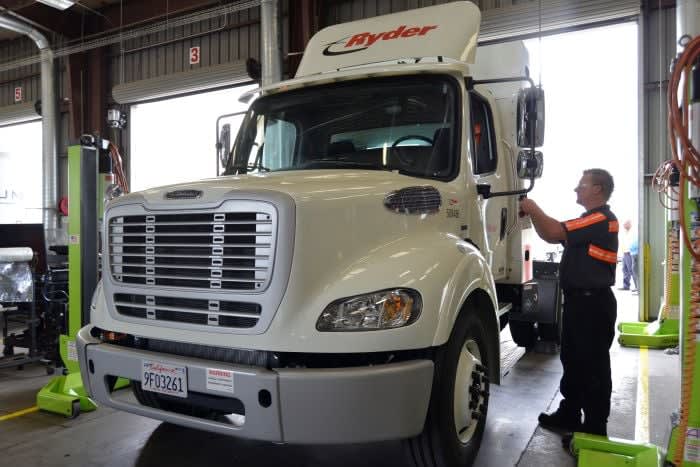
Ryder’s Scott Perry sees an 800-pound gorilla named California at the fuel pump, which could eventually help drive up sales of natural-gas vehicles. Photo: Ryder
9 min to read
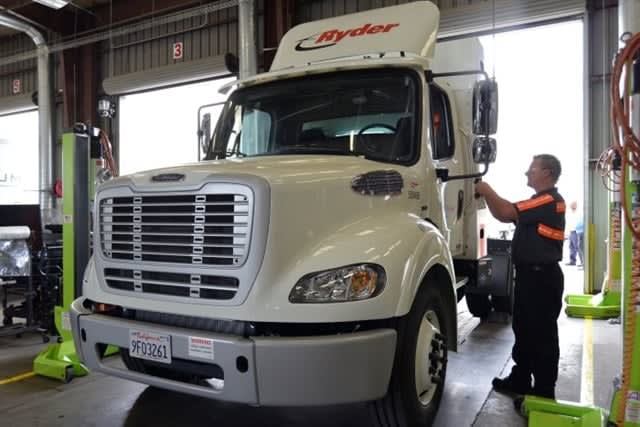
Ryder’s Scott Perry sees an 800-pound gorilla named California at the fuel pump, which could eventually help drive up sales of natural-gas vehicles.Photo: Ryder
Not so long ago, the enthusiasm in trucking circles for using natural gas as a vehicle fuel was so hopped up it could have sparked a fire in a capped wellhead. But now that the price of diesel has plummeted back to earth, you’d be forgiven if you thought interest in natural gas would have pretty much flamed out.
But it hasn’t. And that makes sense when you consider that all along, there essentially have been three types of buyers (with a lot of overlap) for natural gas trucks: Those that are required to do so by clean-air rules, those that need or desire to be perceived as environmentally friendly, and those that are looking to save money over diesel.
When diesel prices were rising rapidly, many fleets that were not required by clean-air rules or by the desire or need to be perceived as “running green” were converting to natural gas or other alternatives simply to save on fuel costs.
In many cases, those fleets — as well as those motivated by other goals — made wholesale switches to compressed natural gas (CNG) or liquefied natural gas (LNG), placing hefty truck orders and making large commitments to purchase fuel or invest in fueling infrastructure to leverage the fuel savings as much as possible.
Today, however, it appears the outlook for relatively cheap diesel extends out at least into 2019, meaning that the reason for running natural gas fuel is no longer so compelling.
“The profile of the user of natural gas technology has changed drastically from five years ago,” says Scott Perry, Ryder System’s chief technology and procurement officer - Global Fleet Management Systems. “Back then, the financial decision was the key driver. Now, fleets still involved are those that made an earlier investment in natural gas vehicles and infrastructure or long-term fuel contracts and are still leveraging that investment, as well as those who see natural gas as a way to meet corporate carbon footprint or other green commitments.”
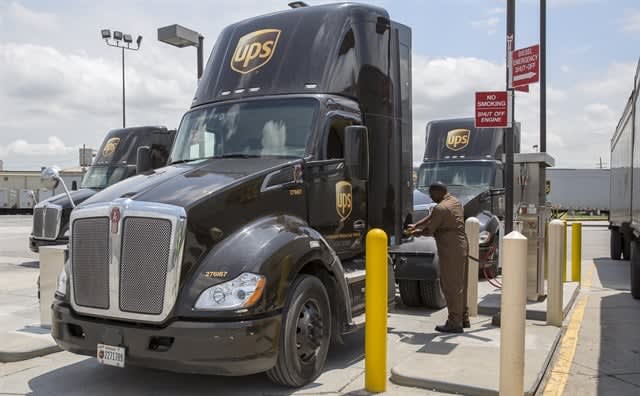
UPS does not base its fueling decisions on the price of fuel alone, continuing to identify areas where it can deploy natural gas rather than diesel.Photo: UPS
The financial case
That trucking is still enjoying lower and fairly stabilized diesel prices into this year’s second half is reflected in the drop-off in sales of trucks powered by natural gas and other alternatives.
“Despite a positive start to the year, U.S. and Canadian natural gas Class 8 truck retail sales have slowed sequentially and on a year-over-year basis almost every month since,” says industry analyst Kenny Vieth, president of ACT Research. “Given the uncertainty spurred by the current political climate regarding environmental policy, advancements in other green technologies, and a still-high price premium for natural gas vehicles in a period of low oil prices, the slowing appears appropriate.”
He observes that natural gas vehicle purchases as of the second quarter appeared to be dominated by refuse fleets, and by transit and school bus operators.
Waste Management, for instance, just announced it has deployed its 6,000th natural gas refuse truck and opened its 100th natural gas fueling station.
“Among truckers, it appears as though the majority of incremental volume came from those who currently have natural gas vehicles and are replacing units or increasing their number,” Vieth says.
But, on the other hand, there are customers in the refuse, municipal and vocational segments “who continue to move toward natural gas as an attractive option. So, emissions would be the main driver today for a fleet to convert to natural gas from diesel.”
“Lower diesel costs have certainly impacted the conversion of fleets from diesel to natural gas,” says Bob Carrick, Freightliner’s vocational sales manager, natural gas, and a former fleet manager. “There are very few new customers who are changing fuels at this point. Over-the-road customers are also seeing better fuel economy with newer diesel products, which negatively impacts the return-on-investment equation for natural gas.”
Analysis of a newly released pricing forecast by Oil Market Analyst Torbjørn Kjus of Norwegian mega-bank DNB predicts that the national average price for diesel in the U.S. will begin to rise in this year’s fourth quarter. The price is expected to average $2.33 per gallon for full-year 2017; then to average $2.55 for 2018 and $2.71 for 2019. The price could climb to $3.03 per gallon for 2020 before noticeably retreating.
Jon Gabrielsen, president of J.T. Gabrielsen Consulting LLC, who analyzed the DNB data for HDT, contends that, “If Kjus’ forecast turns out to be correct and the price of West Texas Intermediate crude rises markedly, a fleet might want to run the business case for their own exact circumstances for compressed natural gas. But for CNG only,” he stresses, “not any other type of alternative fuel.”
Gabrielsen figures that “for some fleets it might make economic sense to convert to CNG if WTI oil rises above $50 to $60 per barrel, but for others it may not. And it’s extremely unlikely — unless WTI was to rise above $80/barrel permanently — that any of the other alternative fuels [beyond natural gas] would make sense for U.S. fleets solely in economic terms.”
Some fleets, however, are looking more long-term. Earlier this year, UPS, which already operates 4,400 natural gas vehicles, announced plans to build an additional six CNG fueling stations and add 390 new CNG tractors and terminal trucks and 50 LNG vehicles to its alternative fuel and advanced technology fleet.
While some may still regard switching from diesel to natural gas as an either/or proposition, UPS looks at that question quite differently. “We prefer not to think in terms of ‘conversion’ but rather of ‘supplementing,’” says UPS Director of Fleet Procurement Mike Casteel. “We are not changing from diesel to natural gas; we are adding natural gas trucks and stations to our fleet,” he explains. “In some cases, these trucks are purchased instead of diesel as older diesel trucks are removed from service. In some cases, the natural gas trucks are being added as part of fleet growth. But in all of our locations so far where we have built natural gas stations, we continue to run diesel and gasoline vehicles as well.”
Casteel says these are long-term decisions for UPS, “not something we would abruptly change. Other fleets would likely take the same approach and stay the course if they have made similar investments in infrastructure. But if they have only been dabbling or testing, then, yes, I can see how they might alter or postpone additional natural gas purchases given the current fuel economics.”
Ryder’s Scott Perry sees an 800-pound gorilla named California at the fuel pump, which could eventually help drive up sales of natural-gas vehicles.Photo: Ryder
Other factors
Nevertheless, there are still fleets buying natural gas vehicles and still manufacturers happy to support them.
Peterbilt produces a large volume of natural gas vehicles, says Chief Engineer Scott Newhouse. “We’ve enhanced our natural gas product line to benefit refuse companies that pull ‘free’ [biomethane] gas from their sites as well as companies that operate in non-attainment clean-air areas and those that value presenting a green image.
“With Near Zero [engine emission] technologies entering the marketplace, customers may find alternative fuels to be better than electric vehicles,” he continues. “We are currently developing a demonstration vehicle to validate the user cycle, and Peterbilt is in a good position to support both of these markets in the future.”
John Moore, Volvo Trucks’ product marketing manager – powertrain, says the company’s customers are continuing to buy about the same mix of natural gas- and diesel-powered vehicles. He cautions buyers to be aware of the fuel-cost spread. “For fleets looking simply at fuel costs, the near-term outlook for converting to CNG would not be promising, since the lower total cost of ownership driven by cheaper natural gas costs are offset by higher initial capital costs for natural gas fueling infrastructure.”
However, he adds, “other factors are involved that move purchasing decisions in favor of natural gas.” For example, he points out that natural gas-powered vehicles do not use a diesel particulate filter or selective catalytic reduction aftertreatment systems.
“If a fleet hauls short distances under light engine loads with diesel engines, the DPF may require frequent manual, parked regenerations that upset delivery schedules,” Moore explains. “These could be avoided with natural gas-powered vehicles that use a three-way catalyst that requires no maintenance.
“In addition, some fleets may have a new source of renewable CNG [aka. biomethane] from landfill gas, wastewater sludge or food waste because of acquisitions. It’s an easy move to natural gas when the energy is almost free.”
Life cycle is another consideration. ACT Research’s Vieth says that with the typical trade cycle of around five years for Class 8 tractors, “the payback period [for converting] has to be relatively short to drive demand. Other applications, like transit buses or garbage trucks, have much longer cycles, making these segments better candidates for conversion to alternative fuels.”
UPS is one of those with a longer cycle, running trucks till the end of life. “We will even repower a five- or six- year old Class 8 natural gas truck if the high-mile routes on which it’s deployed exhausts the life of the engine, but the truck is in otherwise good condition,” Casteel says. “This allows us to essentially re-use the most expensive component – the natural gas fuel tank system – which in most cases are designed to last much longer than the truck itself.” And they don’t have to worry about what will happen to the value of the vehicle on the used-truck market.
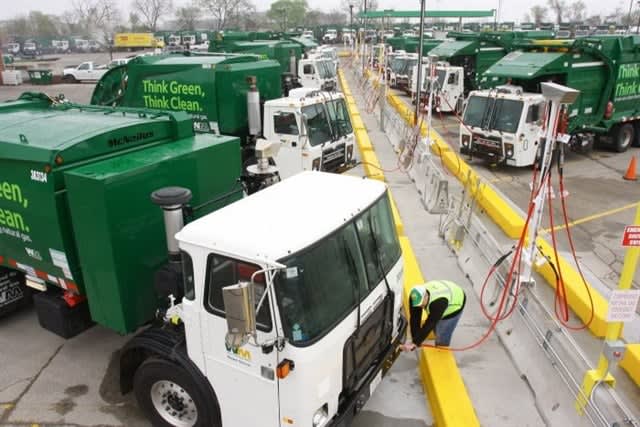
Natural gas vehicle purchases continued to be dominated by refuse fleets in the second quarter of 2017, as well as transit and school bus operators, according to ACT Research.Photo: Waste Management
The 800-pound gorilla
While it seems that the natural-gas truck market will largely flatten out until diesel prices rise substantially, Ryder’s Perry points out there is an 800-pound gorilla named California at the fuel pump, which could eventually help drive up sales of natural-gas vehicles.
Natural gas is one of the strategies being deployed to meet the Southern California ports’ Clean Truck Program standards. And Perry notes that the rules put forth by California’s Air Resources Board are always far-reaching, as they apply to any vehicles operating, not just those domiciled, in California.
“California’s ‘near zero’ emission standards — aimed at light- and medium-duty commercial vehicles — now includes natural gas power, so more fleets will be looking at [CNG] for compliance reasons,” Perry explains. “Think of it as targeted tool for meeting emission limits for sustainable transportation. As a measure of compliance, these standards amount to a ‘bridge’ to the ultimate goal of zero emissions” from trucks.
Hugh Donnell, North American truck market leader for Cummins Westport, says that since the price of diesel has dropped, the emphasis has shifted away from saving money on cheaper natural gas to leveraging the alternative fuel to further cut engine emissions to meet the near-zero standards set by CARB.
“We worked in partnership with CARB in developing our ISL G engine, which we introduced late last year, and our 12L ISX G engine, which is due out next February,” Donnell says.
Emissions from the 8.9L ISL G are 90% lower than the current NOx limit of 0.2 gram per brake horsepower-hour. And the engine meets 2017 EPA greenhouse gas emission reduction requirements.
In the end, trucking operates in too complicated a world — including the fact that California is not an island — for anyone to downplay natural gas as the most widely accepted alternative fuel for trucks. At least for now.
“People need to stop searching for ‘the one solution for all,’” says Mario Sanchez-Lara, director of technical sales support for Cummins. “Diesel was that one solution. But those days are over and the solutions are different now.”
Subscribe to Our Newsletter
More Fuel Smarts

Detroit Opens Orders for EPA 2027 Engines
Detroit isn’t starting from scratch to meet EPA 2027 diesel emissions standards. Its Gen 6 DD13 and DD15 engines keep much of today’s platform while updating the fuel and aftertreatment systems.
Read More →
Zero-Emission Truck Corridor Planned for West Coast
California, Oregon, Washington, British Columbia and Baja California are coordinating plans for truck charging and hydrogen fueling from Canada to Mexico.
Read More →
A Closer Look at Kenworth’s Electric T880E Vocational Truck [Video]
Learn more about Kenworth's T880E battery-electric vocational truck at the Paccar Technical Center, including its range, applications, upfitting considerations, and PTO options, in this HDT Spotlight video.
Read More →
Kenworth T880E Brings EV Power to Vocational Trucks
A closer look at the Kenworth T880E’s range, charging, powertrain and upfit options — and where fleets are showing the most interest.
Read More →
Jennie Abarca Is Proving Electric Trucks Can Do the Job
HDT Truck Fleet Innovator Jennie Abarca is building confidence in fleet electrification one load at a time while openly sharing the challenges she encounters along the way as a small-fleet owner.
Read More →
Cummins Adjusts 2027 Engine Rollout After EPA Proposal
The engine maker will gradually introduce its new Model Year 2027 diesel engines while continuing to offer current models during the transition, citing the EPA's proposed emissions rule changes.
Read More →
EPA Proposal Could Ease 2027 Truck Costs and Buying Uncertainty
The proposal doesn't change the tougher NOx standard, but it would revise key implementation requirements that manufacturers say have driven up costs and complicated fleet purchasing decisions.
Read More →
Cummins, Paccar Ease DEF Derates After EPA Guidance
Updated diesel engine software gives truck operators more time to address emissions-system issues while staying compliant with EPA emissions standards.
Read More →
Maintenance in the Messy Middle Part 3: Biodiesel
Biodiesel can reduce emissions, improve fuel-system lubricity and use existing diesel infrastructure. But NACFE’s Messy Middle maintenance report says fleets must actively manage storage, cold-weather operation, filters and oil drain intervals to avoid problems.
Read More →
Enhance Fleet Performance with High-Efficiency Auxiliary Power Units
Drive sustainable cost savings while increasing driver comfort during short- and long-haul logistics operations.
Read More →