





Related: Love’s Offers 99 Cent Per Gallon CNG
Touting CNG in the Texas Triangle
In eastern Texas, natural gas has seen successes within the highly traveled corridor linking three huge metro areas.
February 24, 2015
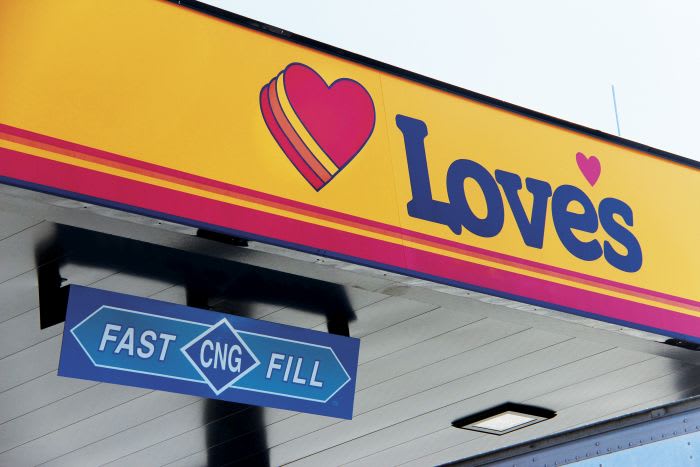
Love’s first began providing CNG to heavy-duty drivers in 2012, and has continued to expand its network throughout the U.S., including adding stations in eastern Texas. Photo via Love's
2 min to read
Love’s first began providing CNG to heavy-duty drivers in 2012, and has continued to expand its network throughout the U.S., including adding stations in eastern Texas. Photo via Love's
Natural gas proponents should look to the Texas Triangle for inspiration. This “megaregion” contains three of the Lone Star State’s largest cities — Houston, Dallas and San Antonio — which are connected by a highway system of Interstates 45, 10 and 35.
“It is a great network of shipping lanes that with the natural gas infrastructure has eliminated the fueling infrastructure concerns,” says Mike O’Connell, senior director, fleet supply chain, at Frito-Lay.
O’Connell, who currently runs a total of 51 CNG trucks in the region and plans on adding 22 more this year, says the Triangle owes this to the support of the natural gas and trucking industries, which have built out the necessary infrastructure and placed CNG and LNG trucks on the ground in Texas.
Giving CNG some Love
Love’s Travel Stops began offering CNG in 2010, with its first heavy-duty fueling station designed for Class 8 truck use popping up two years later. Since then, the company has continued to expand its CNG network in the state, including within the Texas Triangle.
“The Texas Triangle was a good area for Love’s to expand its CNG network because of the heavy truck traffic,” says Bill Cashmareck, Love’s general manager of natural gas. “The routes are heavily traveled, which also makes it a good place for fleets to take advantage of the CNG offerings and determine that CNG is a viable option for over the road applications.”
Fleets that use the Texas Triangle have responded positively, according to Cashmareck, which has helped his team determine future CNG locations, including three stations in Houston, three in Dallas/Fort Worth, and one in San Antonio. To celebrate, Love’s offered drivers CNG for 99 cents for the second half of February, starting on Valentine’s Day, at its Texas locations.
CNG’s success
The Texas Triangle is a natural gas fuel success story, according to Clean Energy spokesperson Patric Rayburn, “because of the investment Texas, Clean Energy and other industry players have made to bring America’s abundant natural gas to truckers as a vehicle fuel.”
Fleets such as Dart Transit, Dillon Transport, Swift Transportation and Seaboard Transportation have taken advantage of the growing CNG infrastructure within the area.
In 2011, the Texas State Senate established the Clean Transportation Triangle program, which provides grants for the creation of natural gas fueling stations in the 63 counties in the state. Last year, a total of more than $7.7 million was granted to 19 applicants.
“The success of natural gas fuel in meeting the demanding requirements of fleets such as UPS and EJ Madison operating throughout Texas and the region has showcased the tremendous potential natural gas fuel offers other freight corridors,” adds Rayburn.
Subscribe to Our Newsletter
More Fuel Smarts

How Volvo Updated Its D13 for EPA 2027 [Watch]
Volvo’s updated D13 promises lower emissions without sacrificing performance or fuel economy. Take a closer look at what changed inside the engine in this HDT Spotlight video.
Read More →
Diesel Price Spike Shortens Payback for Natural Gas Trucks, Report Says
Energy Vision estimates fleets could recover the higher purchase price of an RNG-fueled Class 8 tractor in 1.3 to 2.8 years under current fuel-price scenarios.
Read More →
Calstart Becomes Catalyst Mobility, Reflecting Broader Focus
Calstart is now Catalyst Mobility, reflecting the nonprofit’s growing national role in clean transportation, including zero-emission trucks, infrastructure and incentive programs.
Read More →

Record Diesel Prices Squeeze Trucking Fleets
Average U.S. diesel prices have climbed to nearly $6 a gallon, surpassing the 2022 record as tight refinery capacity and Middle East disruptions keep fuel costs elevated.
Read More →
Sponsored•September 9, 2026
How Fuel Delivery Shapes Engine Performance
Fuel delivery depends on more than what happens at the injector. For fleet, maintenance and technical professionals, looking at the full path from pump to injector can provide useful context for understanding engine performance.
Read More →
East Coast Port Launches $45M Electric Truck Push
The Port Authority of New York and New Jersey announced millions in incentives for zero-emission drayage trucks, yard tractors, and new charging hubs near the port.
Read More →
California Bill Could Shed Light on Electric Truck Prices
Why do battery-electric Class 8 trucks remain so expensive? A California bill headed to Gov. Gavin Newsom would give fleets and state agencies more visibility into what manufacturers charge.
Read More →
Detroit Opens Orders for EPA 2027 Engines
Detroit isn’t starting from scratch to meet EPA 2027 diesel emissions standards. Its Gen 6 DD13 and DD15 engines keep much of today’s platform while updating the fuel and aftertreatment systems.
Read More →
Zero-Emission Truck Corridor Planned for West Coast
California, Oregon, Washington, British Columbia and Baja California are coordinating plans for truck charging and hydrogen fueling from Canada to Mexico.
Read More →
A Closer Look at Kenworth’s Electric T880E Vocational Truck [Video]
Learn more about Kenworth's T880E battery-electric vocational truck at the Paccar Technical Center, including its range, applications, upfitting considerations, and PTO options, in this HDT Spotlight video.
Read More →