





Related: Answers to 3 Key Questions on the 2 New Oil Categories
FA-4: Oil Worth Waiting For
The newest API oil-service category promises to boost mpg, but its use is limited to new engines.
June 20, 2017
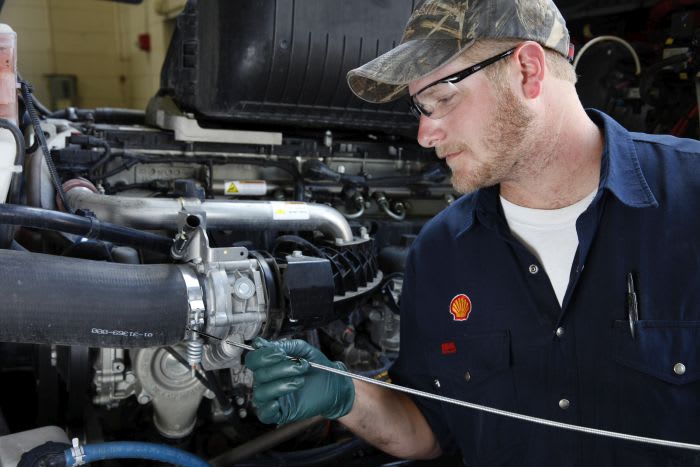
The new API FA-4 oil-service category was developed specifically to work in concert with the new generation of more fuel-efficient heavy-duty diesels starting to come on the market. Photo: Shell Oil
5 min to read

The new API FA-4 oil-service category was developed specifically to work in concert with the new generation of more fuel-efficient heavy-duty diesels starting to come on the market.Photo: Shell Oil
It’s too early in the game to officially say that the fuel efficiency promise of the newly rolled out API FA-4 oil-service category has been met. On the other hand, there is enough research already in the bag to state with a high degree of certainty that this spec formulation will give a noticeable boost to mpg — and do so without any effort or even decision-making on the part of many fleets.
FA-4 is one of two new API donuts that started appearing on heavy-duty engine oil packaging late last year; the other being CK-4. CK-4 oil is the one the vast majority of fleets are now using (or will be using once their stocks of CJ-4 oil are used up.) CK-4 oil is backward-compatible for applications that originally required the use of CJ-4 oil.
Both CK-4 and FA-4 oils are formulated to improve resistance to aeration and to increase shear stability to ensure engines are protected from wear and tear. FA-4 is distinguished because the category was developed specifically for formulating oils to work in concert with the new generation of heavy-duty diesel engines — starting to come on the market this year — to improve fuel mileage.
An example of third-party research attesting to the fuel economy benefit expected of FA-4 oils comes by way of a recent Confidence Report issued by the North American Council for Freight Efficiency and Carbon War Room. The report focuses on the general benefit to mpg to be had by switching to a lower-viscosity CJ-4 or CK-4 oil, but also shows how moving all the way to FA-4 will up the increase.
The report shows that over-the-road fleets can realistically expect fuel savings in the range of 0.5% to 1.5% if they switch from 15W-40 to 5W/10W-30 oil, whether the product selected carries the CJ-4 or CK-4 donut. And moving still lower to a 5W/10W-30 FA-4 oil could add a further 0.4% to 0.7% of fuel savings. That is to say, jumping right on down from a 15W-40 CJ-4 or CK-4 product to a new 5W/10W-30 FA-4 oil should lift fuel economy by a healthy 0.9 to 2.2%.
The researchers report their findings are based on data from multiple sources. Still, “given that fuel savings of this magnitude can be difficult for fleets to conclusively verify in their own testing, the Confidence Report suggests that fleets considering a switch to lower-viscosity engine oil use a conservative 0.5% in calculating the payback.” Then, if an acceptable return on investment is shown with this low level of fuel savings, “fleets should be able to confidently make the switch” to a lower-viscosity oil, including an FA-4 product if it has been approved for use by their OEM.
So, if CK-4 is the steady Eddie but smoothly improved replacement for CJ-4, then FA-4 is your huckleberry friend. That is to say, it’s waiting ‘round the bend for when you get there.
For some fleets, FA-4 oil is only as far away as their next order of new trucks. Each heavy-duty engine maker issues its own application approvals and service recommendations for the two new oil-service categories. At this point, only some are addressing both the CK-4 and FA-4 spec.
Phillips 66 expects the adoption of API FA-4 oils to reflect a cautious approach by fleet owners and operators toward the new technology, says Tony Negri, commercial products manager. “Early adopters are experimenting, but broader sales will take several more years to develop until there is more equipment that requires this advanced formulation.”
Negri stresses that most OEMs have made FA-4 “an option, not a mandate, for 2017 models, and back-serviceability [for pre-’17 engines] is still being evaluated by most of the engine builders.”
While Detroit Diesel is factory-filling with API FA-4 oils, other OEMs have been slower to adopt, says Rommel Atienza, commercial brand manager for Chevron. “Currently, most OEMs still factory-fill with API CK-4 oils — mainly SAE 10W-30 — but we anticipate that changing as OEMs, [lubricant] marketers, and customers become more educated on the benefits of API FA-4 oils. For mixed fleets, API CK-4 still seems to be the best fit.”
FA-4 oils have specifically been designed for some 2017 on-highway engines, points out Brian Humphrey, OEM technical liaison for Petro-Canada Lubricants. He expects the uptake of FA-4 will rise year by year “as fleet owners see the potential cost benefits they can achieve and OEMs design improved engines to meet [emission] standards.”
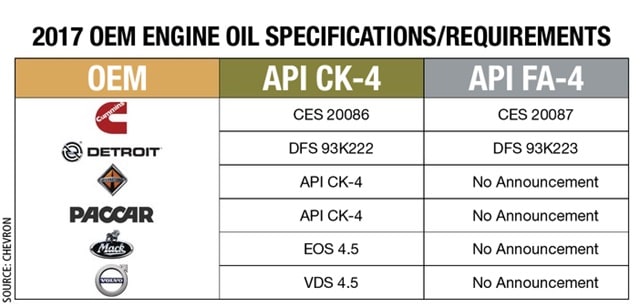
Both CK-4 and FA-4 spec oils are still new to the market and each heavy-duty engine maker issues its own application approvals and service recommendations for engine lubricants.
“Since most fleets are not made up of brand-new trucks, it’s not likely that a lot of fleets will really begin to use the new FA-4 oils for at least a couple of years,” explains Paul Cigala, ExxonMobil applications engineer for commercial vehicle lubricants. “Part of the reason FA-4 oils are in less demand, as we had expected, is that most fleets only want to have one oil, and many have older equipment that can’t accept the lower viscosity product.”
He points out that FA-4 oils are designed for trucks with 2016 or 2017 model year engines and stresses that FA-4 is not backward-compatible with all engine makes and models. Companies need to check with their OEM or lubricant supplier for backward-compatibility recommendations.
“Over the next several years,” Cigala says, “we are sure the question of whether to use CK-4 or FA-4 formulations will come up even more often as more fleets diversify their mix of older and newer vehicles in use.”
“At this moment, it’s still a bit too early to really get a gauge on the uptake of FA-4 oils from fleets,” says Dan Arcy, global OEM technical manager for Shell. “We are receiving lots of inquiries on availability and compatibility, but due to the fact that many of the new engines that allow the specification have not yet even reached their first drain, it is hard to guess where fleets will be going.
“As with all major technology upgrades and changes,” he adds, “we do expect this to be a slow rollout and that we will see the adoption rate rise over time with the technology maturing in the marketplace.”
Subscribe to Our Newsletter
More Maintenance

Mack Expands Extended Coverage With Four Chassis System Plans
Mack Trucks' new system-specific coverage options allow heavy-duty fleets to select protection for driveline, cab, HVAC, electronics, and advanced safety components.
Read More →
What an Out-of-Service Order Really Costs, and How to Plan for One
The repair invoice is the first number you see — and often one of the smallest. Here’s what else an out-of-service order can cost a fleet, and how planning can reduce the damage.
Read More →
International Launches Online Truck Parts Store
Fleetrite.com lets fleets and repair shops find OEM and all-makes parts, check prices and availability, and order without calling a parts counter.
Read More →

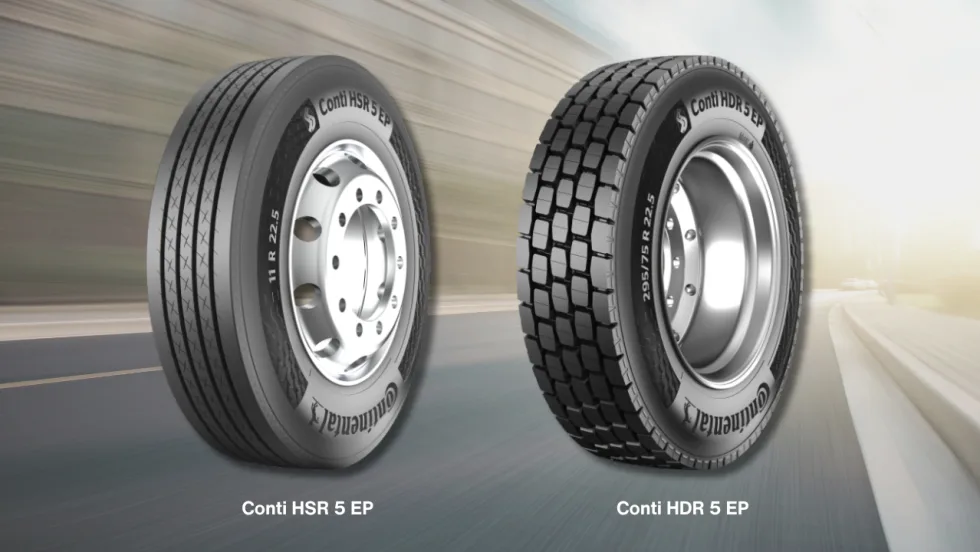
Continental Introduces New Regional Truck Tires
Continental says its new Generation 5 steer and drive tires for regional operations offer longer tread life, with estimated mileage gains of 22% and 19%, respectively.
Read More →
Sponsored•October 1, 2026
How AI Can Help Your Techs’ Efficiency
The technician shortage isn't going away, and no single fix can close the gap on its own. Trent Broberg makes the case that AI's real job in the shop is protecting the billable hours and job satisfaction of the techs you already have, not asking them to work faster.
Read More →
Sponsored•September 16, 2026
Color Match Smarter: Tools That Restore & Perform
For fleet managers and collision repair professionals keeping heavy-duty trucks on the road, getting the color right the first time isn't just about appearance — it's about efficiency, turnaround time, and bottom-line results. Discover how today's digital color tools are transforming the repair process from guesswork to precision.
Read More →
Wrong Repair Prompts Recall of Freightliner, Western Star 4x2 Trucks
DTNA is recalling more than 2,400 trucks that received an incompatible software fix instead of the hardware repair required to address brake valve corrosion.
Read More →
Truck Drivers Need More Than Another Alert
Fleets have more visibility into truck health, safety events, and driver activity than ever. The next challenge is turning all that information into useful guidance for the person who has to decide what to do next.
Read More →
The Maintenance Checks Trucking Fleets Should Prioritize Before Fall Freight Picks Up
Making it through August isn’t the same as being ready for the next several months of operation. Find out what systems may have suffered from summer heat and need to be checked out before fall.
Read More →
What Three Fleets Are Doing Differently When Buying Truck Parts in 2026
With freight improving but costs still climbing, fleet maintenance executives explain how they're balancing price, quality, and supplier relationships.
Read More →