




Tried and True Tire Repairs
Smart fleet managers understand that wringing every possible mile from a truck tire saves money. Which means that getting tires fixed properly after failures do occur is vital for both vehicle productivity and fleet profitability.

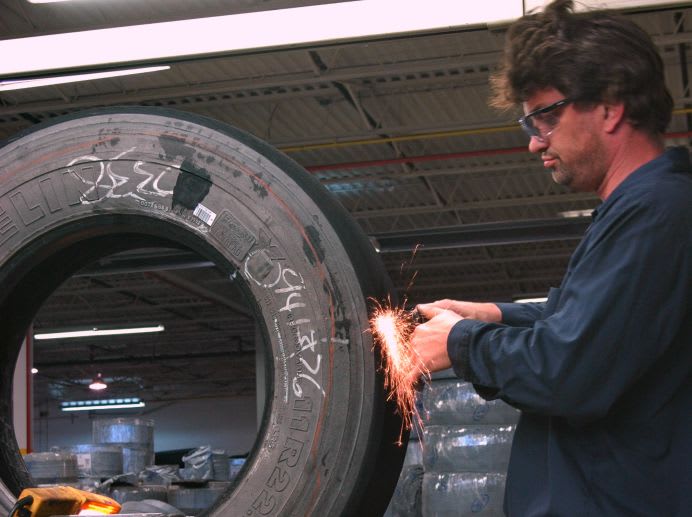
The first, and most crucial step in any tire repair process is to completely remove any foreign material from the damaged area. Photos: Jim Park
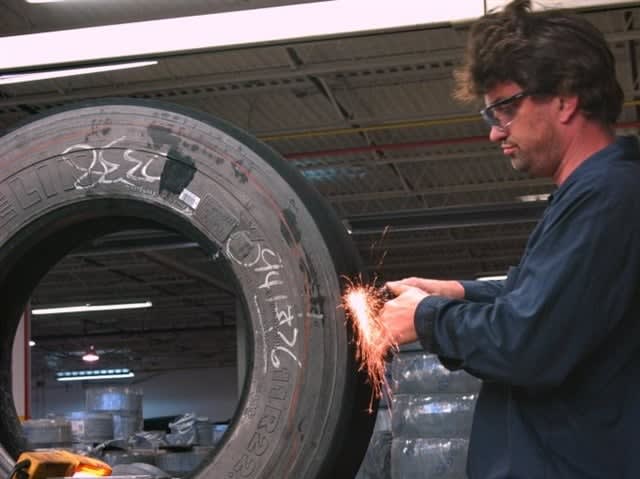
The first, and most crucial step in any tire repair process is to completely remove any foreign material from the damaged area.Photos: Jim Park
The flat tire is arguably motoring’s oldest nemesis. Check out any film or photography from the early Automotive Age, and sooner, rather than later, somebody is going to roll their sleeves up and get to work patching a tire.
Early automotive tires were essentially scaled-up versions of bicycle tires. But they evolved quickly to meet the more rigorous demands put on them by early cars and trucks. Improvements to roads and highways made a big difference, too. So today, full-on tire failures are relatively rare compared to those early years behind the wheel.
But flat tires remain a serious threat for fleets today. And, of course, when flats do occur, they rarely happen in front of your local tire dealer’s store. And fixing a truck tire is a complicated, safety-focused affair. Unlike an enterprising passenger car driver, pulling out a set of tire plugs and setting to work just isn’t going to get the job done.
And, of course, tires aren’t cheap. Smart fleet managers understand that wringing every possible mile from a truck tire saves money. Which means that getting tires fixed properly after failures do occur is vital for both vehicle productivity and fleet profitability.
When Bubbles Bring Bad News
As with so many things in fleet operations, your drivers are your first line of defense when it comes to tire repairs. And this defense should begin every day with a thorough pre-trip inspection with a focus on good tire health.
The quickest and surest way to determine if there’s a slow leak in a tire is by checking tire pressure with an accurate, properly calibrated tire gauge. Unfortunately, many drivers still believe that whacking a tire with an ax handle is the only pressure check required. Tire experts maintain that hitting a tire with a stick does little more than confirm that there is, in fact, some air present in the casing.
The next best thing to putting a gauge on a valve stem is a careful inspection of all the visible tire surfaces. Drivers should visually inspect tires before and after a trip. And technicians should take time to look tires over during any maintenance checks. The focus should be any signs of impending tire failure, which generally shows up as “balloon” areas on the surface or sides of the tires, as well as any foreign objects protruding from those areas. If something is spotted protruding from a tire, check to see if air is leaking by putting liquid over the area in question to see if any air bubbles form. Soapy water is best, but good, old-fashioned spit will do in a pinch.
If you’re a technician and have the tire off the truck, there are more formal inspection guidelines to follow. According to the Rubber Manufacturer’s Association Truck and Bus Tire Repair Guidelines, prior to examining a tire, it should be placed in an approved safety cage and then inflated to recommended (normal operating) pressure. At that point, you can apply a soap-and-water solution to locate damage and any corresponding air leak.
“We always recommend tire technicians use approved tire repair units following recommended industry procedures, in accord with RMA guidelines,” says Brian Buckham, general manager, product marketing, Goodyear. “The technology for repairing truck and bus tires is proven and has remained relatively unchanged for many years. These guidelines can help your technicians repair tires safely and effectively. If done correctly, a repair can last the remaining life of the tire.”
The basic technologies used in tire repair have been around for some time, notes Phil Arnold, field engineer, customer engineering support, Michelin Americas Truck Tires. “However, what has changed is an emphasis on proper training of shop technicians who perform the tire repairs.”
There are many industry guidelines available to help your technicians follow proper repair procedures. Arnold cites the Tire Rubber and Tire Repair Manufacturers Group, the American Trucking Associations’ Technology & Maintenance Council, and the Tire Industry Association, which all publish industry-recommended practices and methods for established tire repair methods as well as new reinforced shoulder repair processes.
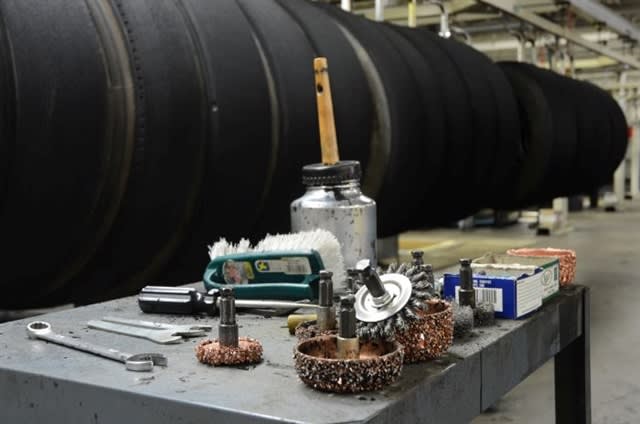
Tire repairs aren’t time consuming, if you have the right tools ready to go. Remember, however, to never mix-and-match glues and patches made by different suppliers.
A two-pronged repair process
Once you have located an injury to a tire casing and a pressure leak, it’s time to go to work.
Tubeless passenger car tires today can be quickly repaired using rubber string “plugs.” But plugs aren’t robust enough for commercial vehicle repairs, which instead require both patching the inner casing and filling in the void created when the tire was punctured.
Robert Palmer, director of market sales engineering for Bridgestone Firestone, says technicians should begin by removing the penetrating object from the casing and then temporarily filling the disrupted area with a cured plug or filling material, capped off with curing repair gum. This will keep moisture out of the puncture, which can degrade both the tire casing and the puncture repair.
“Plugging a tire is a temporary measure to retain inflation pressure,” Palmer says. “A permanent repair is always required to ensure you get the full life out of the casing. Filling the injury with string plugs (plugging) is not considered a proper repair. Plugging does not restore the casing integrity and will lead to further degradation of the injury and casing over time. Filling and installing a repair unit is intended to last the life of the casing and restores the casing to be utilized in its original intended application.”
At this point you’re ready to apply a patch to the inner casing of the tire. Using a spreader, open the tire up so you can access the damaged area in the inner casing. Use a clean rag to wipe the puncture area down and remove any damaged tire sections or foreign objects. Use a wire brush or low-speed drill with cutter head to buff the inner casing area around the puncture. You want a “velvet” finish on the tire to give the patch and the cement a tactile surface to adhere to. Be sure to remove any rubber dust from the buffing process from the casing — but do not use compressed air to do so, as it often contains oil and other contaminants that can degrade repair patch integrity.
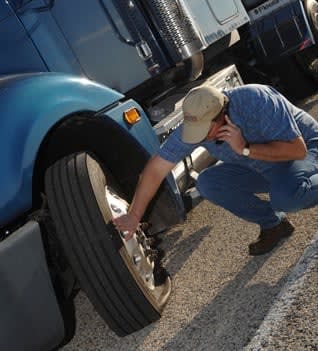
Flat tires never seem to occur in convenient locations. Luckily, many tire manufacturers today have quick-response, roadside assistance programs to help your truck get moving again.
Photo: Goodyear
At this point, the RMA cautions technicians to not mix-and-match patches and glues from different suppliers. Repairs are more effective and last longer if proprietary products are used throughout the repair process. With that in mind, select the appropriate size repair patch required to covered the damaged/prepped area inside the casing. Next, apply rubber cement to the buffed casing surface, then lay the patch down on down on top. Now buff the patch to ensure a good bond with the rubber cement and casing surface.
Arnold stresses that failure to take both steps — plugging the hole and patching the inner casing — can lead to issues with the tire down the road. “An inner liner which is not patched can result in a loss of inflation pressure, and an injury not filled may lead to moisture contamination of the casing, risking loss of tire endurance later,” he says.
At this point you can reassemble the tire and rim. Next, inflate the tire in a safety cage to recommended pressure and check for leaks with soapy water. If no bubbles appear, the tire is ready to go back into service.
Fleets rely on a wide variety of tire types to get work done. And in most cases, tire repair procedures vary little from type to type. Palmer, for example, notes that wide-base singles and low-rolling-resistance tires are repaired in the same manner as conventional truck tires. “Some tire technicians say that wide single tires are actually easier to repair, as the increased width between the sidewalls and wider tread area make it easier to get inside the tire to perform the repair,” he says.
Punctured tires will remain a fact of life for fleets as long as there are rubber tires and debris in the road. And although repair methods have not changed much over the decades, good training and attention to procedures can usually return damaged tires to full service at a fraction of the cost of a new tire.
More Maintenance

Color Match Smarter: Tools That Restore & Perform
For fleet managers and collision repair professionals keeping heavy-duty trucks on the road, getting the color right the first time isn't just about appearance — it's about efficiency, turnaround time, and bottom-line results. Discover how today's digital color tools are transforming the repair process from guesswork to precision.
Read More →
Wrong Repair Prompts Recall of Freightliner, Western Star 4x2 Trucks
DTNA is recalling more than 2,400 trucks that received an incompatible software fix instead of the hardware repair required to address brake valve corrosion.
Read More →
Truck Drivers Need More Than Another Alert
Fleets have more visibility into truck health, safety events, and driver activity than ever. The next challenge is turning all that information into useful guidance for the person who has to decide what to do next.
Read More →
The Maintenance Checks Trucking Fleets Should Prioritize Before Fall Freight Picks Up
Making it through August isn’t the same as being ready for the next several months of operation. Find out what systems may have suffered from summer heat and need to be checked out before fall.
Read More →
What Three Fleets Are Doing Differently When Buying Truck Parts in 2026
With freight improving but costs still climbing, fleet maintenance executives explain how they're balancing price, quality, and supplier relationships.
Read More →
Paccar Recalls 2027 Trucks Built This Summer for Possible Electrical Problem
The nearly 6,000 Kenworth and Peterbilt trucks in the recall could potentially lose engine power, among other things.
Read More →
Will API PC-12 Oil Change Trucking Fleet Maintenance?
The new API PC-12 heavy-duty engine oil category reflects the changing demands of modern diesel engines. But fleets like Foodliner are looking to getting their own data before making decisions on adopting the new oils and questions such as extending oil drain intervals.
Read More →
Brake Safety Week to Focus on Drums and Rotors
Commercial vehicle inspectors are focusing on truck brakes during CVSA's Brake Safety Week, August 23-29.
Read More →Possible Battery-Cable Fires Prompt Recall of 15,000+ International MV and HV Trucks
On the recalled vehicles, manufacturing variations can cause the battery interconnect cable to contact the auxiliary stud and hold down the bracket.
Read More →
Rush, MCT Team Up to Grow Refrigeration Service Network
The joint venture will operate MCT's network of Carrier Transicold dealerships and mobile service locations, with the companies promising greater service capacity and uptime for refrigerated fleets.
Read More →