




TMC Members Share Corrosion Experience, Advice
At the recent meeting of the ATA's Technology & Maintenance Council, fleet members talked about road salt-induced corrosion and how to combat it.

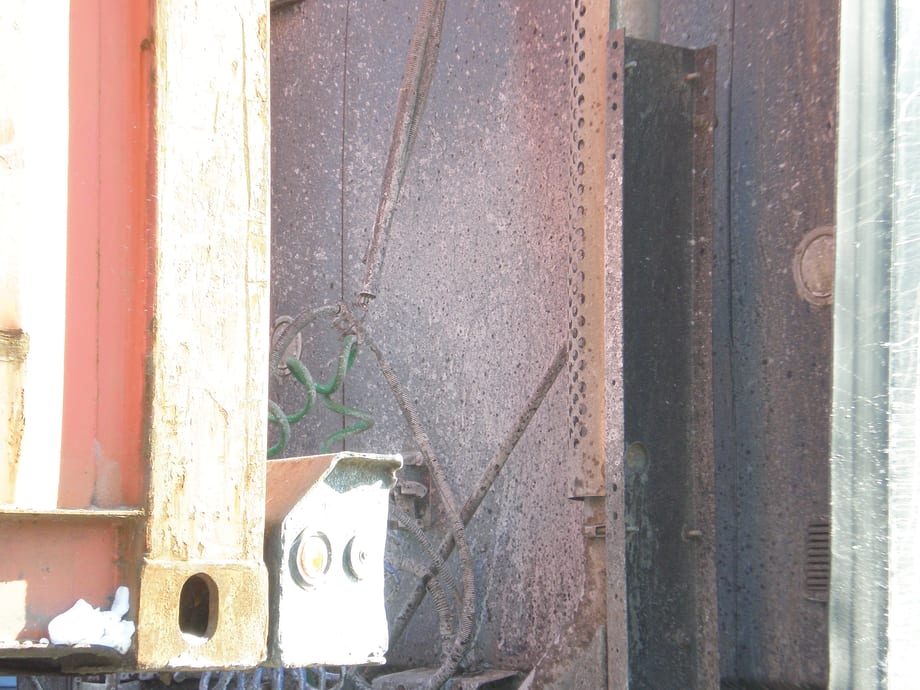
Aggressive road salts can do a number on sheet metal, like the rear of this cab, especially if maintenance is ignored.

Aggressive road salts can do a number on sheet metal, like the rear of this cab, especially if maintenance is ignored.
It’s said that “rust never sleeps.” In the last 15 to 20 years, the insidious but natural chemical process has gotten rather nasty.
Road maintenance departments are using de-icing agents that do a better job at keeping roads clear and safe, but they aggressively attack metals on trucks and cars. And the salts continue their assaults, even when the weather danger has passed, causing premature failure of components that costs billions of dollars a year, according to industry estimates.
For Roy Gambrell, now-retired fleet manager at Truck It Inc. in Tennessee, the corrosion problem began in brake shoes, with linings cracking and separating from their steel tables, he said in a session during the Technology & Maintenance Council’s recent annual meeting in Nashville, Tenn. “Rust jacking,” as it came to be known, was something new in 2000. Other managers he quizzed weren’t having the problem – or so they thought.
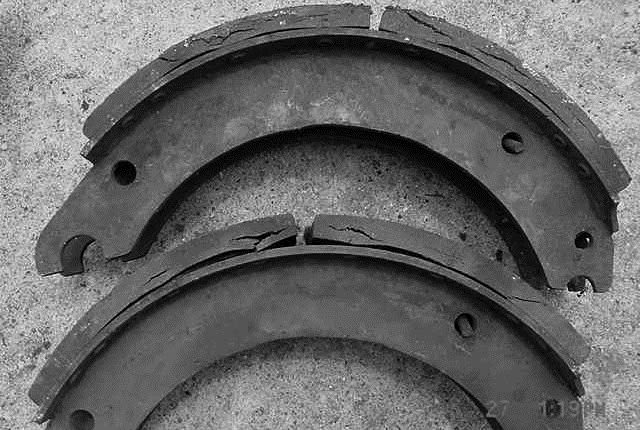
"Rust jacking" -- the lifting of brake linings off their steel tables -- was one of the first things noticed as damage from mahnesium- and calcium chloride salts became evident.
Suppliers said they hadn’t heard of it, and “one of them told me that it was probably caused by radiation from a nuclear power plant” his trucks regularly hauled to, Gambrell said.
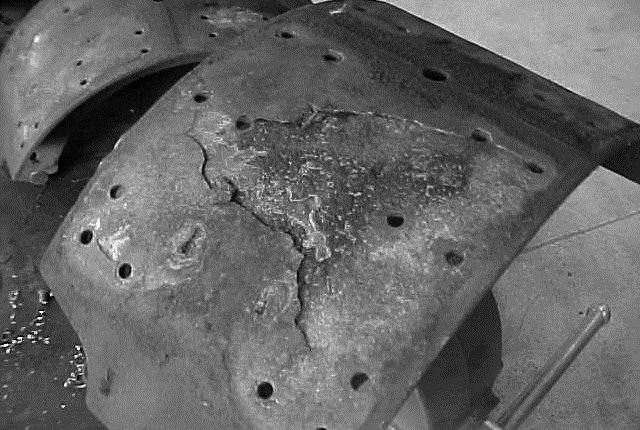
Rust jacking also cracks lining material. Alerted by customers, suppliuers began painting tables to protect surfaces.
But more reports of rust jacking soon began coming in and by 2003, TMC, an arm of the American Trucking Associations, was looking into it. Fleet manager-members started holding sessions in which some of them showed photos and physical evidence of damage to all kinds of chassis components, from brake shoes and drums to wiring and connectors to and frame rails and crossmembers on trucks and trailers.
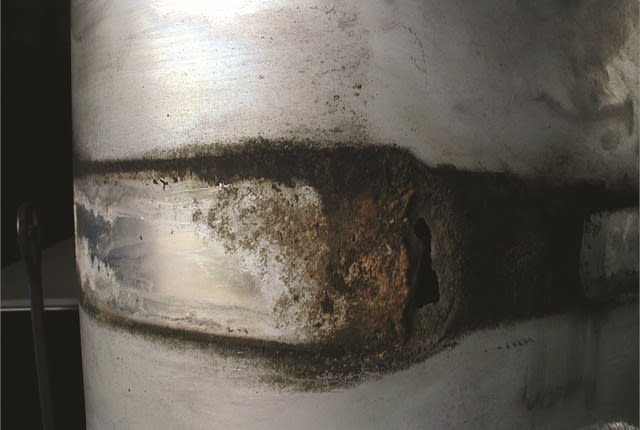
Corrosion of this aluminum tank under its steel straps was severe enough to eat a hole into it, allowing diesel fuel to leak out.
One member presented a photo of a fuel tank that rusted through and had begun leaking fuel – a potentially expensive environmental event and an obvious safety concern.
Rust from rock salt was a long tradition of winter in northern and mountain states, but now the damage occurred sooner and was more extensive. As we now know, the culprit turned out to be calcium and magnesium chloride salts that cling to and break down steel and other metals. Road departments had begun using the salts in various combinations, and crews found they worked better in very cold temperatures when rock salt – sodium chloride – quit working.
The new products were cheaper, too, so there was no talking highway officials out of using them. They admitted that their own trucks were suffering increased damage, but their primary concern was public safety: Pavement must be cleared to prevent accidents, injuries and deaths.
But fixing and replacing damaged truck and trailer parts was costing the industry $2.4 billion to $4 billion a year, Gambrell said, citing national estimates. TMC formed a Corrosion Control Action Committee, with branches in many of its task forces that specialize in specific areas of truck maintenance, to better organize studies into the problem and find preventive measures.
In corrosion-control sessions, fleet and supplier members traded concerns and ideas; fleet people wanted better materials to fight rust, while suppliers offered remedies, like special coatings for vehicle undercarriages, especially on trailers.
But suppliers noted that certain measures were more expensive than customers wanted to pay. Some stainless steel alloys, for instance, stand up well to the aggressive salts but are costly and heavy. Aluminum, for many years a tool to reduce poundage, also costs more than mild steel but resists salt damage, though not forever.
TMC’s focus then turned to prevention through use of regular cleanings and applications of special compounds. For example, brush-cleaning more effectively removes salt and road grime than high-pressure spraying, which drives salts up into crevices under trucks and trailers, said Todd Cotier, director of maintenance at Hartt Trucking.
(Another Cotier tip: Don’t wash sheet-and-post trailers from back to front because that pushes salt into the trailing edges of overlapping vertical aluminum panels; instead, wash from front to back.)
Hartt operates in Maine and other northeastern states where salt is a major problem. Cotier is among numerous managers who’ve developed procedures for regular cleaning and application of rust inhibitors. He has a compound applied at modification centers adjacent to manufacturers’ factories, when the vehicles are brand-new. And he has it reapplied periodically, after washings that begin in spring.
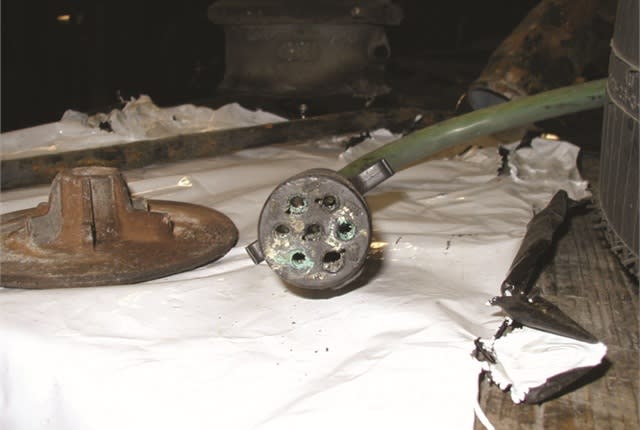
Corroded 7-pin connector is obvious, but salt-induced corrosion can also wick into wiring under its insulation.
Kevin Willis, a fleet leader at a Pepsi Beverages operation in Massachusetts, told the Nashville audience that his company has an “aggressive maintenance program” to combat corrosion, from when trucks and trailers are new to when they’re eventually retired.
Roll-up side-door beverage trailers, for example, are refurbished after 10 years of service; floors and lift gates are often replaced at considerable expense: “A new lift gate costs about $20,000,” Willis said.
Inhibitors are sprayed on by outside specialty shops. While they are considered food-grade compounds, workers wear respirators to avoid inhaling fumes. The program extends to many of the fleet’s tens of thousands of vehicles in the United States and Canada. Of all work orders in Pepsi shops, 25% are related to rust, Willis said.
As the anti-corrosion crusade continued through the aught years, information on what works and what doesn’t took written form. Members of the Corrosion Control Action Committee began organizing a manual, which was completed and published in 2012. TMC has renewed promoting the manual, “Corrosion: Complaint, Cause & Correction,” and attendees at the Nashville session received copies.
The manual covers 103 pages, describing the salts and where they’re used (or were when the manual was compiled); conditions encountered in daily operations; the many parts in trucks and trailers that are affected (virtually all of them); and corrective measures that most effectively deal with road salts. TMC has printed thousands of copies, and the manual is available to members and the trucking public.
Carl Kirk, TMC’s executive director, suggested that a copy be sent to every ATA-affiliated state trucking association. They can show it to members and road maintenance officials who might take some of the information to heart, he said. Meanwhile, the manual can be ordered at http://tmc.trucking.org, or by calling 703-838-1763.
More Maintenance

Color Match Smarter: Tools That Restore & Perform
For fleet managers and collision repair professionals keeping heavy-duty trucks on the road, getting the color right the first time isn't just about appearance — it's about efficiency, turnaround time, and bottom-line results. Discover how today's digital color tools are transforming the repair process from guesswork to precision.
Read More →
Wrong Repair Prompts Recall of Freightliner, Western Star 4x2 Trucks
DTNA is recalling more than 2,400 trucks that received an incompatible software fix instead of the hardware repair required to address brake valve corrosion.
Read More →
Truck Drivers Need More Than Another Alert
Fleets have more visibility into truck health, safety events, and driver activity than ever. The next challenge is turning all that information into useful guidance for the person who has to decide what to do next.
Read More →

The Maintenance Checks Trucking Fleets Should Prioritize Before Fall Freight Picks Up
Making it through August isn’t the same as being ready for the next several months of operation. Find out what systems may have suffered from summer heat and need to be checked out before fall.
Read More →
What Three Fleets Are Doing Differently When Buying Truck Parts in 2026
With freight improving but costs still climbing, fleet maintenance executives explain how they're balancing price, quality, and supplier relationships.
Read More →
Paccar Recalls 2027 Trucks Built This Summer for Possible Electrical Problem
The nearly 6,000 Kenworth and Peterbilt trucks in the recall could potentially lose engine power, among other things.
Read More →
Will API PC-12 Oil Change Trucking Fleet Maintenance?
The new API PC-12 heavy-duty engine oil category reflects the changing demands of modern diesel engines. But fleets like Foodliner are looking to getting their own data before making decisions on adopting the new oils and questions such as extending oil drain intervals.
Read More →
Brake Safety Week to Focus on Drums and Rotors
Commercial vehicle inspectors are focusing on truck brakes during CVSA's Brake Safety Week, August 23-29.
Read More →
Possible Battery-Cable Fires Prompt Recall of 15,000+ International MV and HV Trucks
On the recalled vehicles, manufacturing variations can cause the battery interconnect cable to contact the auxiliary stud and hold down the bracket.
Read More →
Rush, MCT Team Up to Grow Refrigeration Service Network
The joint venture will operate MCT's network of Carrier Transicold dealerships and mobile service locations, with the companies promising greater service capacity and uptime for refrigerated fleets.
Read More →