




Related: The Modern Maintenance Manager: Managing Today's Technicians
The Modern Maintenance Manager: The Connected Shop
From remote diagnostics to predictive analytics, being on top of maintenance today means using data and connections.
by Deborah Lockridge and Jim Park
March 18, 2016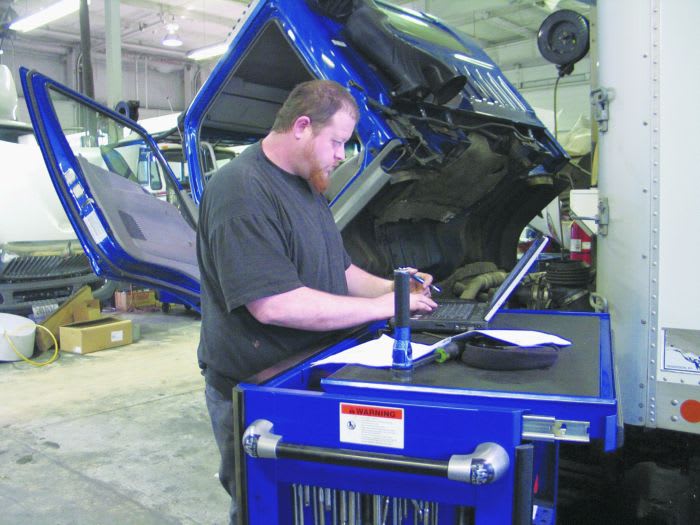
Computers in the shop have become commonplace. The modern maintenance manager is moving beyond that to data analytics and predictive maintenance. Photo: Evan Lockridge
8 min to read
Computers in the shop have become commonplace. The modern maintenance manager is moving beyond that to data analytics and predictive maintenance.Photo: Evan Lockridge
A connected shop has many connections: between the shop’s software and the fleet’s back office enterprise system, between technicians on the floor and online repair manuals and the shop’s software, between the shop’s software and an OEM’s or dealers system, between the shop and third-party systems, and perhaps most importantly, between the shop and the vehicles themselves. In many instances, a connected shop is simply an extension of a connected fleet — multiple systems and people sharing the same data.
In many ways it’s a reflection of the Internet of Things concept — sensors in a truck interacting with systems in the fleet or dealership. The benefits of these connections are big because each one produces data. Today’s maintenance and fleet manager can analyze that data to find patterns that lead to more efficient operations, more efficient spec’ing of vehicles and a better bottom line.
In the most connected shops, paper is practically non-existent. Everything is available either online or through a fleet’s maintenance or enterprise system. Repair manuals, parts catalogs, diagnostic information and other data is readily accessible via the technician’s computer, whether that’s a handheld device, tablet or laptop. All a tech has to do is scan the vehicle’s VIN, and everything he needs to know — warranty information, service history, mileage, driver vehicle inspection reports and other data — is right there, including diagnostic information the vehicle generates.
“The modern maintenance manager will issue a laptop to every technician as their most important tool, with strong Wi-Fi signals in the shop and the software to work on every piece of equipment assigned,” says Bruce Stockton, vice president of fleet services at Kenan Advantage Group in North Canton, Ohio. “The days of community computers or shop laptops, passed down from the sales force or executive management, are a thing of the past.”
At Kenan, Stockton says, TMT maintenance software helps the fleet manage every asset for improved utilization. They can track downtime and look at cost trends, and also manage every work order created and drive the process of diagnosing the complaint, cause and correction to put the equipment back in service.
Diagnostics is one of the most prevalent ways today’s connected shop takes advantage of technology and data.
Today’s techs have adapted well to all the diagnostic type software, says Eric Peterson, vice president of maintenance at Burr Ridge, Ill.-based Dillon Transport. “I would have to say in the majority of the shops today it’s almost as common as a 9/16 wrench in your box.”
Trucks and telematics
Telematics, however, have taken diagnostics in the connected shop to the next level, thanks to the partnerships and integrations between truck OEMs, maintenance systems and telematics platforms.
For instance, Dillon’s Peterson says Cummins’ Connected Diagnostics alerts maintenance personnel when there is problem with a vehicle. The telematics system sends the alerts via email, so maintenance managers have an idea what the problem might be before the truck comes into the shop. Downtime has been reduced because technicians are able to diagnose trucks quicker.
Integrations between a vehicle’s telematics platform and the fleet’s maintenance system can save time when repairs are needed, says Kerri Tabor, director of integration services for PeopleNet. Integration between PeopleNet’s platform and TMW’s TMT fleet maintenance software automates that process. The integration includes an electronic form drivers fill out from their cab, which automates a repair order within the maintenance software. The automation saves time and helps reduce mistakes, Tabor says, especially for dispatch personnel, who no longer have to take a phone call from the driver, write down the information and then send that to the shop – essentially eliminating the “middle man” with an automated process.
Mark Wallin, vice president product marketing for Telogis, says the ability to integrate OEM diagnostic data into a telematics system gives fleets the ability to see beyond driver behavior. “You start looking at more diagnostics,” he says. Integrating with OEM data can show exactly how people are driving and also how the truck is performing mechanically. “The better data you can get out, the more insight you can provide.”
However, going beyond diagnostics — harnessing the results of all this connectivity and using the data for planning, spec’ing, scheduling, etc. — is where the real payoff lies.
And telematics aren’t limited to trucks and engines. Tire inflation monitoring systems, refrigeration units, trailer tracking systems and others are also sources of real-time data fleets can use.
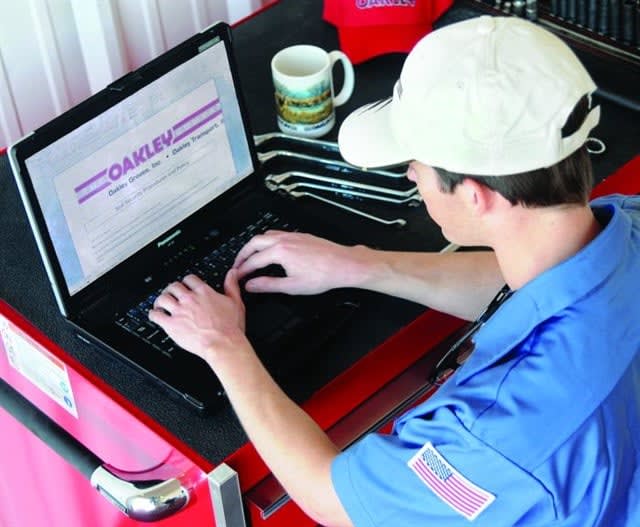
Oakley Transport, a liquid bulk food-grade transporter based in Lake Wales, Fla., deployed Decisiv’s service platform in 2014 to better manage service and repair for its fleet of 500 trucks. Photo: Decisiv
Data-Driven Maintenance
“Making data-driven decisions is by far the most important characteristic of the modern maintenance manager,” Stockton says. “Making decisions based on relationships or ‘gut feelings’ no longer create efficiency.”
The advent of cloud computing plays a role, as the cloud uses the Internet for data sharing. Maintenance managers and technicians can access information from any Internet-enabled device from any remote location. This allows for multiple remote users and faster communication between drivers, fleet management and maintenance operations.
That in turn allows fleets to better control maintenance costs and allows managers to make informed decisions quickly using the data they are able to collect, share and analyze.
Data, for instance, can help identify systems that are being overlooked and causing breakdowns, Stockton says. “Identifying breakdowns that happen within 30 days of a scheduled PM will quickly identify the systems being overlooked or potentially ‘pencil whipped’ by a mechanic.”
At an industry symposium sponsored by ALK Technologies last year, Chris Smallwood, with Tennessee-based carrier U.S. Express, said data from the company’s trailer-tracking system allowed the fleet to inspect trailer tires based on mileage instead of on a time schedule.
Mike McDonald, director of fleet maintenance at Don Hummer Trucking in Oxford, Iowa, says his company uses data to analyze failure rates, “to drive a different specification or warranty program base to cover those types of failures.”
He says he also uses the data to analyze processes, “to see if we need to add or subtract PMs or make our periodic maintenance more robust based on a failure we’re having on a particular component. That’s why getting the good data in is so important; you can only manage what you can track and what you can identify as issues.”
McDonald also uses data analysis for predictive maintenance and proactive trade cycles.
Randy Obermeyer, terminal manager in charge of equipment and maintenance for Batesville’s private fleet in Batesville, Ind., says the availability of data drives many decisions.
“There’s a lot of data that will tell you if you have an issue with that system before it becomes a major problem that’s going to leave the guy sitting on the side of the road,” he says. That allows the fleet to be proactive and repair a system before it breaks down — also known as predictive maintenance.
“If you know the starter lasts for two years, you can proactively put a new one on every two years and not worry about it breaking down at 25 months and causing unnecessary downtime,” Obermeyer says.
Doug Peters, GE Capital Fleet Services, says using the data generated from the shop and vehicles to predict component failures leads to “the holy grail,” which is to eliminate downtime. Of course, he noted that “you will never get a prediction that is perfect” and that you don’t want to replace something that isn’t going to break, but the data provides an insight that was not previously available.
Changing thinking
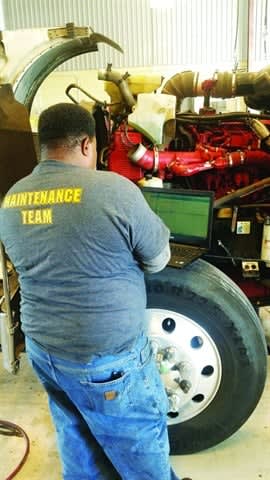
A technician uses a laptop at Dillon Transport, where data helps the Illinois-based carrier stay on top of a fleet that’s about half natural gas powered. Photo: Evan Lockridge
One problem, Kenan’s Stockton says, is many maintenance managers don’t have the level of confidence and trust that they need to in the data, in the diagnostic tools and computer programs.
He compares the traditional way of managing maintenance “to playing a game of pinball with a mechanical game that could be coerced and even ‘tilted’ to success. The modern maintenance manager has to understand the logic behind the programming of the computer board and would never resort to ‘tilting’ the machine to score.”
Connecting with outside service providers
Even for fleets that run their own shops, trucks often are serviced or repaired on the road at dealership or third-party locations. The connected shop can apply even in these instances, either through connections with an OEM or using software platforms that connect fleet maintenance managers with outside service vendors.
One such platform, the Decisiv Service Relationship Management system, strives to eliminate paper, phone calls and wasted time when trucks are due maintenance while on the road or to handle breakdowns.
Traditionally, the repair process meant generating a mountain of paper — inspection forms, warranty information, parts requisitions, work order approvals, hand-written notes — each of which might be handled and looked at by numerous people, complicating the process. A misplaced piece of paper might lead to situations where neither the repair facility nor the fleet came away happy with the outcome.
Systems such as Decisiv’s cut through the paperwork clutter by automating the process. This allows both the fleet and the repair facility to immediately see cost estimates, service authorizations and other information. This makes it easier to manage the process, as each step along the way is all on one screen for both the service provider and the fleet to see.
In the long run, a connected and data-driven shop helps keep trucks on the road. As McDonald from Don Hummer Trucking says, “We want to be the company that hauls freight, not the company that fixes trucks. We want to drive our warranty coverage and trade cycles around controlling our costs and leaving less things unknown. In the transportation business the surprises are what you’ve got to eliminate. You’ve got enough surprises out there with the weather and things like that; you don’t need surprises in your maintenance.”
Subscribe to Our Newsletter
More Maintenance

Sponsored•September 16, 2026
Color Match Smarter: Tools That Restore & Perform
For fleet managers and collision repair professionals keeping heavy-duty trucks on the road, getting the color right the first time isn't just about appearance — it's about efficiency, turnaround time, and bottom-line results. Discover how today's digital color tools are transforming the repair process from guesswork to precision.
Read More →
Wrong Repair Prompts Recall of Freightliner, Western Star 4x2 Trucks
DTNA is recalling more than 2,400 trucks that received an incompatible software fix instead of the hardware repair required to address brake valve corrosion.
Read More →
Truck Drivers Need More Than Another Alert
Fleets have more visibility into truck health, safety events, and driver activity than ever. The next challenge is turning all that information into useful guidance for the person who has to decide what to do next.
Read More →
The Maintenance Checks Trucking Fleets Should Prioritize Before Fall Freight Picks Up
Making it through August isn’t the same as being ready for the next several months of operation. Find out what systems may have suffered from summer heat and need to be checked out before fall.
Read More →
What Three Fleets Are Doing Differently When Buying Truck Parts in 2026
With freight improving but costs still climbing, fleet maintenance executives explain how they're balancing price, quality, and supplier relationships.
Read More →
Paccar Recalls 2027 Trucks Built This Summer for Possible Electrical Problem
The nearly 6,000 Kenworth and Peterbilt trucks in the recall could potentially lose engine power, among other things.
Read More →
Will API PC-12 Oil Change Trucking Fleet Maintenance?
The new API PC-12 heavy-duty engine oil category reflects the changing demands of modern diesel engines. But fleets like Foodliner are looking to getting their own data before making decisions on adopting the new oils and questions such as extending oil drain intervals.
Read More →
Brake Safety Week to Focus on Drums and Rotors
Commercial vehicle inspectors are focusing on truck brakes during CVSA's Brake Safety Week, August 23-29.
Read More →Possible Battery-Cable Fires Prompt Recall of 15,000+ International MV and HV Trucks
On the recalled vehicles, manufacturing variations can cause the battery interconnect cable to contact the auxiliary stud and hold down the bracket.
Read More →
Rush, MCT Team Up to Grow Refrigeration Service Network
The joint venture will operate MCT's network of Carrier Transicold dealerships and mobile service locations, with the companies promising greater service capacity and uptime for refrigerated fleets.
Read More →