




Tire Report: Balancing Act - Why Balance Just Tires?
Try starting a discussion about balancing truck wheels

Try starting a discussion about balancing truck wheels.
You can just watch the eyeballs rolling backward in their sockets. It's just not necessary, is the common retort. It's expensive relative to the return, it's time-consuming, and it won't solve cupping wear - the most common problem associated with wheel balance. Why bother?
There's much more to wheel balancing than clipping weights to new tires and wheels to prevent irregular wear. The immediate benefit is improved tread life, and therefore, lower tire life-cycle costs. The advantages extend to the vehicle itself by reducing or eliminating vibrations that can beat up chassis components and loosen fasteners.
There are even HR implications to wheel balancing: Vehicle vibrations make drivers really cranky. Low-frequency vibration has been cited by OSHA as a cause of worker dissatisfaction and discomfort. It's known to contribute to various lost-time disorders that reduce productivity.
Balancing can improve tire life by 15 to 20 percent by preventing irregular wear that isn't caused by some external source, and by mitigating the impact of pre-existing wear, according to Mike Beckett of MD Alignment in Des Moines, Iowa - a guy with no stake in the balancing game but who has tons of experience with tire problems and their fixes.
"Balance is a hard thing to sell," Beckett says. "A lot of people seem to think balance is related only to cupping problems. Balancing will not solve cupping wear; that's caused by something else. Balancing can help tires wear more evenly from the start. It can also compensate for existing wear, like cupping or flat-spotting, by stabilizing the balance of the tire in the areas where rubber has already disappeared."
If you look at balancing from a life-cycle point of view, the value of extending tread life speaks for itself. There's also casing integrity to consider, retreadability, and to a growing degree, disposal costs. Sure, there's an upfront cost to balancing, but it's more than offset in the long run - if you take the right approach from the start.
Where The Problems Start
Most people with some skin in the game agree that balancing new, premium-quality tires generally isn't necessary. Uniformity derived from automated manufacturing consistently produces near-perfectly round tires, for the most part. Hand-made tires, and tires produced in third-world countries may still require balancing to overcome manufacturing deficiencies.
"When balanced new, static and dynamic off-the-truck balancing will keep a tire and wheel running true for about one-third to one-half of its life - if it's good to begin with and nothing else goes wrong," Beckett says.
The obvious place to start is when mounting the tire on the rim. If you really take this seriously - and many fleets pay no heed to this at all, Beckett says - you'll need to ensure used wheels are not warped and have no high or low spots (also known as radial and lateral run-out). A run-out gauge will help, but simply placing an object very close to the rotating wheel will allow you to see if it's running straight while still on the hub. Check that the stud holes are all clean and round, not elongated from being run loose. There could be mounting problems here, but we'll get to that.
Some tire and wheel manufacturers mark the high and low spots on their tires, as well as the light spots, with colored dots, dimples, or marks. Mount new tires according to the manufacturers' recommendations for optimum balance from the beginning. But it doesn't stop there.
Centering the tire on the rim is equally important. Bead-seating errors can cause the tire to mount off-center on the rim, resulting in high and low spots relative to the center of the hub.
"This is a common source of imbalance," says Roger LeBlanc, president of Counteract Balancing Beads. "But it's easy to correct. Carefully clean the contact area on the rim, and lubricate the bead area of the tire prior to mounting. Most importantly, mount the tire with the assembly in a horizontal position. When mounting it vertically, or while leaning against a wall, gravity will pull the rim down, and cause it to mount off-center."
Always ensure the guide rib in the bead area of the tire is concentric relative to the rim. It's an easy visual check that is often overlooked, LeBlanc says.
It's a different game when remounting used tires. A significant amount of rubber will already be worn off, rendering the tire maker's markings useless.
"Obviously," Beckett points out, "unless you correct the cause of the uneven wear that killed the original tire, installing a new tire is simply consigning that one to an early grave, too. Tires generally do not wear unevenly on their own. Identify and correct the problem before installing the new tire."
The Technology and Maintenance Council's Recommended Practice 219, "Radial Tire Wear Conditions and Causes," lists no less than seven wear conditions directly attributable to out-of-balance or non-concentric mounting, including cupping and scalloping - the two most commonly associated with balance problems. That type of wear can also be caused by loose kingpins, improper bearing adjustment, and lack of shock absorber control.
Regardless of the source of the wear, each will prematurely remove rubber from the tread, making your balance problems worse.
Hubs, Drums and Wheels
Working outward from the center, the spindle and hub are not often the source of an imbalance condition, but loose bearings causing excessive end-play can cause the inner edge of the tire to wear, which can lead to balance problems. Hubs can suffer from balance problems, too, but because the hub is half the diameter of the tire and the imbalance is usually slight, their overall contribution to imbalance would be small.
Brake drums are frequently seen out of balance. Weights that are often welded to the drums can fall away, and the depth of the grooves found on some brake drums changes relative to the friction surface. As material wears, the balance changes.
Mounting the wheel (tire and rim) on the hub can be a major trouble source. For a variety of reasons - manufacturing tolerances, wear, etc. - stud and hub piloted wheels may not center precisely on the hub. A gap between the hub tang and the rim no thicker than a business card can result in an off-center wheel that produces an "egg-shaped" rotation. This uneven motion results in wheel vibration and can produce irregular tire wear. Even if you balance the tires, the wheel is still off-center. In fact, balancing could mask that problem.
This condition is known as radial run-out. TMC's RP 214B suggests any run-out condition beyond 0.125 inch for steering assemblies and 0.187 inch for dual assemblies should be corrected.
Several methods exist to correct this problem, including fastening nuts with sleeves that fill the gap between the stud and the hole, and tools that will center the hole over the stud before tightening the fasteners, taking the hub tangs out of the equation altogether.
Tru-Balance offers three approaches to wheel centering, says President Angela Lang. The first is threaded re-usable sleeves that screw onto the studs to center the wheel before fastening it down. The sleeves are removed after the wheel is partially torqued down and replaced by standard fasteners. The other two are sleeves as well, but these stay with the wheel as it's fastened down. One mounts between the stud and brake drum, centering it.
Wheel Tite Sleeve Nut from Okabe Inc., and Skirt Nut (distributed in the U.S. by Esco) offer a similar approach, using a chamfered sleeve that fits into the stud hole on the wheel to center the holes over the studs as they are torqued down.
The result in these cases is the wheel is truly centered on the studs, and may not even be in contact with the hub tangs. As an added benefit, because there's no vo
More Maintenance
What Three Fleets Are Doing Differently When Buying Truck Parts in 2026
With freight improving but costs still climbing, fleet maintenance executives explain how they're balancing price, quality, and supplier relationships.
Read More →
Paccar Recalls 2027 Trucks Built This Summer for Possible Electrical Problem
The nearly 6,000 Kenworth and Peterbilt trucks in the recall could potentially lose engine power, among other things.
Read More →
Will API PC-12 Oil Change Trucking Fleet Maintenance?
The new API PC-12 heavy-duty engine oil category reflects the changing demands of modern diesel engines. But fleets like Foodliner are looking to getting their own data before making decisions on adopting the new oils and questions such as extending oil drain intervals.
Read More →
Brake Safety Week to Focus on Drums and Rotors
Commercial vehicle inspectors will be focusing on brakes during CVSA's Brake Safety Week, August 23-29.
Read More →
Possible Battery-Cable Fires Prompt Recall of 15,000+ International MV and HV Trucks
On the recalled vehicles, manufacturing variations can cause the battery interconnect cable to contact the auxiliary stud and hold down the bracket.
Read More →
Rush, MCT Team Up to Grow Refrigeration Service Network
The joint venture will operate MCT's network of Carrier Transicold dealerships and mobile service locations, with the companies promising greater service capacity and uptime for refrigerated fleets.
Read More →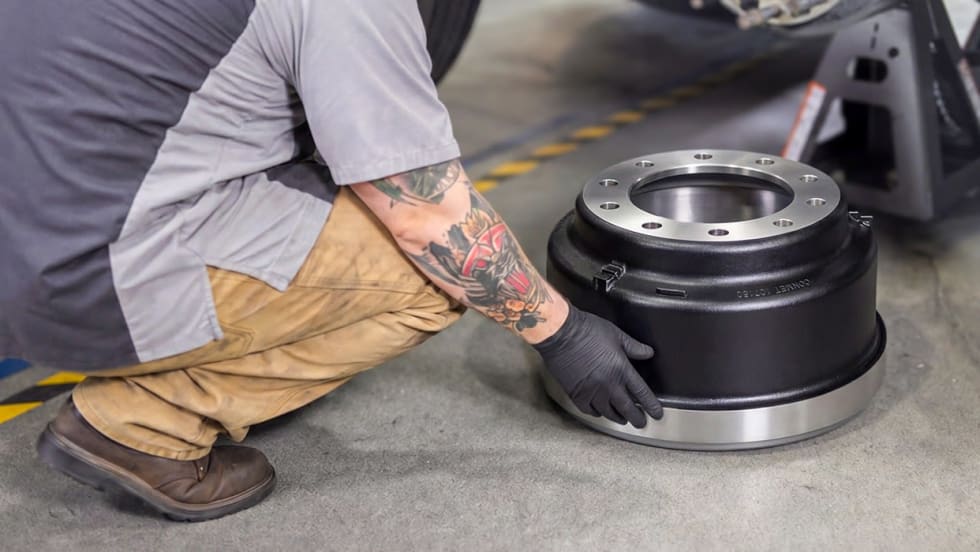
ConMet Expands Aftermarket Brake Drum Lineup With TruCast
A new heavy-duty truck brake drum option in the aftermarket gives customers more flexibility within the ConMet product family.
Read More →
Mack Expands Premium Service Contract Coverage to Medium-Duty MD
With a service contract, inspections, preventive maintenance and repairs can be handled in a single visit instead of multiple ones.
Read More →
Maintenance in the Messy Middle Part 5: Battery-Electric Trucks
No oil changes. No diesel exhaust fluid. No exhaust aftertreatment. But NACFE battery-electric trucks still require specialized maintenance procedures.
Read More →
Trucking Fleets Faced Record Operating Costs During Third Year of Freight Recession
ATRI's annual operational cost report shows carriers trimmed fleets, delayed equipment purchases, and ran older trucks as expenses continued to outpace freight rates.
Read More →