




Clean Vehicle Tech Grows in Face of Shifting Regulations
Clean vehicle technology is advancing by leaps and bounds, but the direction it is moving is not always clear. A panel discussion at a recent alt fuel conference explored global trends in the space and the need for more certainty.
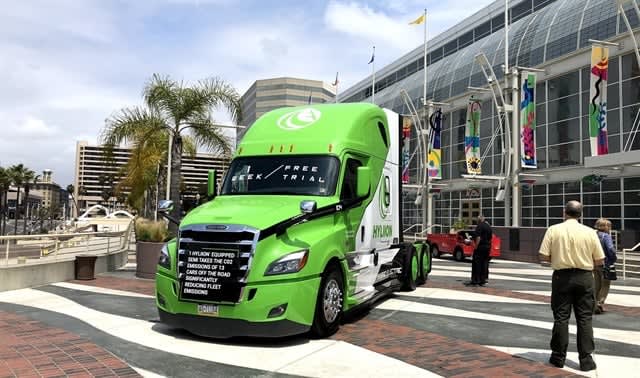
Clean vehicle technology took center stage at recent alt fuel conference in Long Beach. In front of the event, a Class 8 Hyliion demonstration truck drew attention from passersby. Photos: Steven Martinez
Photo: Steven Martinez
Clean vehicle technology is advancing by leaps and bounds, but the direction it is going in is not always clear. For the panelists in a discussion about global advanced transportation trends, the exciting space may need more certainty.
At the recent ACT Expo in Long Beach, California, a panel of industry leaders from Navistar, UPS, Cummins, Honda, and the California Air Resources Board spoke about global trends that are accelerating advanced transportation innovation. Each panelist described the challenges of staying on top of the evolving clean vehicle technologies space while also adapting to different needs in markets all over the world.
Clean Tech is Global
While the U.S. is still a leader in low-emissions vehicle technology, China and Western Europe are also driving the conversation – and in some cases taking a lead role. Meritor CEO and President Jay Craig, in a keynote address leading into the panel discussion, said that China was going head-on into clean technologies and that 60% of transit buses in the country are already fully electric.
But he had a warning for companies that fail to see the shift toward clean tech that is still on the horizon. He explained that unless transportation companies invest in the future, they might find themselves on the outside looking in.
While he said that it wasn’t certain exactly which technologies and markets will become most prominent, it was up to business leaders to stay on top of it, or find themselves becoming obsolete. Referencing an infamous episode of Happy Days, he said that companies that dominate a market today could become eventually become obsolete.
“Don’t jump the shark with your companies,” said Craig. "I’m planning not to with ours.”
Invest and Analyze
The common thread between all of the representatives on the panel was a willingness to invest in clean technologies, even when it seemed that not all of their bets would pan out.
Tamara Baker, UPS chief sustainability officer and vice president of environmental affairs, said the company is currently testing a variety of technologies in its 9,100-vehicle "rolling laboratory" fleet. The company’s strategy is not only to try out every viable technology, but also to deploy each tech in places where it makes the most sense.
She said because UPS has 119,000 vehicles deployed across the globe, the company felt it needed to do all it could to reduce its impact on the environment. The company previously declared that it had a goal of reducing overall emissions 12% by 2025, all while the company continues to grow.

A panel of industry leaders from Navistar, UPS, Cummins, Honda, and the California Air Resources Board spoke about global trends that are accelerating advanced transportation innovation.
Too Many Clean-Power Choices?
Between fully electric, hybrid-electric, alternative fuels and cleaner traditional vehicles, it seems that the space is full of choices for transportation companies to focus on, and may even seem overwhelming. But all the panelists seemed to feel that for now, a multitude of choices was a good thing.
Julie Furber, executive director of electrification for Cummins, said choice is a good thing, and that in the end, the right tech will eventually come through and the path forward will be clearer.
Steve Center, vice president of environmental business development for American Honda, said that choice was the best way to figure out what works. The sentiment was also echoed by UPS’s Baker, who said that it was important to fail fast in a rapidly changing space.
There was some caution, however, as Steve Gilligan, North America vice president of product and vocational marketing for Navistar, described the challenge of investing while still providing a product that customers wanted. He said that with too many choices, it is hard for infrastructure to scale with the technologies. He also said that his customers won’t buy into trucks that they can't service as well, another difficulty when supporting technologies that are not yet established enough to provide satisfactory support to them.
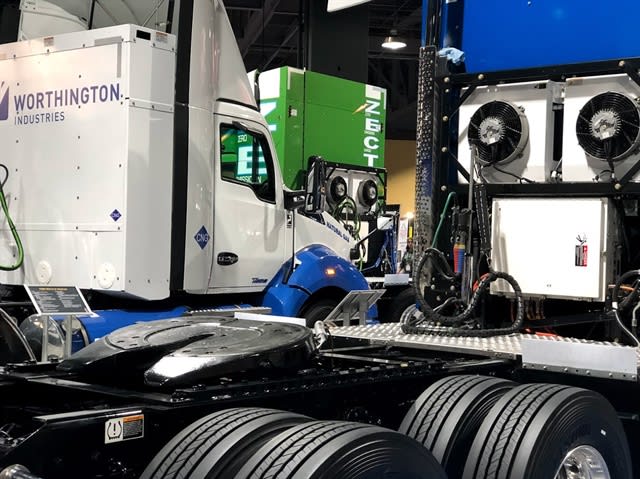
On the show floor, trucks of all types were shown using every conceivable low-emissions technology.
The Changing Regulatory Landscape
While the discussion covered a global perspective, it also spent a lot of time talking local news. The state of California sees itself as a leader in emissions regulation, and it recently joined with 17 other states to sue the Environmental Protection Agency for recent rollbacks to fuel economy and emissions standards.
CARB Assistant Division Chief Analisa Bevan kicked off the conference by reading a statement from CARB Chair Mary Nichols explaining why the state feels the rollbacks were not made in good faith. But regardless which side ultimately comes out on top, the uncertainty creates an unstable business atmosphere for companies in the clean vehicle technology market.
Gilligan said that for International, multiple standards are a doomsday scenario for its investments in clean tech. He said the company wants a clear direction for compliance and that ideally International would like a single standard to follow – indicating no preference for more or less lenient regulations, just consistent and stable ones. Furber agreed, saying that Cummins also preferred a clear direction and a consistent timeline as well for compliance.
UPS was primarily interested in lowering emissions, but Barker also said that due diligence was important when implementing new regulations. She recalled a situation in Mexico City that banned certain vehicles from entering the city on certain days in order to reduce emissions. However, businesses ended up buying more vehicles in order to always be able to operate regardless of the day’s restrictions, resulting in an increase in emissions.
CARB’s Bevan told the other panelists that “getting off course could be disastrous.” While regulatory bodies like hers acknowledged the problems that have arisen along the way, she said that CARB is focused on its goal of helping the environment, and it wants to avoid anything that could derail regulations and take the mission off course.
Despite concerns, the panelists made it clear that no matter how it happens or how long it takes, the clean technology future is going to come. But for now, the market remains a Wild West of exciting technological innovation and unstable rules.
Related: CNG-Powered Step Van to Feature Morgan Olson, Agility Equipment
More Fuel Smarts

How Volvo Updated Its D13 for EPA 2027 [Watch]
Volvo’s updated D13 promises lower emissions without sacrificing performance or fuel economy. Take a closer look at what changed inside the engine in this HDT Spotlight video.
Read More →
Diesel Price Spike Shortens Payback for Natural Gas Trucks, Report Says
Energy Vision estimates fleets could recover the higher purchase price of an RNG-fueled Class 8 tractor in 1.3 to 2.8 years under current fuel-price scenarios.
Read More →
Calstart Becomes Catalyst Mobility, Reflecting Broader Focus
Calstart is now Catalyst Mobility, reflecting the nonprofit’s growing national role in clean transportation, including zero-emission trucks, infrastructure and incentive programs.
Read More →

Record Diesel Prices Squeeze Trucking Fleets
Average U.S. diesel prices have climbed to nearly $6 a gallon, surpassing the 2022 record as tight refinery capacity and Middle East disruptions keep fuel costs elevated.
Read More →
How Fuel Delivery Shapes Engine Performance
Fuel delivery depends on more than what happens at the injector. For fleet, maintenance and technical professionals, looking at the full path from pump to injector can provide useful context for understanding engine performance.
Read More →
East Coast Port Launches $45M Electric Truck Push
The Port Authority of New York and New Jersey announced millions in incentives for zero-emission drayage trucks, yard tractors, and new charging hubs near the port.
Read More →
California Bill Could Shed Light on Electric Truck Prices
Why do battery-electric Class 8 trucks remain so expensive? A California bill headed to Gov. Gavin Newsom would give fleets and state agencies more visibility into what manufacturers charge.
Read More →
Detroit Opens Orders for EPA 2027 Engines
Detroit isn’t starting from scratch to meet EPA 2027 diesel emissions standards. Its Gen 6 DD13 and DD15 engines keep much of today’s platform while updating the fuel and aftertreatment systems.
Read More →
Zero-Emission Truck Corridor Planned for West Coast
California, Oregon, Washington, British Columbia and Baja California are coordinating plans for truck charging and hydrogen fueling from Canada to Mexico.
Read More →
A Closer Look at Kenworth’s Electric T880E Vocational Truck [Video]
Learn more about Kenworth's T880E battery-electric vocational truck at the Paccar Technical Center, including its range, applications, upfitting considerations, and PTO options, in this HDT Spotlight video.
Read More →