




Navistar-VW Alliance to Bring Electric Truck, Integrated Powertrain to Market
The Navistar-Volkswagen Truck & Bus Alliance has borne fruit faster than either company expected. Officials announced Monday they will develop a proprietary, integrated powertrain; a common connected vehicle and cloud platform; and an electric-powered Class 6/7 truck.

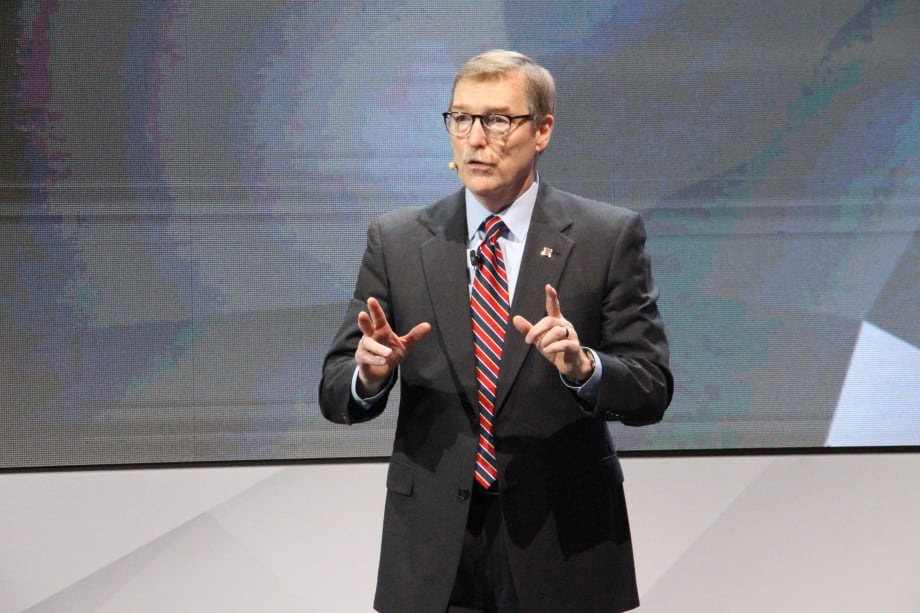
“Navistar is now writing the next chapter of our story,” said Troy A. Clarke, chairman, president and CEO, Navistar. Photo: Evan Lockridge

“Navistar is now writing the next chapter of our story,” said Troy A. Clarke, chairman, president and CEO, Navistar. Photo: Evan Lockridge
ATLANTA – The Navistar-Volkswagen Truck & Bus Alliance has borne fruit faster than either company expected, and officials announced Monday at the inaugural North American Commercial Vehicle Show. they will develop a proprietary, integrated powertrain; a common connected vehicle and cloud platform; and an electric-powered Class 6/7 truck.
Navistar expects to be in a position to launch its first medium-duty electric powered vehicle for the U.S. and Canadian markets in late 2019 or early 2020.
"We believe the Class 6/7 vehicle is ideal for electric powertrain solutions in the near term, given its abundance of packaging space, and that these vehicles typically run short distances and can depot to recharge at the end of the day,” said Troy A. Clarke, chairman, president and CEO, Navistar.
Clarke pointed out that Navistar was “probably ahead of its time” when it launched the eStar electric vehicle back in 2010, “but we never gave up believing there is an application for electric commercial vehicles in the North American commercial vehicle market,” he said.
Clarke also noted that electric power for commercial vehicles is particularly growing in urban areas, “where congestion often leads to air quality issues.”
In fact, Volkswagen has already delivered the first 10 electric trucks to an Austrian customer for testing, said Andreas Renschler, CEO of Volkswagen Truck & Bus. “For us, the customer’s view is first and foremost in priority. If the customer tells us what he or she wants to do with electric trucks we can deliver.”

Andreas Renschler, head of Volkswagen Truck & Bus, talks to reporters at the NACV show Monday.Photo: Evan Lockridge
Renschler said he couldn’t answer media questions about things like how many such vehicles they expect to sell, because “Of course it depends on customers. The question for us is not to tell them what to do; they tell us what we should do with such a solution, but we can offer the innovation. I think electrical buses for example are important, but also the medium truck, with so called last mile, we see a good chance for the customer to be able to use it.”
Integrated Powertrain
In preparation for the next greenhouse gas emission regulations globally, Navistar and VW also are collaborating on a fully integrated, next-generation diesel big bore powertrains for North America, launching in 2021.
However, the two companies would offer no further details.
“We'd love to say a lot more about that,” Clarke said, but didn’t want to divulge too much of the company’s future plans for fear of how the competition might use it against them. “I guarantee you this, the next one of these shows in 2019 it will all be very evident.”
Asked if the powertrain would also include a proprietary transmission, Clarke and Renschler were noncommittal, saying such things were “possible.”
Converging Connectivity
Navistar and Volkswagen Truck & Bus also announced their intention to converge their connectivity activities – OnCommand Connection and RIO, Volkswagen Truck & Bus's digital brand – to a Volkswagen Truck & Bus global connected vehicle platform. The first step will be the adoption of common, in-cab connecting device hardware. This would serve as a major step toward creating a global connected platform, covering roughly 650,000 vehicles worldwide, "making it the world's largest global ecosystem for commercial vehicles, once the migration is completed," Clarke said.
Volkswagen Truck & Bus expects to launch the cloud-based, brand-independent platform by the end of the year, which will be the basis for the cooperation.
"Future transportation will massively be building on connectivity, as this will make our world much more efficient," said Renschler. "The ecosystem we are about to create with our common platform will drive our strategic alliance to the next level."
Joint Venture
Navistar also reported that the procurement joint venture – Global Truck & Bus Procurement LLC – it created with Volkswagen Truck & Bus is off to a strong start. The team has met with more than 250 new and existing suppliers, and to date, have completed 40 joint bidding contracts.
"We're on track to achieve our expected cost savings thanks to our fast start with the procurement JV and the great progress on our technology collaboration," said Clarke. "As a result, we are in a much more competitive position today in the areas that are quickly revolutionizing our industry globally.”
“Navistar is now writing the next chapter of our story,” Clarke said. “Unlike any time in our history, we are positioned to win, and we will. We have the products, we have the dealers, we have the partner, and most importantly we have the will to win. We have the resolve to fight the next battle and the one after that.”
More Fuel Smarts

Why Diesel Price Relief Efforts May Fall Short
Diesel prices have eased from September’s record high, but doubts about additional Russian supply and limits on dyed-diesel tax relief mean trucking fleets still face expensive fuel. And prices could go higher.
Read More →
Why Small Fuel Savings Matter in Trucking
Can better fuel economy help pay for driver raises? In this podcast, GP Transco explains how small efficiency gains create room to reinvest in its people.
Read More →
How GP Transco Cuts Trucking Fuel Costs, a Tenth of a Gallon at a Time
What’s another tenth of a mile per gallon worth? GP Transco shares how equipment upgrades and driver coaching turn small gains into meaningful fuel savings.
Read More →
Electric Yard Tractors Move Beyond Pilots
Operating-cost savings have overtaken sustainability goals as the leading reason surveyed fleets are adopting battery-electric terminal tractors, according to new NACFE research.
Read More →
Geotab Links Fleet Card to Vehicle Data
The new card combines fuel discounts with telematics-based purchase controls. Geotab’s analysis also points to potential savings from choosing lower-priced fuel stops.
Read More →
Fleet Economics Shape Electric Truck Outlook
ACT Research expects costs, charging infrastructure, and technology improvements to drive zero-emission commercial vehicle adoption as federal regulations and incentives retreat.
Read More →
Wex Adds Cardless Fuel Payments for Over-the-Road Customers
A new fuel card feature for Wex customers offers convenience and security.
Read More →
New California Law Could Shed Light on Electric Truck Prices
Why do battery-electric Class 8 trucks remain so expensive? A California bill signed by Gov. Gavin Newsom would give fleets and state agencies more visibility into what manufacturers charge.
Read More →
How Volvo Updated Its D13 for EPA 2027 [Watch]
Volvo’s updated D13 promises lower emissions without sacrificing performance or fuel economy. Take a closer look at what changed inside the engine in this HDT Spotlight video.
Read More →
Diesel Price Spike Shortens Payback for Natural Gas Trucks, Report Says
Energy Vision estimates fleets could recover the higher purchase price of an RNG-fueled Class 8 tractor in 1.3 to 2.8 years under current fuel-price scenarios.
Read More →