




Related: Volvo’s SuperTruck Exceeds EPA Freight Efficiency Goals
Navistar SuperTruck Beats DOE Efficiency Goals, Hits 13 MPG
Navistar has revealed that its SuperTruck program demonstration vehicle, CatalIST, exceeded the improvement goals set by the Department of Energy for the SuperTruck program.
by Staff
September 28, 2016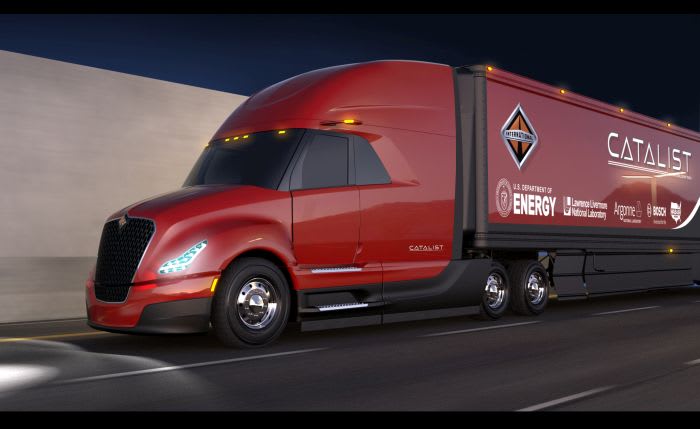
The CatalIST SuperTruck Image courtesy of Navistar
2 min to read
The CatalIST SuperTruck Image courtesy of Navistar
Navistar has revealed that its SuperTruck program demonstration vehicle, CatalIST, exceeded the improvement goals set by the Department of Energy for the SuperTruck program.
CatalIST achieved a freight efficiency improvement of 104% compared to the DOE’s control vehicle, sipping diesel at 13 mpg. The vehicle also demonstrated 50.5% Brake Thermal Efficiency and Navistar said it is on the path towards 55% BTE.
"The CatalIST's significant improvements in freight efficiency, achieved with the support of DOE's SuperTruck program, demonstrate tremendous potential for reduction in the trucking industry's consumption of energy," said Mark Stasell, vice president, product development. "In addition, a number of the technology innovations we have achieved through the program are already being implemented in production vehicles today."
The vehicle was named CatalIST because it will serve as the catalyst for significant improvements in future commercial trucks. The last three letters of CatalIST stand for International SuperTruck, referencing the vehicle’s International Trucks branding.
Through the program, the company was able to make improvements to its own vehicle technology. One innovation from the program was Navistar’s predictive cruise control, which looks ahead of the vehicle and recognizes terrain, continuously calculating the most efficient speed and gear for better fuel economy in real time.
Other improvements included:
Advanced integration of Navistar N13 Engine utilizing proprietary intelligent controls and high-efficiency combustion.
Reduction in aerodynamic drag through replacement of cab- and hood-mounted mirrors with a series of cameras and interior-mounted monitors, which also yield equal or better indirect vision for the driver.
A new LED headlamp system that reduces lamp size for a more aerodynamic shape and cuts electrical power requirements by greater than 80%, while improving luminous output and light color for improved night-time direct driver vision and reduced driver fatigue.
An all-new shape with a sloped windshield and wedged cab for improved aerodynamics. Innovative use of lighter-weight carbon-fiber panels in the upper body, roof headers, back panel, and dash panel.
A hybrid front suspension and lightweight rear suspension that leverages lightweight alloys with composite materials, reducing weight and enabling an electronic ride height management system, which provides dynamic ride height and pitch control for improved aerodynamics.
Aerodynamic improvements that reduce the trailer's drag coefficient by more than 30%.
The vehicle is part of the DOE’s SuperTruck program – a five-year research and development initiative aimed at improving freight efficiency, based in the measure of the payload carried while burning less fuel.
Its objective is to develop and demonstrate a 50% improvement in overall freight efficiency on a Class 8 tractor-trailer vehicle as measured in ton-miles per gallon of diesel fuel.
More Fuel Smarts

Wex Adds Cardless Fuel Payments for Over-the-Road Customers
A new fuel card feature for Wex customers offers convenience and security.
Read More →
New California Law Could Shed Light on Electric Truck Prices
Why do battery-electric Class 8 trucks remain so expensive? A California bill signed by Gov. Gavin Newsom would give fleets and state agencies more visibility into what manufacturers charge.
Read More →
How Volvo Updated Its D13 for EPA 2027 [Watch]
Volvo’s updated D13 promises lower emissions without sacrificing performance or fuel economy. Take a closer look at what changed inside the engine in this HDT Spotlight video.
Read More →

Diesel Price Spike Shortens Payback for Natural Gas Trucks, Report Says
Energy Vision estimates fleets could recover the higher purchase price of an RNG-fueled Class 8 tractor in 1.3 to 2.8 years under current fuel-price scenarios.
Read More →
Calstart Becomes Catalyst Mobility, Reflecting Broader Focus
Calstart is now Catalyst Mobility, reflecting the nonprofit’s growing national role in clean transportation, including zero-emission trucks, infrastructure and incentive programs.
Read More →
Record Diesel Prices Squeeze Trucking Fleets
Average U.S. diesel prices have climbed to nearly $6 a gallon, surpassing the 2022 record as tight refinery capacity and Middle East disruptions keep fuel costs elevated.
Read More →
Sponsored•September 9, 2026
How Fuel Delivery Shapes Engine Performance
Fuel delivery depends on more than what happens at the injector. For fleet, maintenance and technical professionals, looking at the full path from pump to injector can provide useful context for understanding engine performance.
Read More →
East Coast Port Launches $45M Electric Truck Push
The Port Authority of New York and New Jersey announced millions in incentives for zero-emission drayage trucks, yard tractors, and new charging hubs near the port.
Read More →
Detroit Opens Orders for EPA 2027 Engines
Detroit isn’t starting from scratch to meet EPA 2027 diesel emissions standards. Its Gen 6 DD13 and DD15 engines keep much of today’s platform while updating the fuel and aftertreatment systems.
Read More →
Zero-Emission Truck Corridor Planned for West Coast
California, Oregon, Washington, British Columbia and Baja California are coordinating plans for truck charging and hydrogen fueling from Canada to Mexico.
Read More →