




Related: It's Time to Look at Lower-Viscosity Oils for Fuel Savings
Diesel Prices Increase For the First Time in Over 2 Months
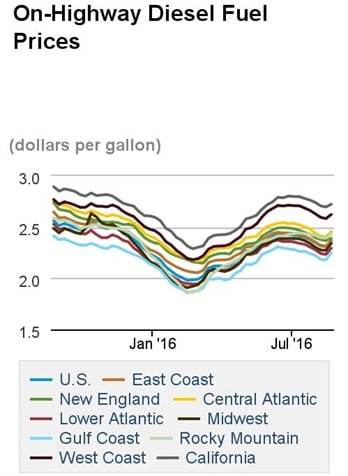
The price of diesel fuel increased for the first time in over 2 months after slowly falling from a high of 2.43 in mid-June, according to the latest numbers from the Energy Department.
by Staff
August 22, 2016
2 min to read
Source: EIA
The price of diesel fuel increased for the first time in over 2 months after slowly falling from a high of 2.43 in mid-June, according to the latest numbers from the Energy Department.
The average price of on-highway diesel fuel increased by 6 cents last week, rising to $3.37 per gallon. With steadily rising prices, diesel fuel is still 19.1 cents cheaper than it was in the same week in 2015.
The largest increase in prices was in the Gulf Coast region with a 7-cent increase for the week. The New England region was the least affected by rising prices with a 2.3-cent increase last week.
Gasoline prices were also up for the week, increasing 4.4 cents to $2.183 per gallon. The price is still 44.4 cents cheaper than it was in the same week of 2015. The largest increase in prices by region was in the New England region at 6.2 cents while the smallest increase was in the Rocky Mountain region at 1.5 cents.
Global crude oil prices fell on Monday as a potential decrease in production by OPEC seems unlikely once again, according to a MarketWatch report. Demand for crude oil has been weak for the past year with economic problems in countries like China causing an oil supply glut.
When combined with an increase in oil production by the U.S. and OPEC, oil prices fell significantly over that period. The prospect of a production freeze had been bolstering the market in the past few weeks, causing prices to rise steadily. However it appears that a deal to reduce output is unlikely in the short term.
More Fuel Smarts
Why Diesel Price Relief Efforts May Fall Short
Diesel prices have eased from September’s record high, but doubts about additional Russian supply and limits on dyed-diesel tax relief mean trucking fleets still face expensive fuel. And prices could go higher.
Read More →
Why Small Fuel Savings Matter in Trucking
Can better fuel economy help pay for driver raises? In this podcast, GP Transco explains how small efficiency gains create room to reinvest in its people.
Read More →
How GP Transco Cuts Trucking Fuel Costs, a Tenth of a Gallon at a Time
What’s another tenth of a mile per gallon worth? GP Transco shares how equipment upgrades and driver coaching turn small gains into meaningful fuel savings.
Read More →
Electric Yard Tractors Move Beyond Pilots
Operating-cost savings have overtaken sustainability goals as the leading reason surveyed fleets are adopting battery-electric terminal tractors, according to new NACFE research.
Read More →
Geotab Links Fleet Card to Vehicle Data
The new card combines fuel discounts with telematics-based purchase controls. Geotab’s analysis also points to potential savings from choosing lower-priced fuel stops.
Read More →
Fleet Economics Shape Electric Truck Outlook
ACT Research expects costs, charging infrastructure, and technology improvements to drive zero-emission commercial vehicle adoption as federal regulations and incentives retreat.
Read More →
Wex Adds Cardless Fuel Payments for Over-the-Road Customers
A new fuel card feature for Wex customers offers convenience and security.
Read More →
New California Law Could Shed Light on Electric Truck Prices
Why do battery-electric Class 8 trucks remain so expensive? A California bill signed by Gov. Gavin Newsom would give fleets and state agencies more visibility into what manufacturers charge.
Read More →
How Volvo Updated Its D13 for EPA 2027 [Watch]
Volvo’s updated D13 promises lower emissions without sacrificing performance or fuel economy. Take a closer look at what changed inside the engine in this HDT Spotlight video.
Read More →
Diesel Price Spike Shortens Payback for Natural Gas Trucks, Report Says
Energy Vision estimates fleets could recover the higher purchase price of an RNG-fueled Class 8 tractor in 1.3 to 2.8 years under current fuel-price scenarios.
Read More →