




Annual Fleet Efficiency Study Helps NACFE Benchmark Fuel-Saving Trends
Seventeen fleets operating more than 62,000 tractors and 217,000 trailers saw a 3% increase in fuel economy in 2015, saving an accumulative $501 million on fuel when compared to the 2015 national average fuel spend of 1.7 million over-the-road Class 8 trucks.
Seventeen fleets operating more than 62,000 tractors and 217,000 trailers saw a 3% increase in fuel economy in 2015, saving an accumulative $501 million on fuel when compared to the 2015 national average fuel spend of 1.7 million over-the-road Class 8 trucks.
They achieved these gains by purchasing a variety of fuel efficiency technologies, according to the Annual Fleet Fuel Study released by the North American Council for Freight Efficiency.
Fleet-wide mpg increased from 6.87 to 7.06 in 2015, the largest margin of improvement in eight years of consecutive improvements. The trade cycle for these fleets is a little over five years, meaning that the new trucks are about 16% more efficient than the 2010 model year trucks they replaced. The adoption rate of new efficiency technologies such as electronically controlled transmissions, low-viscosity engine oil, and tire pressure inflation on trailers continued to increase even though diesel fuel prices averaged $2.71 in 2015.
“Investing in efficiency technologies is the new normal,” said Mike Roeth, operation lead for CWR’s Trucking Efficiency and executive director of NACFE. “And these fleets are continuing to make investments because they do not want to be caught short when fuel prices go up again.”
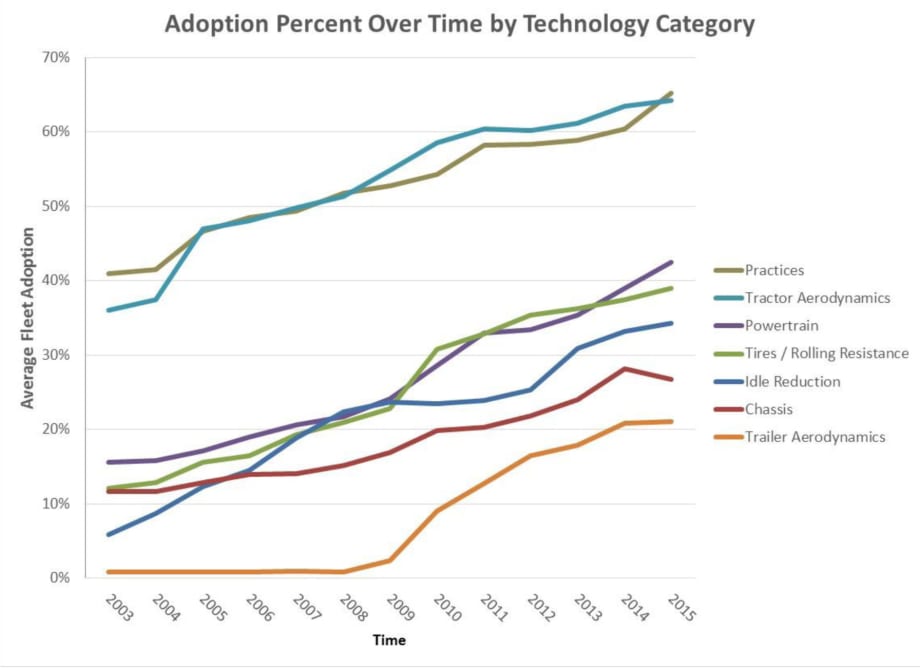
The primary finding of this report is that the 17 fleets studied are increasing their rate of adoption of these technologies, and that they are enjoying improved fuel economy as a result. The overall adoption rate for the technologies studied in this report has grown from 18% in 2003 to 43% last year.
The average fleet-wide fuel economy of the trucks in this study averaged 7.06 mpg in 2015, a 3% increase over the same fleet in 2014. The fleets in this study on average sell their trucks in 5.25 years. This suggests that the new trucks put into service in 2015 (2016 MY) by these fleets were about 16% better than the ones removed — the ones which had been put into service in 2009 (2010 MY). This is a significant improvement in fuel efficiency, and the report concludes there were three basic elements: movement to EPA 2010 systems using diesel exhaust fluid, the 2014 GHG phase 1 products, and the year-over-year increase in adoption of the technologies included in this study.
The fuel savings in 2016 between the “business-as-usual” 6.30 mpg and the NACFE fleets average of 7.06 mpg amounts to $4,653 per year per truck, at the $2.71 per gallon fuel cost over the average tractor mileage of 99,958. The fleets are saving $8,075 over the national average of 5.83 mpg. If fuel costs had been at the four-year average of $3.89 per gallon, the savings would have been $6,679 and $11,591, respectively.
And finally, for these 17 fleets operating 62,123 trucks, in 2015 combined they saved $500.6 million compared to the average trucks on the road.
The 17 fleets varied in the choices they make in fuel efficiency solutions. For instance, in their adoption of idle reduction solutions, some fleets are using diesel auxiliary power units, others electric HVAC systems, others automatic start/stop, while some are managing idle with engine parameter settings, diesel-fired heaters and driver training and incentives.
Participating fleets are Bison Transport, CR England, Cardinal Logistics, Challenger Motor Freight, Con-way Truckload (now part of XPO Logistics), Crete Carriers, Frito Lay, Maverick, NFI Industries, Nussbaum, Paper Transport, Prime, Ryder, Schneider, and United Parcel Service.
A new section of the study this year combines the fleet data with the just released final EPA and NHTSA Greenhouse Gas and Fuel Efficiency Phase 2 Regulations. A set of charts has been released to show where the studied fleets are in adoption of several of the regulated areas and how the trend lines from these adoption rates project into the required levels years into the future phases of the implementation.
A benchmarking tool was also released with this study, a spreadsheet that can be used by any dealership or fleet owner to compare their own technology adoption to these NACFE studied fleets.
Technologies most commonly adopted by the 17 fleets were:
Anti-idle electronic engine controls
Aero hoods and fenders
Aerodynamic bumpers
Aerodynamic mirrors
Engine parameters set for fuel economy
Synthetic axle lube
Full-height roof air fairing
Driver training for fuel economy
Synthetic transmission oil
Limit speed to less than 65 mph
To download the report, click here.
More Fuel Smarts

Why Diesel Price Relief Efforts May Fall Short
Diesel prices have eased from September’s record high, but doubts about additional Russian supply and limits on dyed-diesel tax relief mean trucking fleets still face expensive fuel. And prices could go higher.
Read More →
Why Small Fuel Savings Matter in Trucking
Can better fuel economy help pay for driver raises? In this podcast, GP Transco explains how small efficiency gains create room to reinvest in its people.
Read More →
How GP Transco Cuts Trucking Fuel Costs, a Tenth of a Gallon at a Time
What’s another tenth of a mile per gallon worth? GP Transco shares how equipment upgrades and driver coaching turn small gains into meaningful fuel savings.
Read More →
Electric Yard Tractors Move Beyond Pilots
Operating-cost savings have overtaken sustainability goals as the leading reason surveyed fleets are adopting battery-electric terminal tractors, according to new NACFE research.
Read More →
Geotab Links Fleet Card to Vehicle Data
The new card combines fuel discounts with telematics-based purchase controls. Geotab’s analysis also points to potential savings from choosing lower-priced fuel stops.
Read More →
Fleet Economics Shape Electric Truck Outlook
ACT Research expects costs, charging infrastructure, and technology improvements to drive zero-emission commercial vehicle adoption as federal regulations and incentives retreat.
Read More →
Wex Adds Cardless Fuel Payments for Over-the-Road Customers
A new fuel card feature for Wex customers offers convenience and security.
Read More →
New California Law Could Shed Light on Electric Truck Prices
Why do battery-electric Class 8 trucks remain so expensive? A California bill signed by Gov. Gavin Newsom would give fleets and state agencies more visibility into what manufacturers charge.
Read More →
How Volvo Updated Its D13 for EPA 2027 [Watch]
Volvo’s updated D13 promises lower emissions without sacrificing performance or fuel economy. Take a closer look at what changed inside the engine in this HDT Spotlight video.
Read More →
Diesel Price Spike Shortens Payback for Natural Gas Trucks, Report Says
Energy Vision estimates fleets could recover the higher purchase price of an RNG-fueled Class 8 tractor in 1.3 to 2.8 years under current fuel-price scenarios.
Read More →