




DOE Boosts SuperTruck Funding, Medium-Duty Grants
The U.S. Department of Energy has boosted funding for its SuperTruck II initiative to increase fuel efficiency of Class 7and 8 trucks and will provide funding for several projects that would develop alternative powertrains for medium-duty vehicles, the agency announced at the Work Truck Show.
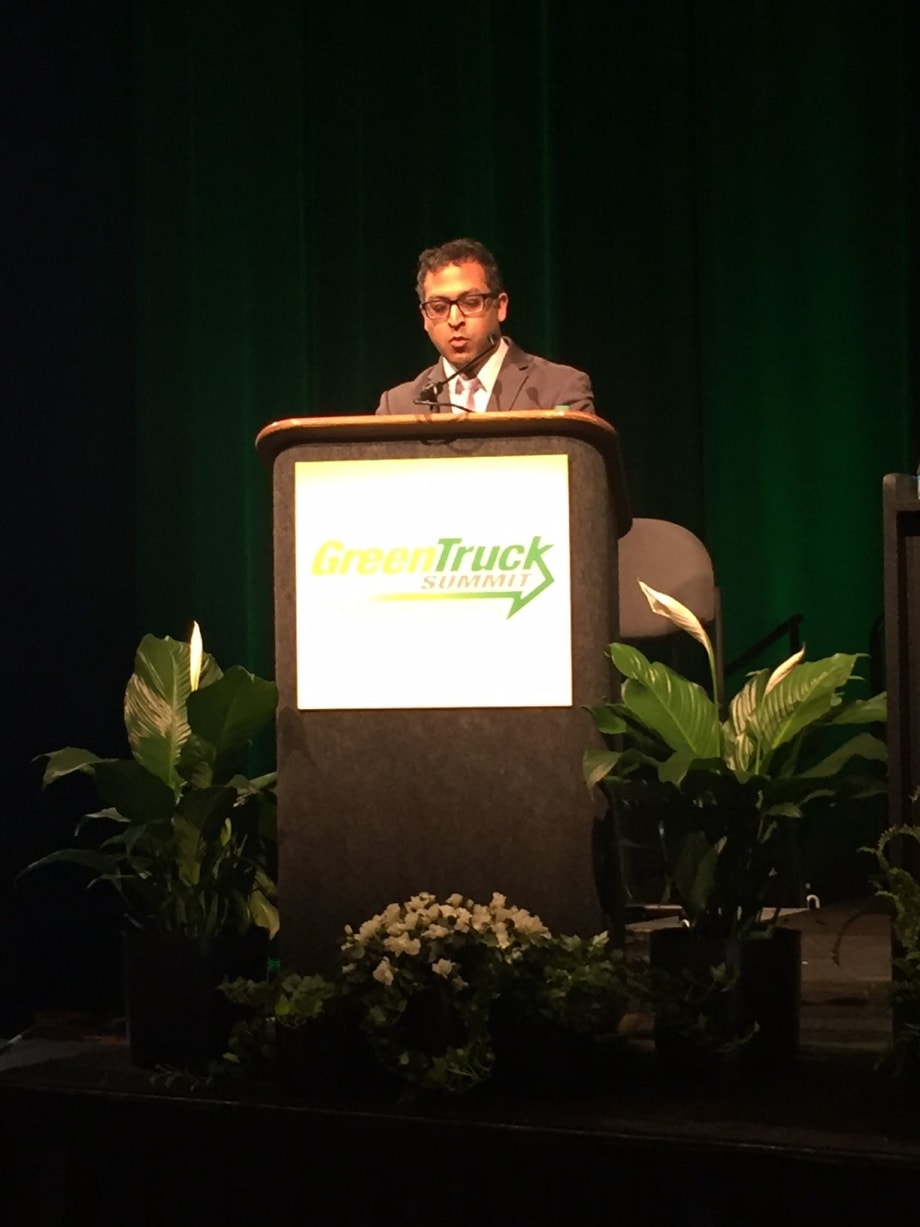
Photo of U.S. DOE Deputy Asst. Secretary Reuben Sarkar by Mike Antich .
Photo of U.S. DOE Deputy Asst. Secretary Reuben Sarkar by Mike Antich .
The U.S. Department of Energy has boosted funding for its SuperTruck II initiative to increase fuel efficiency of Class 7and 8 trucks and will provide funding for several projects that would develop alternative powertrains for medium-duty vehicles, the agency announced at the Work Truck Show.
During the opening keynote for the 2016 Green Truck Summit, Reuben Sarkar, deputy assistant secretary for Sustainable Transportation for the U.S. Department of Energy (DOE), announced that the SuperTruck II initiative would receive $80 million in funding.
The initial DOE budget proposal had set the SuperTruck II request for appropriations at $60 million, much of it coming at the expense of cuts in the DOE’s Clean Cities program.
SuperTruck II, which is subject to congressional appropriations, will provide funding for cost-shared projects, which would provide research and demonstrate long-haul truck technology that are able to achieve a greater than 100% improvement in vehicle freight efficiencies relative to the 2009 baseline, and also to provide engine thermal brake efficiencies greater than or equal to 55%.
Sarkar also announced more than $12 million in selections for three new cost-shared projects focused on the research, development, and demonstration of plug-in electric powertrain technologies for medium- and heavy-duty vehicles.
Among the medium-duty projects that are receiving funding are:
Robert Bosch LLC (Farmington Hills, MI) will receive $5 million to develop and demonstrate a medium-duty plug-in hybrid vehicle powertrain that reduces fuel consumption by 50%.
Cummins Corporate Research and Technology (Columbus, IN) will receive $4.5 million to develop and demonstrate a Class 6 plug-in hybrid delivery truck that reduces fuel consumption by 50%.
McLaren Performance Technologies (Livonia, MI) will receive $2.6 million to develop a Class 6 delivery truck with a scalable, innovative, lightweight, low-cost, and commercially-viable plug-in electric drive system that improves fuel economy by 100%.
“Improving the efficiency of commercial trucks is critical to reducing our petroleum consumption, strengthening our clean energy economy, and further reducing our contributions to climate change,” Sarkar said. “This new funding will not only accelerate innovation but also foster rapid market adoption of new energy efficient vehicle technologies.
The Department of Energy launched its SuperTruck initiative in 2010. Vehicles developed under SuperTruck I are Class 8 combination trucks that dramatically increase tractor-trailer fuel, engine and drivetrain efficiency through the use of advanced technologies. As the backbone of domestic freight transportation, 18-wheelers haul 70% of freight tonnage.
More Fuel Smarts

How Volvo Updated Its D13 for EPA 2027 [Watch]
Volvo’s updated D13 promises lower emissions without sacrificing performance or fuel economy. Take a closer look at what changed inside the engine in this HDT Spotlight video.
Read More →
Diesel Price Spike Shortens Payback for Natural Gas Trucks, Report Says
Energy Vision estimates fleets could recover the higher purchase price of an RNG-fueled Class 8 tractor in 1.3 to 2.8 years under current fuel-price scenarios.
Read More →
Calstart Becomes Catalyst Mobility, Reflecting Broader Focus
Calstart is now Catalyst Mobility, reflecting the nonprofit’s growing national role in clean transportation, including zero-emission trucks, infrastructure and incentive programs.
Read More →

Record Diesel Prices Squeeze Trucking Fleets
Average U.S. diesel prices have climbed to nearly $6 a gallon, surpassing the 2022 record as tight refinery capacity and Middle East disruptions keep fuel costs elevated.
Read More →
How Fuel Delivery Shapes Engine Performance
Fuel delivery depends on more than what happens at the injector. For fleet, maintenance and technical professionals, looking at the full path from pump to injector can provide useful context for understanding engine performance.
Read More →
East Coast Port Launches $45M Electric Truck Push
The Port Authority of New York and New Jersey announced millions in incentives for zero-emission drayage trucks, yard tractors, and new charging hubs near the port.
Read More →
California Bill Could Shed Light on Electric Truck Prices
Why do battery-electric Class 8 trucks remain so expensive? A California bill headed to Gov. Gavin Newsom would give fleets and state agencies more visibility into what manufacturers charge.
Read More →
Detroit Opens Orders for EPA 2027 Engines
Detroit isn’t starting from scratch to meet EPA 2027 diesel emissions standards. Its Gen 6 DD13 and DD15 engines keep much of today’s platform while updating the fuel and aftertreatment systems.
Read More →
Zero-Emission Truck Corridor Planned for West Coast
California, Oregon, Washington, British Columbia and Baja California are coordinating plans for truck charging and hydrogen fueling from Canada to Mexico.
Read More →
A Closer Look at Kenworth’s Electric T880E Vocational Truck [Video]
Learn more about Kenworth's T880E battery-electric vocational truck at the Paccar Technical Center, including its range, applications, upfitting considerations, and PTO options, in this HDT Spotlight video.
Read More →