




House Bill Would Advance Clean Vehicle Technologies
A bill that would earmark funds for research and development of alternative fuels and advanced vehicle technologies as well as create truck-specific programs within the Department of Energy has been introduced in the House.

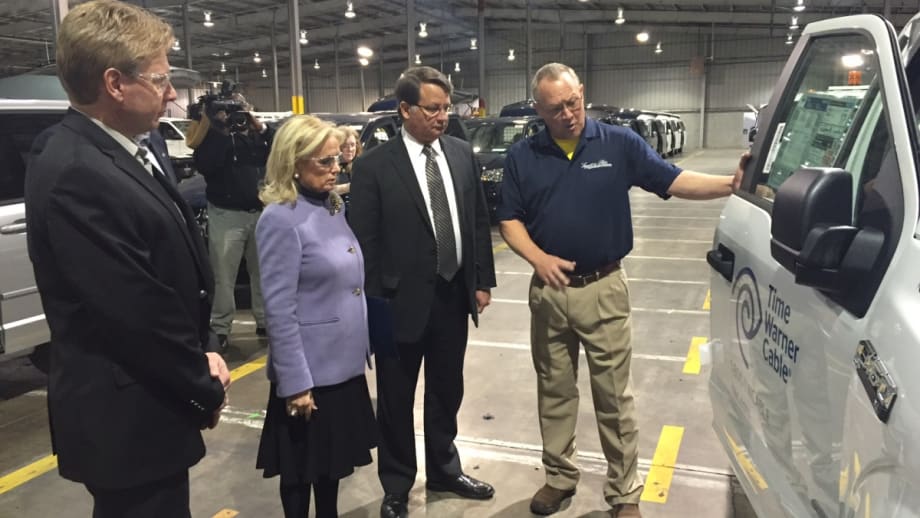
Rep. Debbie Dingell and Sen. Gary Peters touring Leggett and Platt Commercial Vehicle Products plant in Taylor, Mich. Photo: debbiedingell.house.gov
Rep. Debbie Dingell and Sen. Gary Peters touring Leggett and Platt Commercial Vehicle Products plant in Taylor, Mich. Photo: debbiedingell.house.gov
A bill that would earmark funds for research and development of alternative fuels and advanced vehicle technologies as well as create truck-specific programs within the Department of Energy (DOE) has been introduced in the House by Rep. Debbie Dingell (D-MI) as the Vehicle Innovation Act (VIA), H.R. 4106.
Sen. Gary Peters (D-MI) introduced the legislation in the Senate earlier this year with cosponsors Sens. Debbie Stabenow (D-MI) and Lamar Alexander (R-TN). Their bill was passed by the Senate Energy and Natural Resources Committee as part of a larger package of energy legislation.
According to the Senate and House sponsors, VIA legislation will promote investments in research and development of clean vehicle technologies to create more fuel-efficient vehicles, reduce dependence on foreign oil and support American auto manufacturers and suppliers.
Rep. Dingell said the act would reauthorize the Department of Energy’s Vehicle Technologies Program, which works with light-duty automobile and medium- and heavy-duty commercial truck manufacturers and suppliers to conduct research and development to improve fuel efficiency in vehicles.
She said examples of these technologies include mild hybrid, engine downspeeding, power pack modeling and testing, advanced boosting systems, new vehicle sensing and communication, hydrogen and natural gas refueling, and electric vehicle charging technology.
In addition, the bill includes provisions that would encourage the development and use of vehicle-to-vehicle (V2V) communications systems that have the potential to improve fuel efficiency and reduce traffic accidents and congestion.
“Our nation’s vehicle suppliers and manufacturers have made major advances in cutting-edge fuel efficiency technologies in the last decade, and we need to keep that progress going,” said Dingell. “The Vehicle Innovation Act will build on successful research programs that have resulted in large savings for consumers at the pump and keep the U.S. and Southeast Michigan in the lead in developing high-tech, energy efficient vehicles.”
“American auto manufacturers rely on emerging technologies and innovations to continue to grow and compete in the global economy, and we must make critical investments to develop and build those technologies here at home,” said Sen. Peters. “This legislation will provide sustainable funding to promote research and development of new vehicle innovations that will make the cars and trucks of the future cleaner, safer and more efficient.”
NTEA Executive Director Steve Carey praised VIA, stated that “for the work truck industry to compete globally and continue to meet the needs of vocational truck users, it will need to employ advanced technologies and deploy more alternatively fueled trucks. The Vehicle Innovation Act will support continued public-private partnerships and drive research that will keep us competitive and help us get more fuel-efficient trucks on the road.”
According to NTEA, VIA legislation “would support the science and industry needed to improve vehicle fuel economy and minimize petroleum use” yet is “technology-neutral — it develops and strengthens the tools for vehicle experts, without bias.”
NTEA also noted that activities under VIA would be carried out in partnership or collaboration with automotive manufacturers, heavy commercial, vocational and transit vehicle manufacturers, qualified plug-in electric vehicle manufacturers, compressed natural gas vehicle manufacturers, vehicle and engine equipment and component manufacturers, manufacturing equipment manufacturers, advanced vehicle service providers, fuel producers and energy suppliers, electric utilities, universities, national laboratories and independent research laboratories.
The Congressional sponsors said that the legislation is supported by a broad coalition of environmental groups and manufacturers including the Motor and Equipment Manufacturers Association, the BlueGreen Alliance, the Auto Alliance, NTEA, the United Auto Workers, the League of Conservation Voters, the Union of Concerned Scientists, the Natural Resources Defense Council, the Sierra Club, the American Automotive Policy Council, the Electric Drive Transportation Association, Robert Bosch LLC, the Lord Corporation, Umicore, Bergstrom, Magna International, Inc., and Dorman Products, Inc.
More Fuel Smarts

How Volvo Updated Its D13 for EPA 2027 [Watch]
Volvo’s updated D13 promises lower emissions without sacrificing performance or fuel economy. Take a closer look at what changed inside the engine in this HDT Spotlight video.
Read More →
Diesel Price Spike Shortens Payback for Natural Gas Trucks, Report Says
Energy Vision estimates fleets could recover the higher purchase price of an RNG-fueled Class 8 tractor in 1.3 to 2.8 years under current fuel-price scenarios.
Read More →
Calstart Becomes Catalyst Mobility, Reflecting Broader Focus
Calstart is now Catalyst Mobility, reflecting the nonprofit’s growing national role in clean transportation, including zero-emission trucks, infrastructure and incentive programs.
Read More →

Record Diesel Prices Squeeze Trucking Fleets
Average U.S. diesel prices have climbed to nearly $6 a gallon, surpassing the 2022 record as tight refinery capacity and Middle East disruptions keep fuel costs elevated.
Read More →
How Fuel Delivery Shapes Engine Performance
Fuel delivery depends on more than what happens at the injector. For fleet, maintenance and technical professionals, looking at the full path from pump to injector can provide useful context for understanding engine performance.
Read More →
East Coast Port Launches $45M Electric Truck Push
The Port Authority of New York and New Jersey announced millions in incentives for zero-emission drayage trucks, yard tractors, and new charging hubs near the port.
Read More →
California Bill Could Shed Light on Electric Truck Prices
Why do battery-electric Class 8 trucks remain so expensive? A California bill headed to Gov. Gavin Newsom would give fleets and state agencies more visibility into what manufacturers charge.
Read More →
Detroit Opens Orders for EPA 2027 Engines
Detroit isn’t starting from scratch to meet EPA 2027 diesel emissions standards. Its Gen 6 DD13 and DD15 engines keep much of today’s platform while updating the fuel and aftertreatment systems.
Read More →
Zero-Emission Truck Corridor Planned for West Coast
California, Oregon, Washington, British Columbia and Baja California are coordinating plans for truck charging and hydrogen fueling from Canada to Mexico.
Read More →
A Closer Look at Kenworth’s Electric T880E Vocational Truck [Video]
Learn more about Kenworth's T880E battery-electric vocational truck at the Paccar Technical Center, including its range, applications, upfitting considerations, and PTO options, in this HDT Spotlight video.
Read More →