




Related: Feds Claim Phase 2 GHG Rules Will Cut Pollution and Save Money
Concerns Aired at GHG Phase 2 Hearing
EPA and NHTSA's public hearing on proposed GHG Phase 2 standards allowed fleets, manufacturers, environmental groups and legislators to air their concerns on the future emissions rules, often disagreeing on the particulars.

Steven Martinez・Web Editor
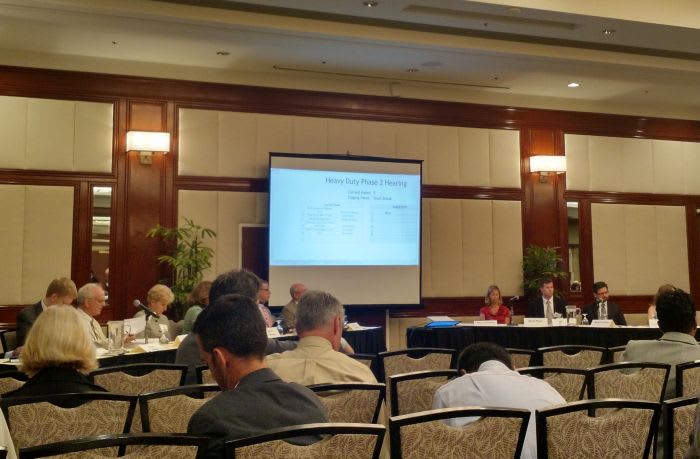
A panel of representatives from the EPA and NHTSA listened to comments and suggestions for the proposed Phase 2 GHG rules. Photo by Steven Martinez.
5 min to read

A panel of representatives from the EPA and NHTSA listened to comments and suggestions for the proposed Phase 2 GHG rules. Photo by Steven Martinez.
The U.S. Environmental Protection Agency and National Highway Traffic Safety Administration held a public hearing in Long Beach, Calif., Tuesday to listen to comments about their jointly proposed greenhouse gas emissions and fuel efficiency standards for medium- and heavy-duty trucks.
Representatives from government and environmental agencies, manufacturers, fleets and other related organizations were allowed five minutes each to make a public statement on the proposed Phase 2 GHG rules as currently outlined. A panel of top members from EPA and NHTSA listened and posed clarifying questions.
"This is the most important part of my job," said Christopher Grundler, director of the EPA's Office of Transportation and Air Quality. "We're here to listen."
While most representatives who spoke were positive about the proposed regulations, there was disagreement on particulars such as the timing of implementation, NOx standards, and incentives for business.
California Air Resources Board Chair Mary Nichols said the greenhouse gas reductions could stabilize the climate and reduce reliance on foreign oil. However, as currently written, CARB feels that the standards "missed some critical opportunities to further Phase 1."
The implementation time frame in the proposed regs as they now stand, known as Alternative 3, calls for full implementation of the standards by 2027. Nichols and other environmental and regulatory agencies were pushing for Alternative 4, which pushes the deadline up from 2027 to 2024.
Nichols also said there needs to be a mandatory NOx standard and tighter engine standards, citing a belief that manufacturers could double the current figures.
CARB's sentiments were echoed by other environmental groups and agencies, including the South Coast Air Quality Management District, the International Council on Clean Transportation, the Environmental Defense Fund and others.
"We believe the standards are necessary and feasible," said Barry Wallerstein, of the South Coast AQMD. Wallerstein added that tightening the emissions goals was the best way to "give California a chance to meet Clean Air Act standards."
However, manufacturers said the extended Alternative 3 timeline allows for realistic adoption and production cycles.
Cummins representative Brian Mormino supported the current timeline, saying it gave the best chance for manufacturers to support it. He also stressed that the rules on GHG and NOx should be standardized nationally, and that carbon-dioxide standards should be the same for all fuels, not just diesel.
Cummins also supports a separate engine standard, and Mormino cautioned against implied engine standards, saying that such rules "lacked regulatory clarity and should be explicit in a rule."
Speaking on behalf of Daimler, Navistar, Volvo and Paccar, Dan Kieffer, director of emissions compliance for Paccar, said the companies were focused on the regulations delivering benefits to customers and broader society. "Our goal is a classic win-win scenario and we are hopeful we can achieve it," he said.
The companies also opposed the shorter Alternative 4 timelines, saying that based on their own analysis, Alternative 3 targets were not clearly achievable.
"One thing we are certain of is that we could not achieve, and therefore cannot support, the pull-ahead of these standards according to the plan identified as 'Alternative 4' in the proposed rule," said Kieffer.
The manufacturers support a full-vehicle approach that takes into account other factors when evaluating engine standards, including engine size, power output, power demand and driveline characteristics. Regarding NOx standards, Kieffer said EPA should consider more than just engine-related reductions.
"Technology that reduces the engine work required to complete a mission, such as improved aerodynamics or reduced rolling resistance, inherently results in a proportionate reduction in total NOx output," said Kieffer. "This is not the case with engine efficiency improvement, where there is a well-documented trade-off between NOx reduction and engine efficiency."
Fleets such as Frito Lay and Waste Management were also represented at the hearing. Mike O'Connell of Frito-Lay said that his fleet was in support of the Phase 2 standards, but emphasized a broader approach to emissions and fuel economy improvements.
"We do not believe there is a silver bullet in improving fuel efficiency and reducing emissions," said O'Connell. He added that a two-year payback was feasible and asked for additional financial incentives which Frito-Lay believes will increase adoption and implementation.
Waste Management, which manages a North American fleet of over 18,000 trucks, is in support of Phase 2 GHG goals but said that a consistent nationwide rule was important. Waste Management has made strides to reduce emissions by using natural gas trucks and has a goal set to run 90% of its fleet on natural gas.
California Rep. Grace Napolitano said she supported the rule, but pushed for a 40% reduction in fuel use and called for more government involvement in making new technologies affordable so manufacturers can meet the standards.
Air quality standards in Southern California are among the worst in the nation, she indicated, specifically in the regions surrounding the Ports of Long Beach and Los Angeles.
A representative speaking on behalf of California state Sen. Ricardo Lara pointed to the statistically higher instances of asthma and other respiratory health issues that were common in Southern California as incentive for these emissions improvements. A statistic he cited claimed that as many as one in 11 children in his district suffered from asthma and that it was disproportionately affecting poor communities.
South Coast AQMD representative Wallerstein upped the ante by saying that faster implementation of standards could save thousands of lives. Rep. Napolitano lamented the damage excessive emissions have done to Southern California's air quality, referring to future generations saying, "What are we leaving for them?"
More Fleet Management

Nominations Open for HDT Emerging Leaders
Heavy Duty Trucking is looking for accomplished trucking fleet professionals under 40 who are making an impact and helping lead the industry forward.
Read More →
Why Private Fleets Are Taking More Freight
Private fleets are putting their own trucks on demanding customers and high-cost lanes as companies seek greater control over service, costs, and capacity.
Read More →
Sponsored•September 16, 2026
Color Match Smarter: Tools That Restore & Perform
For fleet managers and collision repair professionals keeping heavy-duty trucks on the road, getting the color right the first time isn't just about appearance — it's about efficiency, turnaround time, and bottom-line results. Discover how today's digital color tools are transforming the repair process from guesswork to precision.
Read More →


FMCSA Pauses Biennial-Update Enforcement Amid Motus Transition
Carriers whose updates were due on or after June 1 have more time, while FMCSA works to stabilize its new registration system and warns of phishing sites impersonating its new carrier registration system, Motus.
Read More →
Sponsored•September 14, 2026
2026 Blueprint for Countering Smarter Supply Chain Theft
Cargo theft is no longer just the cost of doing business. It's a multi-billion-dollar criminal enterprise exploiting vulnerabilities across your fleet, drivers, and supply chain.
Read More →
Sponsored•September 1, 2026
How Telematics Improves Visibility, Control, and Performance in Refrigerated Fleets
Explore how telematics help refrigerated fleets improve visibility, uptime, efficiency, compliance, and cargo protection across connected cold chain operations.
Read More →
What the U.S.-Canada Trade War Means for Trucking
Escalating U.S.-Canada tariffs could disrupt cross-border freight, reduce truck volumes, raise costs, and create new uncertainty for carriers on both sides of the border.
Read More →
What Are Trucking’s Top Concerns for 2026?
The American Transportation Research Institute wants to know what's worrying trucking fleet managers, drivers, and other stakeholders in its annual Industry Issues survey.
Read More →
American Trucking Associations Looks for a New Leader
ATA President and CEO Chris Spear abruptly left his job at the association on August 21, at a pivotal time for the trucking industry.
Read More →
Public Wi-Fi Cybersecurity Risks: How Truck Drivers and Fleets Can Protect Their Data
Public Wi-Fi can expose truck drivers and fleets to credential theft, malware, and other cyber threats. Here’s how to reduce the risk on the road.
Read More →