





Lower costs for compression and for building filling stations would halve the payback period for fleets.
Carbon Adsorption to Reduce CNG Costs
Two companies report they're on the brink of commercializing low-pressure dispensing and storage of compressed natural gas through carbon adsorption, which they say will keep the fuel cheaper and make filling stations a reality even for small fleets.
August 5, 2015
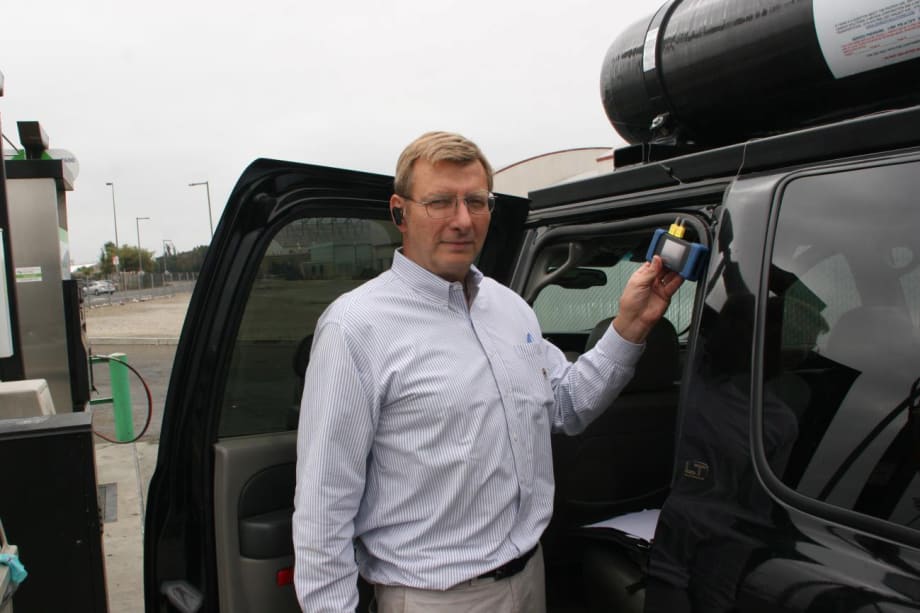
Gary Fanger, COO and team leader of Cenergy Solutions’ ANG project, installs carbon-filled tanks atop a Chevrolet Suburban used in testing. For common use, the tanks would have protective caging or be installed inside. Photo courtesy Cenergy
5 min to read
Gary Fanger, COO and team leader of Cenergy Solutions’ ANG project, installs carbon-filled tanks atop a Chevrolet Suburban used in testing. For common use, the tanks would have protective caging or be installed inside.Photo courtesy Cenergy
Low-pressure dispensing and storage of compressed natural gas through carbon adsorption will further cut the price of the low-cost fuel and make filling stations affordable for smaller fleets, according to companies now working on the technology. Both said scientific breakthroughs with activated carbon about a year ago will commercialize the science involved.
The phenomenon of adsorption causes CNG to cling to activated carbon inside storage tanks, enhancing their ability to carry the gas instead of cramming it into tanks under high pressure, as is done now, executives explained. Storage pressure that’s one-quarter to one-tenth of the usual 3,600 psi will cut the cost of compression and simplify the building of CNG fueling stations.
Adsorbed Natural Gas Products (ANGP), a group of four companies collaborating on methods and equipment, and Cenergy Solutions, which works with two partners, announced in recent days that they will market products by year’s end. Each uses a different form of activated carbon that methane gas grabs onto as it’s pumped into metal tanks.
ANGP's method
ANGP’s method uses pressure of 900 to 1,000 psi, said Bob Bonelli, co-founder and chief executive officer. This cuts 40 to 60 cents per gasoline gallon equivalent (GGE), because compressing the gas requires less energy, and a fueling station using this technology is simpler and less costly than CNG stations designed for high-pressure gas.
The chemically activated carbon is formed into porous circular blocks – “think of a big hockey puck,” Bonelli explained – about 2 inches thick and 7.5 inches in diameter. The blocks, called “monoliths,” are installed in 8-inch-diameter by 48-inch-long Type 1 aluminum tanks, each one holding 1.25 GGE, mounted on the truck.
The carbon holds gas until it’s drawn out by a military grade “microcompressor” to feed the engine. An array of tanks would be fitted to a vehicle to supply enough range for operations. The weight is about 25% more than existing tanks.
Pure CNG would be used for cars and light-duty trucks, while dual-fuel, CNG-diesel systems would be used for heavier trucks, Bonelli said. The reasonable cost of a lower-pressure fueling station puts it in reach of a small fleet (or even a private motorist who could have it installed in his garage).
A consumer-type 900-1,000-psi station might cost $1,200 vs. $5,000 for a 3,600-psi station, he said. An “industrial strength” station capable of fueling four to six light-duty trucks would cost about $5,000 instead of tens of thousands of dollars.
Lower costs for compression and for building filling stations would halve the payback period for fleets, from about four years for high-pressure CNG to two years for ANGP’s system, Bonelli said.
Cenergy's approach
Cenergy’s system uses even lower pressure – 350 to 700 psi, and it’s likely to stay much closer to 350 psi when it goes to market, said Gary Fanger, the chief operating officer. The system’s activated carbon is a “very fine, porous powder, so fine that it floats in air” if released. Inside a fuel tank, it’s compacted through a proprietary process to about one-seventh its free-state volume, greatly increasing its capacity to adsorb gas.
“It adsorbs so much methane that it becomes almost a liquid state,” he said of the gas. A 16- by 60-inch cylindrical tank holds 17.5 to 18 GGE, or about 30% more than a high-pressure CNG tank. As-filled pressure pushes gas through a regulator to fuel lines, and as pressure drops, “the tank is heated to agitate the particles to get them to cough up the methane.”
Hot engine coolant that’s circulated through lines inside the tank heat the carbon to 145 degrees. Microwaving will probably be used in production versions because it’s quicker, Fanger said. Tanks will be Type 1 steel or aluminum; composite tanks wouldn’t work well with the heating or microwaving.
The carbon powder could be installed in existing tanks or new, purpose-built ones with thinner walls. These would offset a downside: The compacted carbon powder weighs 1 pound per liter, and that 16 by 60 tank would carry about 200 liters of it. New tanks needn’t be round; they could be shaped to fit into available space in a vehicle.
Cenergy tested its ANG storage system and Pro ANG vehicle conversion system on a truck with a General Motors 8.1-liter engine for more than 10,000 miles in conditions that include heavy payloads, high altitude and cold weather, Fanger said.
“The results have been very positive, and we look forward to testing the system in two distinct and separate commercial fleets,” he added. That will start soon.
More about the companies
Cenergy was founded in 2012 to market gas cylinders and EPA-compliant natural gas conversion systems for vehicles. Its partners in the ANG project are EnerG2, which developed the activated carbon powder under a Department of Energy grant, and NW Natural, a West Coast gas distribution company that’s promoting wider use of gas as a motor fuel.
“The price advantage and environmental benefits of natural gas as a transportation fuel are widely known, and adsorbed natural gas simply makes the physical storage and performance of the fuel delivery work better on board the vehicle,” said Chris Galati, an engineer and business developer with NW Natural.
The Adsorbed Natural Gas Products coalition includes MWV Specialty Chemicals, which developed the activated carbon monoliths, which it calls Nuchar FuelSorb; Worthington Industries, which builds certified pressure storage tanks; Aspen Compressor, producer of the microcompressor that acts as a fuel pump; and Midwest Energy Solutions, which builds and sells natural gas fueling stations.
Both organizations plan to show off their low-pressure, carbon adsorption systems at an NGVehicles expo in Denver in mid-September.
More Fuel Smarts

New California Law Could Shed Light on Electric Truck Prices
Why do battery-electric Class 8 trucks remain so expensive? A California bill signed by Gov. Gavin Newsom would give fleets and state agencies more visibility into what manufacturers charge.
Read More →
How Volvo Updated Its D13 for EPA 2027 [Watch]
Volvo’s updated D13 promises lower emissions without sacrificing performance or fuel economy. Take a closer look at what changed inside the engine in this HDT Spotlight video.
Read More →
Diesel Price Spike Shortens Payback for Natural Gas Trucks, Report Says
Energy Vision estimates fleets could recover the higher purchase price of an RNG-fueled Class 8 tractor in 1.3 to 2.8 years under current fuel-price scenarios.
Read More →

Calstart Becomes Catalyst Mobility, Reflecting Broader Focus
Calstart is now Catalyst Mobility, reflecting the nonprofit’s growing national role in clean transportation, including zero-emission trucks, infrastructure and incentive programs.
Read More →
Record Diesel Prices Squeeze Trucking Fleets
Average U.S. diesel prices have climbed to nearly $6 a gallon, surpassing the 2022 record as tight refinery capacity and Middle East disruptions keep fuel costs elevated.
Read More →
Sponsored•September 9, 2026
How Fuel Delivery Shapes Engine Performance
Fuel delivery depends on more than what happens at the injector. For fleet, maintenance and technical professionals, looking at the full path from pump to injector can provide useful context for understanding engine performance.
Read More →
East Coast Port Launches $45M Electric Truck Push
The Port Authority of New York and New Jersey announced millions in incentives for zero-emission drayage trucks, yard tractors, and new charging hubs near the port.
Read More →
Detroit Opens Orders for EPA 2027 Engines
Detroit isn’t starting from scratch to meet EPA 2027 diesel emissions standards. Its Gen 6 DD13 and DD15 engines keep much of today’s platform while updating the fuel and aftertreatment systems.
Read More →
Zero-Emission Truck Corridor Planned for West Coast
California, Oregon, Washington, British Columbia and Baja California are coordinating plans for truck charging and hydrogen fueling from Canada to Mexico.
Read More →
A Closer Look at Kenworth’s Electric T880E Vocational Truck [Video]
Learn more about Kenworth's T880E battery-electric vocational truck at the Paccar Technical Center, including its range, applications, upfitting considerations, and PTO options, in this HDT Spotlight video.
Read More →