




Diesel Prices Do About-Face
The average price of on-highway diesel moved a little lower this week, following six consecutive weekly increases, according to the U.S. Energy Department.

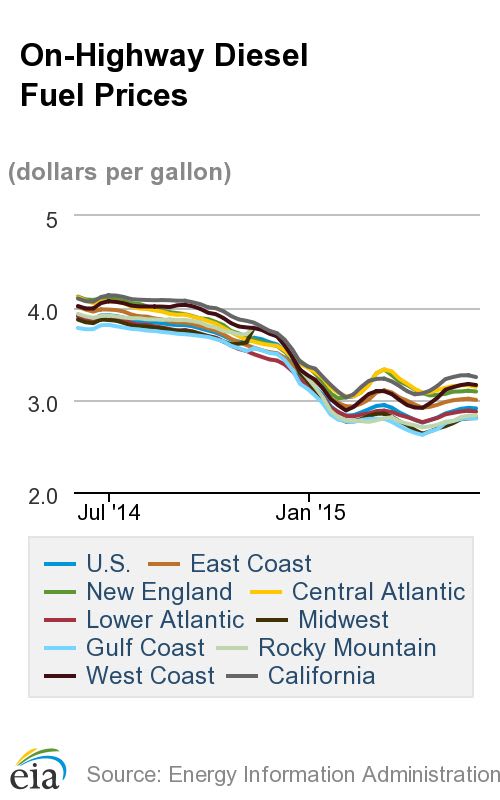
The average price of on-highway diesel moved a little lower this week, following six consecutive weekly increases, according to the U.S. Energy Department.
The 0.5 cent decline puts it at $2.909 per gallon. Compared to this week a year ago the price is $1.009 less.
The drop follows a string of increases that took it from $2.754 on April 13 to $2.914 on May 25, which was the highest price in a little more than two months.
In the different parts of the country, diesel increased over the past week 0.4 cent in the Midwest and 0.5 cent in the Rocky Mountain regions for prices of $2.804 and $2.835, respectively, while it fell in all other sections.
The declines ranged from 0.4 cent in the Gulf Coast region for an average of $2.799, also the least expensive regional price in the country, to 1.9 cents in the Central Atlantic states for an average of $3.143, the second most expensive regional price.
The highest region price is along the West Coast states at $3.163, down 1.1 cent from last week.
Meantime, the average price of regular grade gasoline moved higher for the seventh straight week and hitting its highest level since last November. Over the past seven weeks it has increased a little more than 37 cents.
It increased 0.6 cent to $2.78 per gallon but is 91 cents less than the same time a year earlier.
Prices increased in all regions except for 0.3 cent in Gulf Coast, the least expensive part of the country at $2.483 and 4.3 cents along the West Coast, the most expensive regional price at $3.444
This happened as oil moved little in New York trading on Monday, settling down just 10 cents at $60.20 per barrel and only 15 cents higher than last Tuesday’s opening market price.
The black gold has recovered about 50% of its price since falling to multi-year lows earlier this year, but is still down when compared to more than $100 per barrel prices last year. Monday’s decline was due to the U.S. dollar gaining in value against foreign currencies, following generally positive economic news.
The oil market is now looking ahead toward the end of the week when members of the OPEC oil cartel are set to met in Vienna in which they are expected to keep crude production levels unchanged as U.S. output also remains high.
More Fuel Smarts

How GP Transco Builds Fuel Savings a Fraction at a Time
Aerodynamic specs, solar panels, and driver incentives help GP Transco turn small efficiency gains into savings it can reinvest in its people.
Read More →
Trucking’s Diesel Squeeze Isn’t Letting Up
With diesel topping $6 a gallon nationally, ATA's Bob Costello explains why fleets should prepare for continued pressure at the pump.
Read More →
FlowBelow Redesigns Trailer AeroSlider to Cut Fuel Use
The lighter trailer aerodynamic system installs in less than 45 minutes, according to the company, with potential payback in under a year depending on fuel prices and trailer mileage.
Read More →
Why Diesel Price Relief Efforts May Fall Short
Diesel prices have eased from September’s record high, but doubts about additional Russian supply and limits on dyed-diesel tax relief mean trucking fleets still face expensive fuel. And prices could go higher.
Read More →
Why Small Fuel Savings Matter in Trucking
Can better fuel economy help pay for driver raises? In this podcast, GP Transco explains how small efficiency gains create room to reinvest in its people.
Read More →
How GP Transco Cuts Trucking Fuel Costs, a Tenth of a Gallon at a Time
What’s another tenth of a mile per gallon worth? GP Transco shares how equipment upgrades and driver coaching turn small gains into meaningful fuel savings.
Read More →
Electric Yard Tractors Move Beyond Pilots
Operating-cost savings have overtaken sustainability goals as the leading reason surveyed fleets are adopting battery-electric terminal tractors, according to new NACFE research.
Read More →
Geotab Links Fleet Card to Vehicle Data
The new card combines fuel discounts with telematics-based purchase controls. Geotab’s analysis also points to potential savings from choosing lower-priced fuel stops.
Read More →
Fleet Economics Shape Electric Truck Outlook
ACT Research expects costs, charging infrastructure, and technology improvements to drive zero-emission commercial vehicle adoption as federal regulations and incentives retreat.
Read More →
Wex Adds Cardless Fuel Payments for Over-the-Road Customers
A new fuel card feature for Wex customers offers convenience and security.
Read More →