




Study: Biggest Downside to Natural Gas Trucks is Upstream Methane
Upstream methane is seen as the biggest downside to natural gas trucks, according to a new policy-analysis paper published in the journal Environmental Science & Technology.

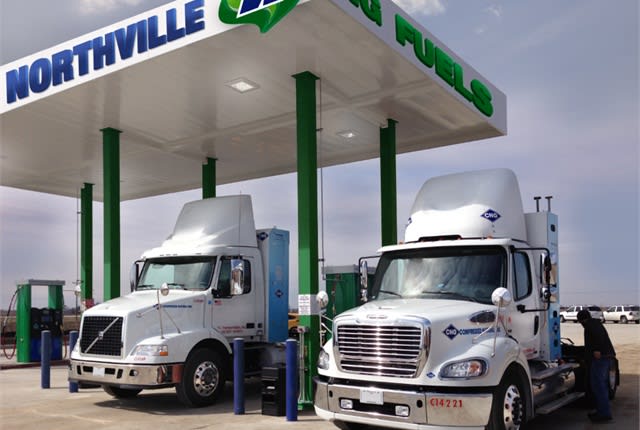
As EDF sees it, even though trucks fueled by natural gas may be regarded as running green, methane is released to the atmosphere “all along the value chain."
Heavy-duty trucks fueled by natural gas will deliver on their “widely promised climate benefits only if widespread emissions of heat-trapping methane across the natural gas value chain are reduced,” says a new policy-analysis paper published in the American Chemical Society journal Environmental Science & Technology.
Co-authored by researchers with the Environmental Defense Fund and Columbia University’s Lenfest Center for Renewable Energy, the study’s findings present “implications for truck and engine manufacturers, shippers, fleet operators and policy makers, many of whom look to the operational advantage in carbon dioxide emissions to justify the higher cost and reduced fuel efficiency of a natural gas truck,” according to EDF.
During a Tuesday media briefing hosted by EDF on the paper’s results, Jonathan Camuzeaux, a study author and Senior Economic Analyst at EDF, said the challenge to powering trucks with natural gas is that its main ingredient — methane — has 84 times the warming power of carbon dioxide over a 20-year timeframe.
As EDF sees it, then, the issue is that even though trucks fueled by natural gas may be regarded as running green, methane is released to the atmosphere “all along the value chain”-- during each upstream step, from production wells right to filling vehicle fuel tanks.
“Natural gas trucks have the potential to reduce overall climate impacts compared to diesel, but only if we clean up the highly potent greenhouse gas emissions from the systems that produce and deliver the fuel,” said Camuzeaux. “Otherwise, the net warming effect is actually a negative one for 50 to 90 years after the fuel is burned.”
Put another way, a conversion from diesel to natural-gas fueling “could lead to greater warming for the next 50 to 90 years before providing [any] climate benefit,” per EDF.
The environmental advocacy group advised that some 6.3 million metric tons of methane escaped from the natural gas value chain just n 2013, according to the Environmental Protection Agency’s latest Greenhouse Gas Inventory Report. EDF said that level of release produces the same negative 20-year climate impact as about 111 million cars or 140 coal-fired plants and that “wasted gas” is worth more than $1.42 billion.
Yet EDF is optimistic that this sustainability wrinkle in the business case for natural-gas trucks can be ironed out. The study examines several types of engine technologies and both liquefied and compressed natural gas fuels.
The group said the paper’s authors “found there are indeed pathways for heavy-duty natural gas vehicles to achieve climate benefits, provided methane emissions across the value chain are reduced both upstream and at the vehicle level. Otherwise, a conversion from diesel could lead to greater warming for the next 50 to 90 years before providing [any] climate benefit.”
For one thing, further improvements in fuel efficiency could help ensure natural-gas trucks are truly “climate friendly.” EDF stated that current natural-gas truck engines are typically 5-15% less efficient than diesel engines, but “if that efficiency gap can be closed, natural gas trucks will fare that much better compared to diesel.”
For another, according to EDF, more can be done upstream to cut methane emissions from natural gas fuel production and distribution.
The group noted that a study by the technology consulting firm ICF International found that the oil and gas industry could reduce methane emissions 40 percent or more for about one cent per thousand cubic feet of natural gas produced– about one-third of one percent at today’s prices– by replacing emissions-prone valves and properly maintaining pumps and other devices.
“The opportunity is there to achieve a climate benefit, provided we address the powerful emissions both from the fuel supply system and the vehicle,” Camuzeaux said.
Natural gas vehicles currently use just 0.1% of the natural gas consumed in the U.S., EDF noted, but that number could rise “significantly” as demand rise for heavy-duty natural gas vehicles.
“Technology moves fast,” said Jason Mathers, a commercial transportation expert who works with shippers and truck makers within EDF’s Corporate Partnerships Program. “The time to get ahead of this question is now, before this industry hits a major growth spurt,” he continued. “Reducing methane leaks upstream of the vehicles themselves will determine whether a shift in fuels will have a cost or a benefit for the climate.”
EDF contends that changes in government policy already in play could better the climate prospects of natural gas trucks, including upcoming federal fuel efficiency and greenhouse gas standards for heavy trucks and recently announced federal regulations on upstream methane emissions.
“Policymakers who want to address climate change should use caution before promoting a switch to natural gas in the trucking sector until we are more certain about the magnitude of methane loss and have acted sufficiently to reduce emissions and improve natural gas engine efficiency,” Mathers remarked.
“The opportunity is there to achieve a climate benefit, provided we address the powerful emissions both from the fuel supply system and the vehicle,” Camuzeaux added.
Natgas Advocates, Diesel Engine Group Respond
The Natural Gas Vehicles for America advocacy group questioned why this particular report was issued by EDF.
“This study clearly demonstrates that there is a role for natural gas in addressing climate change,” said NGVAmerica president Matthew Godlewski in a statement. “We welcome all credible insight into paths for improving emissions, yet it’s confusing that the Environmental Defense Fund has chosen to conduct and release another study, outside of the cooperative work already underway."
Godlewski said many NGVAmerica members have worked in close collaboration with the EDF and its academic partners on a soon-to-be published "Pump to Wheels Methane Leakage" study. “This report is based on extensive research and provides a critical baseline to end speculation about actual in-use methane leaks from natural gas stations and vehicles.”
Godlewski added that “renewable natural gas and near-zero-emission engines are two examples that will play significant roles in future NGV transportation solutions. Natural gas is the cleanest, most economical, and abundant domestic transportation fuel, delivering immediate benefits on the road to sustainable mobility.”
The Diesel Technology Forum advocacy group also weighed in on the study released by EDF.
“This new report puts into perspective the complexity involved in evaluating alternative fuels in the transportation sector, and the importance in understanding the full picture before rushing to judgment about the merits of one technology over another,” said Allen Schaeffer, DTF executive director.
He said that “as the authors suggest, this report does raise serious questions about whether large-scale moves to natural gas as a transportation fuel is truly a climate-positive consideration, or a move that could make things worse.
“It is refreshing that this EDF and Columbia University study compares new clean diesel trucks with new natural gas trucks,” he continued. “Some have made inaccurate environmental and efficiency claims by comparing new technology alternative-fueled vehicles to older diesel trucks. This new study compares ‘apples to apples’ to more accurately evaluate the two technologies.”
More Fuel Smarts

Cummins Adjusts 2027 Engine Rollout After EPA Proposal
The engine maker will gradually introduce its new Model Year 2027 diesel engines while continuing to offer current models during the transition, citing the EPA's proposed emissions rule changes.
Read More →
EPA Proposal Could Ease 2027 Truck Costs and Buying Uncertainty
The proposal doesn't change the tougher NOx standard, but it would revise key implementation requirements that manufacturers say have driven up costs and complicated fleet purchasing decisions.
Read More →
Cummins, Paccar Ease DEF Derates After EPA Guidance
Updated diesel engine software gives truck operators more time to address emissions-system issues while staying compliant with EPA emissions standards.
Read More →
Maintenance in the Messy Middle Part 3: Biodiesel
Biodiesel can reduce emissions, improve fuel-system lubricity and use existing diesel infrastructure. But NACFE’s Messy Middle maintenance report says fleets must actively manage storage, cold-weather operation, filters and oil drain intervals to avoid problems.
Read More →
Enhance Fleet Performance with High-Efficiency Auxiliary Power Units
Drive sustainable cost savings while increasing driver comfort during short- and long-haul logistics operations.
Read More →
Maintenance in the ‘Messy Middle’ Part 2: Renewable Diesel Fuel
NACFE's latest Messy Middle Powertrain Service & Maintenance report says renewable diesel gives fleets an opportunity to reduce carbon emissions without changing trucks, fueling infrastructure or maintenance practices. But technicians still need to understand several important operational differences.
Read More →
The Diesel Engine Enters NACFE’s ‘Messy Middle’
NACFE’s new Messy Middle Powertrain Service & Maintenance report says keeping modern diesel engines running now depends as much on software, diagnostics and data as traditional mechanical service.
Read More →
DTNA Software Update Gives Truckers More Time Before DEF Derates Take Effect
The changes reflect EPA guidance aimed at reducing downtime caused by emissions-system faults while maintaining compliance requirements.
Read More →
New Agentic Predictive Maintenance Report Demonstrates How Degraded Aftertreatment Systems Waste Fuel
Questar analyzed a large mixed-class fleet and discovered it was wasting as much as $30 in fuel per vehicle, per day, because of mechanically degraded aftertreatment systems.
Read More →
New York City's Microhub Project is Delivering Results
Trucking, last-mile delivery companies, and environmental advocates like what they are seeing so far with New York's microhub program.
Read More →