




DOE: Diesel to Average $2.85 in 2015
In the wake of diesel prices falling from an average of more than $4 per gallon nearly a year ago the U.S. Energy Department's Energy Information Administration has lowered its price forecast from last month’s prediction.

In the wake of diesel prices falling from an average of more than $4 per gallon nearly a year ago the U.S. Energy Department's Energy Information Administration has lowered its price forecast from last month’s prediction.
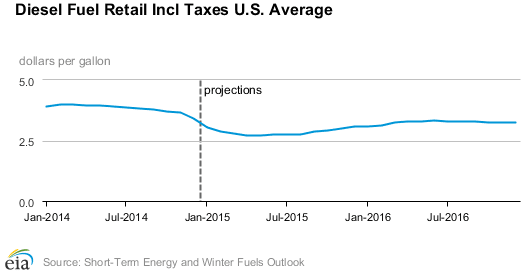
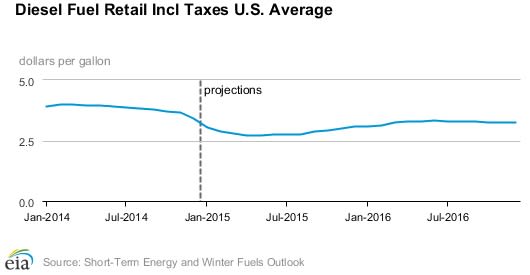
The new Short Term Energy Outlook calls for trucking’s main fuel to average $2.85 per gallon in 2015, 22 cents less that what it said it was expecting a month ago. This compares to an average diesel price of $3.83 last year. However, its first look into 2016 forecasts diesel to rebound at $3.25 per gallon.
The current weekly average for diesel is just over $3.05 per gallon per gallon, its lowest price since October 2010.
In the first quarter of 2015, diesel is expected to average $2.90, falling even more into the second quarter, averaging $2.71, before turning around in the third quarter with an average of $2.79. It should head even higher into the final quarter with an average of $2.99.
DOE projects 2016 prices to average $3.15 in the first quarter, peaking in the second or third quarter at around $3.30, before declining slightly in the final quarter at an average of $3.25.
Regular grade gasoline, which averaged $3.36 in 2014, is forecast to average $2.33 this year, 27 cents less than the outlook a month earlier, and $2.72 in 2016. The currently weekly average is nearly $2.14, its lowest price since May 2009.
Not surprisingly, the expectations are due to the price of oil, which is down from just over $107 in June to less than $50 per barrel this week.
EIA forecasts that Brent crude oil prices will average $58 per barrel in 2015 and $75 per barrel in 2016, with annual West Texas Intermediate prices expected to average $55 per barrel this year, $8 less than last month’s outlook, and $71 in 2016.
It warns because of the current values of futures and options contracts there is very high uncertainty in the price outlook.
Part of the reason for expected lower crude prices is that U.S. oil production is projected to increase. Total U.S. crude oil production averaged an estimated 9.2 million barrels per day in December, according to EIA. Forecast total crude oil production should 9.3 million barrel per day in 2015, followed by 9.5 million barrels per day in 2016, which would be the second-highest annual average level of production in U.S. history. The highest was 9.6 million barrels per day in 1970. This is expected to be offset by cuts in crude oil production overseas.
The forecast for oil is above a new report from the investment firm Goldman Sachs, predicting crude could go as low as $40 per barrel in the first half of this year, with Brent and WTI crude averaging around $50 and $47, respectively in 2015. That’s way down from an earlier forecast of nearly $84 for Brent and almost $74 for WTI. For 2016, it sees Brent at $70 and WTI at $65, down from earlier projections of $90 and $80, respectively.
It's also worth noting oil investor and Saudi Prince Alwaleed bin Tala this week told USA Today he believes the days of $100 a barrel oil are gone forever, due to less demand and an oversupply of crude. His remarks are similar to those last month by Ali al-Naimi, the Saudi oil minister, who said $100 plus crude may also be a thing of the past.
More Fuel Smarts

Trucking’s Diesel Squeeze Isn’t Letting Up
With diesel topping $6 a gallon nationally, ATA's Bob Costello explains why fleets should prepare for continued pressure at the pump.
Read More →
FlowBelow Redesigns Trailer AeroSlider to Cut Fuel Use
The lighter trailer aerodynamic system installs in less than 45 minutes, according to the company, with potential payback in under a year depending on fuel prices and trailer mileage.
Read More →
Why Diesel Price Relief Efforts May Fall Short
Diesel prices have eased from September’s record high, but doubts about additional Russian supply and limits on dyed-diesel tax relief mean trucking fleets still face expensive fuel. And prices could go higher.
Read More →
Why Small Fuel Savings Matter in Trucking
Can better fuel economy help pay for driver raises? In this podcast, GP Transco explains how small efficiency gains create room to reinvest in its people.
Read More →
How GP Transco Cuts Trucking Fuel Costs, a Tenth of a Gallon at a Time
What’s another tenth of a mile per gallon worth? GP Transco shares how equipment upgrades and driver coaching turn small gains into meaningful fuel savings.
Read More →
Electric Yard Tractors Move Beyond Pilots
Operating-cost savings have overtaken sustainability goals as the leading reason surveyed fleets are adopting battery-electric terminal tractors, according to new NACFE research.
Read More →
Geotab Links Fleet Card to Vehicle Data
The new card combines fuel discounts with telematics-based purchase controls. Geotab’s analysis also points to potential savings from choosing lower-priced fuel stops.
Read More →
Fleet Economics Shape Electric Truck Outlook
ACT Research expects costs, charging infrastructure, and technology improvements to drive zero-emission commercial vehicle adoption as federal regulations and incentives retreat.
Read More →
Wex Adds Cardless Fuel Payments for Over-the-Road Customers
A new fuel card feature for Wex customers offers convenience and security.
Read More →
New California Law Could Shed Light on Electric Truck Prices
Why do battery-electric Class 8 trucks remain so expensive? A California bill signed by Gov. Gavin Newsom would give fleets and state agencies more visibility into what manufacturers charge.
Read More →