




Report: New Truck Technologies Can Dramatically Cut Fuel Bills
Fleets operating 41,000 tractors and 130,000 trailers achieved fuel savings of $7,200 per year per truck by adopting a variety of new technologies, according to a new study released Wednesday by the North American Council for Freight Efficiency.
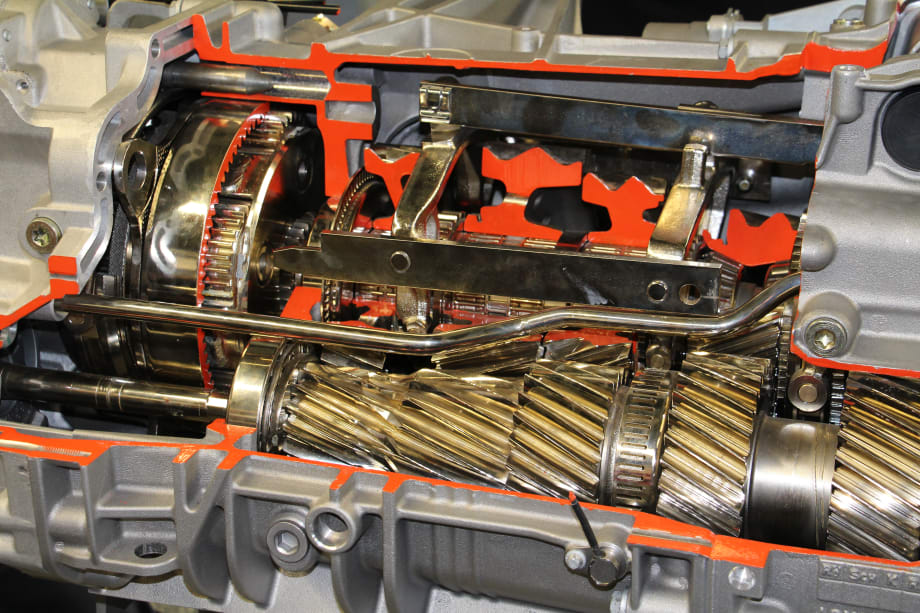
Inside of an automated transmission, one of several technolgies helping fleets reduce their fuel bills, according to NACFE. Photo: Evan Lockridge
Inside of an automated transmission, one of several technolgies helping fleets reduce their fuel bills, according to NACFE.Photo: Evan Lockridge
Fleets operating 41,000 tractors and 130,000 trailers achieved fuel savings of $7,200 per year per truck by adopting a variety of new technologies, according to a new study released Wednesday by the North American Council for Freight Efficiency.
Since 2011 this group of fleets, manufacturers, government and nongovernment organizations has conducted its Annual Fuel Efficiency Benchmark Study, a report on 10 of the largest most innovative fleets in terms of using products to improve fuel efficiency.
The studied fleets, which represent 2.5% of all the trucks on the road, include regional and long haul carriers who haul dry goods and refrigerated cargo.
The new study revealed that the average purchased adoption rate of fuel-saving technologies has increased from 31% to 50% since 2003. As a result, these fleets are achieving fuel economy of 6.77 mpg on average, an 8% increase since 2011.
The study also looked at 66 fuel efficiency technologies in six categories: idle reduction, chassis, practices, tires/wheels, tractor aerodynamics and trailer aerodynamics. Fleets that participated in the study shared their implementation experiences and best practices for using the various technologies. The study offers insights for other fleets considering adding these products or practices in the future, said NACFE.
According to NACFE, fuel saving technologies and practices with high adoption rates include: full height roof air fairings, minimizing fifth wheel height, synthetic transmission oil, limiting speed and training drivers for fuel economy.
Technologies that are being used frequently by fleets, according to the study, include:
Tractor chassis skirts – partial; 40%, up from 27% in 2012
Fixed 5th wheel with minimum gap; 51%, up from 38% in 2012
Specified weight reduction on tractors; 54%, up from 44% in 2012
Specified weight reduction on trailers; 60%, up from 50% in 2012
Spec’ing dead axles; 14% up from 10%, in 2012
Move to automated transmissions; 20%, up from 0% in 2012
“The study is extremely valuable because it is based on technologies that are currently available and being used by fleets in their operations today. Real-world data shows that fleets are increasing their adoption rates of these technologies and seeing measurable improvements in fuel economy,” said Mike Roeth, NACFE executive director.
He said these technologies present an enormous opportunity for improved freight efficiency since there are about 1.5 million tractor-trailers on the road in North America, consuming 26 billion gallons of diesel fuel. For every 1% reduction in fuel use, 260 million gallons of fuel, or about $1 billion, per year are saved, according to Roeth.
“While all these technologies have costs associated with them, the fleets we studied saw a payback in three years,” Roeth. “We anticipate this payback will improve going forward as more fleets adopt these technologies. This should bring economies of scale to producing them and lower the initial purchase price.”
The full report is available on the NACFE website.
More Fuel Smarts

How Volvo Updated Its D13 for EPA 2027 [Watch]
Volvo’s updated D13 promises lower emissions without sacrificing performance or fuel economy. Take a closer look at what changed inside the engine in this HDT Spotlight video.
Read More →
Diesel Price Spike Shortens Payback for Natural Gas Trucks, Report Says
Energy Vision estimates fleets could recover the higher purchase price of an RNG-fueled Class 8 tractor in 1.3 to 2.8 years under current fuel-price scenarios.
Read More →
Calstart Becomes Catalyst Mobility, Reflecting Broader Focus
Calstart is now Catalyst Mobility, reflecting the nonprofit’s growing national role in clean transportation, including zero-emission trucks, infrastructure and incentive programs.
Read More →

Record Diesel Prices Squeeze Trucking Fleets
Average U.S. diesel prices have climbed to nearly $6 a gallon, surpassing the 2022 record as tight refinery capacity and Middle East disruptions keep fuel costs elevated.
Read More →
How Fuel Delivery Shapes Engine Performance
Fuel delivery depends on more than what happens at the injector. For fleet, maintenance and technical professionals, looking at the full path from pump to injector can provide useful context for understanding engine performance.
Read More →
East Coast Port Launches $45M Electric Truck Push
The Port Authority of New York and New Jersey announced millions in incentives for zero-emission drayage trucks, yard tractors, and new charging hubs near the port.
Read More →
California Bill Could Shed Light on Electric Truck Prices
Why do battery-electric Class 8 trucks remain so expensive? A California bill headed to Gov. Gavin Newsom would give fleets and state agencies more visibility into what manufacturers charge.
Read More →
Detroit Opens Orders for EPA 2027 Engines
Detroit isn’t starting from scratch to meet EPA 2027 diesel emissions standards. Its Gen 6 DD13 and DD15 engines keep much of today’s platform while updating the fuel and aftertreatment systems.
Read More →
Zero-Emission Truck Corridor Planned for West Coast
California, Oregon, Washington, British Columbia and Baja California are coordinating plans for truck charging and hydrogen fueling from Canada to Mexico.
Read More →
A Closer Look at Kenworth’s Electric T880E Vocational Truck [Video]
Learn more about Kenworth's T880E battery-electric vocational truck at the Paccar Technical Center, including its range, applications, upfitting considerations, and PTO options, in this HDT Spotlight video.
Read More →