




Truck Electrification System to be Tested at Ports of Los Angeles, Long Beach
The South Coast Air Quality Management District has selected a company to install a catenary system, essentially overhead electrical lines, which supplies trucks with electric power, similar to how modern day trolleys or streetcars are powered on many city streets, while still offering the same flexibility as diesel trucks.
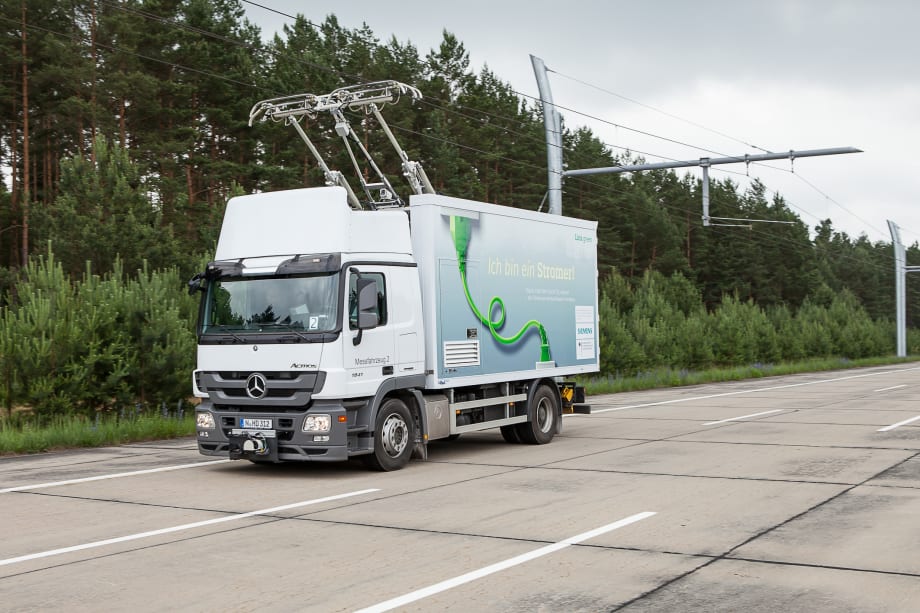
Siemens already is testing an e-highway system in Europe. Photo: Siemens
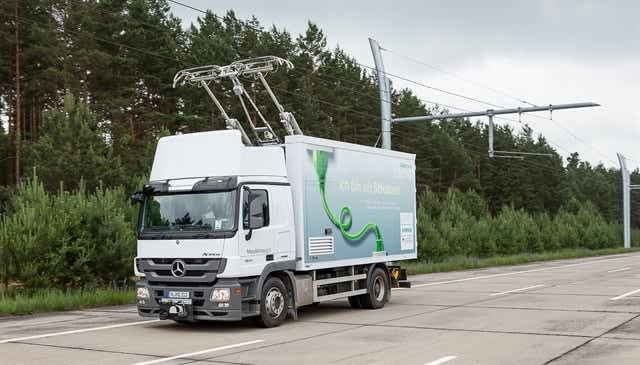
Siemens already is testing an e-highway system in Europe. Photo: Siemens
A project testing a new way to power trucks with electricity is moving forward along selected highway lanes near the Ports of Los Angeles and Long Beach.
The South Coast Air Quality Management District, which is the air pollution control agency for all of Orange County and the urban portions of Los Angeles, Riverside and San Bernardino counties, has selected a company to install a catenary system. This is essentially overhead electrical lines that supply trucks with electric power, similar to how modern day trolleys or streetcars are powered on many city streets.
The two-way, 1-mile mile system will be installed by Siemens and will be demonstrated with different battery-electric and hybrid trucks. The expected result is lower fossil fuel consumption, substantially reduced emissions, and lower operating costs, according to a Siemens release.
Siemens and the Volvo Group, through its Mack Trucks, are developing a demonstration vehicle for the project. Siemens also is supplying current collectors, the technology that allows trucks to connect and disconnect from the catenary system at any speed, to local California truck integrators whose vehicles will also be part of the demonstration.
With the use of a current collector, the trucks can connect and disconnect from the catenary system at any speed for dynamic power supply directly to the electric engine and for on-board storage. To ensure the same flexibility as conventional trucks, the e-highway vehicles use an electric drive system, which can be powered either by diesel, compressed natural gas, battery or other on-board energy source, when driving outside of the catenary lines.
“As the first and second busiest container ports in the U.S., Long Beach and Los Angeles can benefit tremendously from the e-highway system, significantly reducing emissions from commercial trucks that normally contribute to much of the air pollution in this region,” said Matthias Schlelein, president of Siemens Mobility and Logistics division in the U.S.
According to Schlelein, the economic benefit of the e-highway system is compelling for cities like L.A., where many trucks travel a concentrated and relatively short distance, but pollution is high.
The catenary infrastructure will be installed on the northbound and southbound sections of Alameda Street, where it intersects with Sepulveda Boulevard in Carson. Up to four trucks will be running in the demonstration, making multiple drives per day.
”This project will help us evaluate the feasibility of a zero-emission cargo movement system using overhead catenaries,” said Barry Wallerstein, SCAQMD’s executive officer. “Southern California’s air pollution is so severe that it needs, among other strategies, zero- and near-zero emission goods movement technologies to achieve clean air standards.”
The management district earlier commissioned a report by an independent consultancy that investigated how air quality can be improved, despite increases in drayage traffic between the ports and inland logistic hubs. It concluded that catenary hybrid vehicles “can simultaneously address emissions and fuel economy issues while providing operational flexibility at a similar or lower cost of ownership as other zero-emission technologies."
The demonstration project serves the purpose of evaluating the technology, together with the truck manufacturing industry. It is the intention of this demonstration to generate a knowledge base for a potential future extension of the system to commercial applications locally and regionally, according to Siemens.
The project installation will begin immediately with infrastructure commissioned and first truck integrated in order to start the one-year demonstration in July 2015.
Siemens has been working with European truck makers to test a similar e-highway, detailed in the video below.
More Fuel Smarts

Diesel Price Spike Shortens Payback for Natural Gas Trucks, Report Says
Energy Vision estimates fleets could recover the higher purchase price of an RNG-fueled Class 8 tractor in 1.3 to 2.8 years under current fuel-price scenarios.
Read More →
Calstart Becomes Catalyst Mobility, Reflecting Broader Focus
Calstart is now Catalyst Mobility, reflecting the nonprofit’s growing national role in clean transportation, including zero-emission trucks, infrastructure and incentive programs.
Read More →
Record Diesel Prices Squeeze Trucking Fleets
Average U.S. diesel prices have climbed to nearly $6 a gallon, surpassing the 2022 record as tight refinery capacity and Middle East disruptions keep fuel costs elevated.
Read More →

How Fuel Delivery Shapes Engine Performance
Fuel delivery depends on more than what happens at the injector. For fleet, maintenance and technical professionals, looking at the full path from pump to injector can provide useful context for understanding engine performance.
Read More →
East Coast Port Launches $45M Electric Truck Push
The Port Authority of New York and New Jersey announced millions in incentives for zero-emission drayage trucks, yard tractors, and new charging hubs near the port.
Read More →
California Bill Could Shed Light on Electric Truck Prices
Why do battery-electric Class 8 trucks remain so expensive? A California bill headed to Gov. Gavin Newsom would give fleets and state agencies more visibility into what manufacturers charge.
Read More →
Detroit Opens Orders for EPA 2027 Engines
Detroit isn’t starting from scratch to meet EPA 2027 diesel emissions standards. Its Gen 6 DD13 and DD15 engines keep much of today’s platform while updating the fuel and aftertreatment systems.
Read More →
Zero-Emission Truck Corridor Planned for West Coast
California, Oregon, Washington, British Columbia and Baja California are coordinating plans for truck charging and hydrogen fueling from Canada to Mexico.
Read More →
A Closer Look at Kenworth’s Electric T880E Vocational Truck [Video]
Learn more about Kenworth's T880E battery-electric vocational truck at the Paccar Technical Center, including its range, applications, upfitting considerations, and PTO options, in this HDT Spotlight video.
Read More →
Kenworth T880E Brings EV Power to Vocational Trucks
A closer look at the Kenworth T880E’s range, charging, powertrain and upfit options — and where fleets are showing the most interest.
Read More →