




Demonstration SuperTruck Hits 10.7 MPG Mark
Cummins and Peterbilt announced Tuesday their latest version of their SuperTruck demonstration tractor-trailer achieved 10.7 mpg last month under real-world driving conditions.
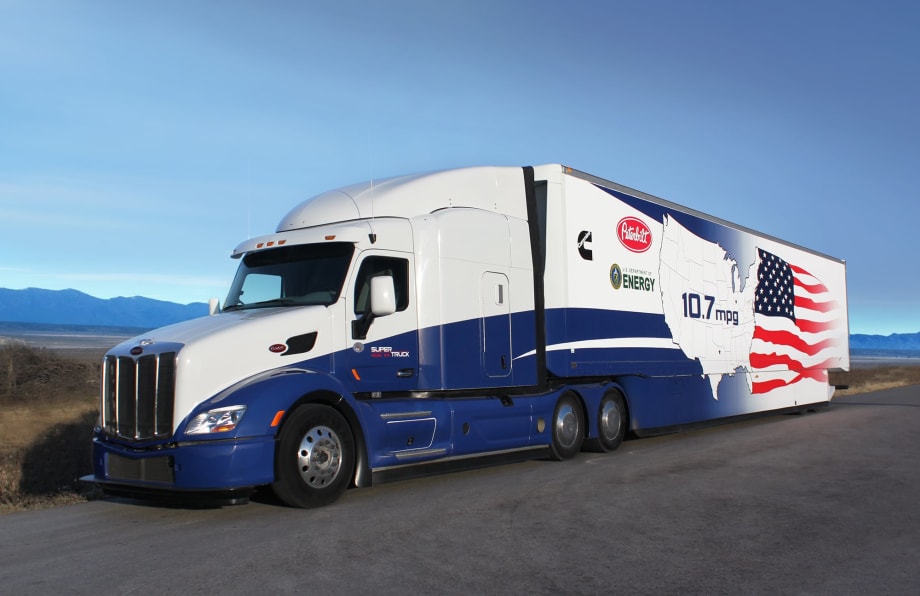
Cummins and Peterbilt announced Tuesday their latest version of their SuperTruck demonstration tractor-trailer achieved 10.7 mpg last month under real-world driving conditions.
It averaged a 75% increase in fuel economy, a 43% reduction in greenhouse gas emissions and an 86% gain in freight efficiency in 24-hour, head-to-head testing against a 2009 baseline truck, according to a release. This surpasses the program goal of a 68% increase in freight-efficiency, a trucking metric based on payload weight and fuel efficiency expressed in ton-miles per gallon.
The Peterbilt Model 579, powered by a Cummins ISX15 engine, achieved the latest results last month between Denton, Texas, and Vernon, Texas. The 312-mile route was the same one used two years ago, when the first version of the Cummins-Peterbilt SuperTruck averaged just under 10 mpg.
The testing in both instances was conducted on a round-trip basis, to negate any wind advantage that might have been gained by traveling one way. Each tractor-trailer had a combined gross weight of 65,000 lbs. running at 64 mph. A longer, 500-mile route between Denton and Memphis, Texas, was also used to demonstrate the vehicle's fuel-efficiency improvement over a 24-hour test cycle.
The Cummins-Peterbilt SuperTruck was on display Tuesday for President Barack Obama's announcement of firm deadlines for the next generation of national fuel-efficiency and GHG emissions standards for heavy-duty commercial vehicles.
The goal of the SuperTruck program, initiated by the U.S. Department of Energy, is to improve long-haul Class 8 vehicle freight efficiency. It focuses on advanced and highly efficient engine systems and vehicle technologies that meet prevailing emissions and Class 8 tractor-trailer vehicle safety and regulatory requirements.
In addition to the benefits of reduced fuel consumption and petroleum usage, the improvements in engine system efficiency will deliver a significant reduction in GHG emissions, according to both companies. The project objectives have included development and demonstration of a highly efficient and clean diesel engine, an advanced waste heat recovery system, an aerodynamic tractor and trailer combination and a lithium ion battery-auxiliary power unit, to reduce engine idling.
The Cummins-Peterbilt SuperTruck engine converts exhaust heat into power delivered to the crankshaft, and has electronic control software that uses route information to optimize fuel use. The SuperTruck also includes chassis refinements, improvements in the aerodynamics and other significant advances in the engine. Lighter weighing components throughout the tractor-trailer also enable increased freight efficiency.
Eaton, also part of the Cummins-Peterbilt SuperTruck project team, is developing a next-generation automated transmission that improves fuel efficiency in heavy-duty trucks. Eaton's contribution includes the design, development and prototyping of an advanced transmission that facilitates reduced engine-operating speeds. Cummins and Eaton jointly designed shift schedules and other features to yield further improved fuel efficiency.
The increase in fuel economy for the Cummins-Peterbilt SuperTruck would save about $27,000 annually per truck based on today's diesel fuel prices for a long-haul truck traveling 120,000 miles per year, according to the companies. It would also translate into a more than 43% reduction in annual GHG emissions per truck. The potential savings in fuel and GHGs are enormous, given that there are about 2 million registered tractor-trailers on U.S. roads today, according to the American Trucking Associations.
Cummins is a prime contractor leading one of four teams under the DOE's SuperTruck project, one of several initiatives that are part of the 21st Century Truck Partnership. The partnership is a public-private initiative to further stimulate innovation in the trucking industry through sponsoring by government agencies, companies, national laboratories and universities.
More Fuel Smarts

How Volvo Updated Its D13 for EPA 2027 [Watch]
Volvo’s updated D13 promises lower emissions without sacrificing performance or fuel economy. Take a closer look at what changed inside the engine in this HDT Spotlight video.
Read More →
Diesel Price Spike Shortens Payback for Natural Gas Trucks, Report Says
Energy Vision estimates fleets could recover the higher purchase price of an RNG-fueled Class 8 tractor in 1.3 to 2.8 years under current fuel-price scenarios.
Read More →
Calstart Becomes Catalyst Mobility, Reflecting Broader Focus
Calstart is now Catalyst Mobility, reflecting the nonprofit’s growing national role in clean transportation, including zero-emission trucks, infrastructure and incentive programs.
Read More →

Record Diesel Prices Squeeze Trucking Fleets
Average U.S. diesel prices have climbed to nearly $6 a gallon, surpassing the 2022 record as tight refinery capacity and Middle East disruptions keep fuel costs elevated.
Read More →
How Fuel Delivery Shapes Engine Performance
Fuel delivery depends on more than what happens at the injector. For fleet, maintenance and technical professionals, looking at the full path from pump to injector can provide useful context for understanding engine performance.
Read More →
East Coast Port Launches $45M Electric Truck Push
The Port Authority of New York and New Jersey announced millions in incentives for zero-emission drayage trucks, yard tractors, and new charging hubs near the port.
Read More →
California Bill Could Shed Light on Electric Truck Prices
Why do battery-electric Class 8 trucks remain so expensive? A California bill headed to Gov. Gavin Newsom would give fleets and state agencies more visibility into what manufacturers charge.
Read More →
Detroit Opens Orders for EPA 2027 Engines
Detroit isn’t starting from scratch to meet EPA 2027 diesel emissions standards. Its Gen 6 DD13 and DD15 engines keep much of today’s platform while updating the fuel and aftertreatment systems.
Read More →
Zero-Emission Truck Corridor Planned for West Coast
California, Oregon, Washington, British Columbia and Baja California are coordinating plans for truck charging and hydrogen fueling from Canada to Mexico.
Read More →
A Closer Look at Kenworth’s Electric T880E Vocational Truck [Video]
Learn more about Kenworth's T880E battery-electric vocational truck at the Paccar Technical Center, including its range, applications, upfitting considerations, and PTO options, in this HDT Spotlight video.
Read More →