





It’s a little strange, this waiting pattern we’re in – lots of news about new electric vehicles coming down the line, but few to put our hands on, drive and evaluate. Yet in the next 12 to 24 months, all-electric trucks and vans will enter serial production and start showing up in larger numbers in North American fleets. Drivers, technicians, and maintenance managers will begin the process of figuring out how to make these vehicles productive and profitable in real-world delivery and hauling applications.
Commentary: How Fuel-Efficient is That Electric Truck?
No standard means of demonstrating the efficiency of electric vehicles has taken root in trucking yet. But the EPA’s MPGe rating gives fleet managers a useful means of comparing new vehicles with conventional ones.
May 9, 2018
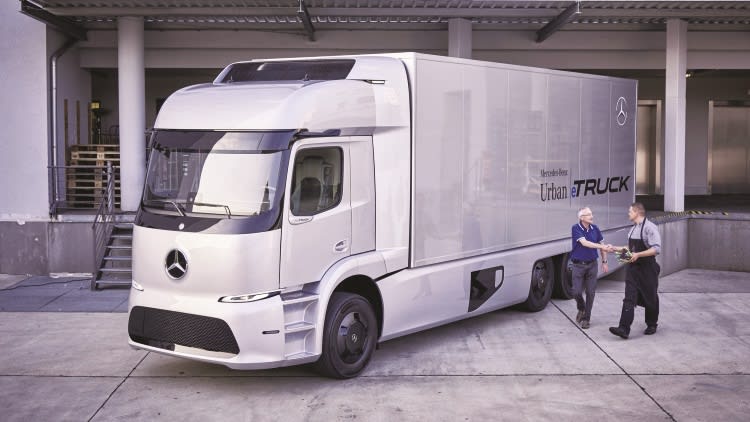
The EPA’s MPGe rating is designed to help compare electric vehicle performance with gasoline and diesel powered units. Photo: Mercedes-Benz
3 min to read
A big part of that equation will be figuring out how economical electric trucks and vans actually are compared to the conventionally powered vehicles in the fleet. And that can be problematic if you have an entire century of figuring nothing but miles per gallon performance as your baseline. Electric vehicles, of course, do not burn fuel. Without a gallon of fuel to burn, an mpg calculation is useless. And although they do use electricity off the main power grid, with an electric meter spinning away like crazy, it’s tough to isolate a tally of daily charges for a single vehicle and separate that amount of voltage from power being used to keep the lights on and the building cool.
The most common measurement heard these days is vehicle range. This makes a lot of sense. That’s an apples to apples, real-world comparison that helps fleet managers make basic decisions on how to deploy these new assets. But even that calculation falls short if you want to compare the economic impact of, say, a gasoline-powered delivery van with an all-electric one.
To help out on this front, the U.S. Environmental Protection Agency put together an all-new calculation exclusively for electric vehicles to help fleet professionals and consumers get a better understanding of how electric vehicles perform compared to diesel or gasoline powered units.
The measurement is called MPGe, which stands for miles per gallon (electric) and was developed with input from focus groups and industry experts as a way of keeping electric vehicle performance ratings simple. With that concept in mind, an MPGe figure represents the number of miles a vehicle can travel using a quantity of “fuel” – actually electricity – with the same energy content as one gallon of gasoline – which mathematically works out to one gallon of gasoline equaling 33.7 kilowatt hours of battery power. In practice, this means that fleets can find the MPGe rating for a particular van or truck by calculating the number of miles a vehicle can go using the same energy content as a gallon of gas. So if you have an electric vehicle that uses 29 kilowatts of electricity to travel 100 miles, for example, that vehicle would get a rating of 115 MPGe. This means, in layman’s terms, that particular vehicle is as efficient as a 115-mpg truck or van would be, were it possible to build a vehicle that efficient with an internal combustion engine.
This measurement system is not without its own variables, of course. Factors such as electricity rates and gasoline and diesel prices mean that an MPGe rating in say, Mississippi, could vary greatly from one calculated in California.
There are other means of figuring electric vehicle performance, such as watt-hours per mile, or kilowatt hours per 100 miles. It remains to be seen which measurement will eventually emerge as the industry standard. But, if nothing else, the MPGe rating serves as an excellent way to demonstrate just how energy-efficient this new generation of electric trucks and vans are, and the potential positive impact they could have on fleet operations – and bottom lines – in the very near future.
Related: How Much Does it Cost to Operate a Battery Electric Truck?
Subscribe to Our Newsletter
More Fuel Smarts
Vanair Introduces Solar, Battery Power Ecosystem for Class 8 Trucks
The company’s expanded EPEQ ecosystem includes flexible solar panels, lithium batteries, hydraulic power systems, and a portable fast charger for electric trucks.
Read More →
Run on Less “Messy Middle” Data Shows Multiple Paths for Truck Powertrains [Listen]
Listen as Mike Roeth of the North American Council for Freight Efficiency shares insights into battery-electric trucks, natural gas, biofuels, and clean diesel on this episode of HDT Talks Trucking.
Read More →
Run on Less “Messy Middle” Data Shows Multiple Paths Forward for Truck Powertrains [Watch]
NACFE's Run on Less - Messy Middle project demonstrates the power of data in helping to guide the future of alternative fuels and powertrains for heavy-duty trucks.
Read More →
Trucking Executive Warns Fuel Spike from Middle East Conflict Hitting Fleets Fast
Mike Kucharski, vice president of refrigerated carrier JKC Trucking, says diesel price jumps tied to global instability are squeezing carriers already struggling with weak freight rates.
Read More →
Smarter Maintenance Strategies to Keep Trucks Rolling
In today’s cost-conscious market, fleets are finding new ways to get more value from every truck on the road. See how smarter maintenance strategies can boost uptime, control costs and drive stronger long-term returns.
Read More →
Researchers Demonstrate Wireless Charging of Electric Heavy-Duty Truck at Highway Speeds
Purdue researchers demonstrated a high-power wireless charging system capable of delivering energy to electric heavy-duty trucks at highway speeds, advancing the concept of electrified roadways for freight transportation.
Read More →
EPA Wants to Know: Are DEF De-Rates Really Needed for Diesel Emissions Compliance?
The Environmental Protection Agency is asking diesel engine makers to provide information about diesel exhaust fluid system failures as it considers changes to emissions regulations.
Read More →
Sponsored•February 1, 2026
Stop Watching Footage, Start Driving Results
6 intelligent dashcam tactics to improve safety and boost ROI
Read More →
California: Clean Truck Check Rules Still in Force for Out-of-State Trucks, Despite EPA Disapproval
The Environmental Protection Agency said California can’t enforce its Heavy-Duty Inspection and Maintenance Regulation, known as Clean Truck Check, on vehicles registered outside the state. But California said it will keep enforcing the rule.
Read More →
Justice Department Pulls Back on Criminal Prosecution of Diesel Emissions Deletes
The Trump administration has announced it will no longer criminally prosecute “diesel delete” cases of truck owners altering emissions systems in violation of EPA regulations. What does that mean for heavy-duty fleets?
Read More →