




Related: Industry Leaders Share Insight at Trucking Efficiency Workshop
New Report Explores Lightweighting
The North American Council on Freight Efficiency and the Carbon War Room released their most recent “Confidence Report,” on lightweighting strategies for heavy-duty trucks, released August 25 at the Fleet Technology Expo in Long Beach, Calif.
by Andrew Halonen, NACFE Study Manager
August 26, 2015
via Trucking Efficiency
4 min to read

via Trucking Efficiency
The North American Council on Freight Efficiency and the Carbon War Room have been studying the myriad of trucking technologies that improve efficiency. The most recent technology studied was lightweighting, resulting in the group’s latest “Confidence Report,” released August 25 at the Fleet Technology Expo in Long Beach, Calif.
The study began with three hypotheses:
Tractor and trailer tare weights are increasing
Logistics and freight handling improvements lead to more freight per shipment
Weight sensitivity and the value for lightweighting will increase in the future.
The study group interviewed fleets, OEMs, component & system manufacturers and associations. There was general support of these hypotheses, with the exception of trailer manufacturers saying that their efforts have actually lowered trailer weights.
On tractors, weight increases have been a result of emission regulations with new diesel equipment; fleets adding features to help retain and attract drivers; and the addition of technologies for improved freight efficiency.
Bulk haulers are the most sensitive to weight and have integrated many of the lightweight technologies available today, reducing truck weights by thousands of pounds using lightweight materials, wide-based tires, aluminum wheels, and right-sized cabs and engines.
Not all lightweighting technologies are applicable for each region. For instance, the 6x2 tandem axle arrangement delivers a reduction of up to 400 pounds, yet because there is also a reduction in tractive effort, it is not used in all regions, even for weight-sensitive bulk haulers.
While weight reduction is often synonymous with fuel economy, it takes thousands of pounds of reduction on a Class 8 truck to be measurable. However, reducing weight allows the ability to carry more payload, or it can allow for the addition of fuel economy products like aerodynamics and automatic manual transmissions without a weight penalty that consumes payload.
Similarly, lightweighting can offset the heavy equipment used to lure drivers. Driver shortages drive carriers to spec “high-rise” sleeper cabs – long, spacious, and heavy. Some weight-sensitive fleets would like to spec 13-liter or even 11-liter engines, but drivers and resale buyers believe the larger and heavier 15-liter is necessary.
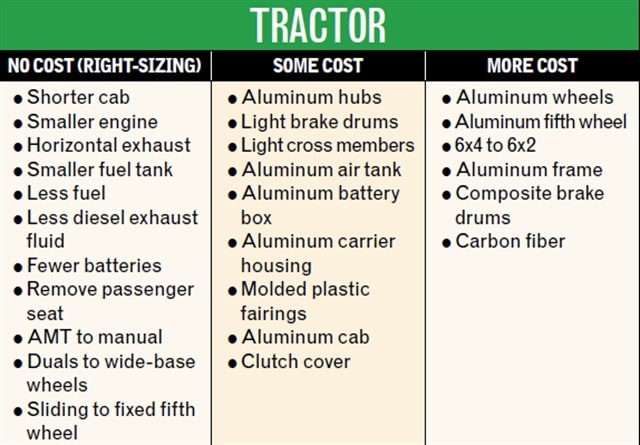
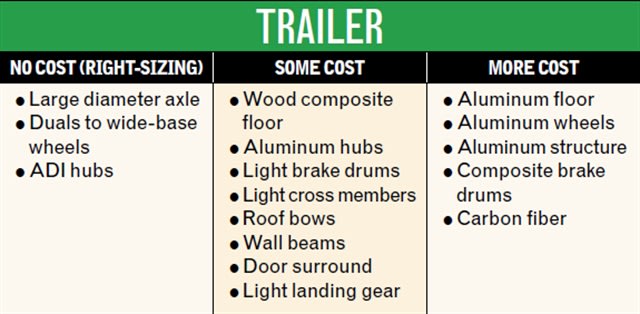
Nothing comes for free. Those who enjoy the most direct benefit of lightweighting value it more and are more likely to buy it. Lower-weight features are generally categorized in a dollar per pound metric, which is a multiplier on the premium over the baseline component. Saving 50 pounds for a customer who is willing to pay $2 a pound means the customer will pay $100 more for the lightweight component. The bulk haulers will pay $6-11 per pound; the next category is largely reefers willing to pay $2-5 per pound, and the other 88%, general dry van freight, will pay $0-2 per pound. Once the product is spec’d as standard equipment, no one talks about dollars per pound.
In addition to the upfront cost, the challenges of lightweighting include impacts on resale value or maintenance. If those effects are unknown, buyers are wary. Loads and routes may vary from week to week, so it’s difficult to calculate the true value of lightweighting.
Another challenge that is inherent in the market is the redundancy in testing that slows the development from the product designer to the integration partner to the OEM to the fleet. Each level is consuming engineering time, money and resources all for the same goal, to prove value and reliability.
The report uncovers many technologies that deliver substantial lightweighting opportunities for both tractors and trailers, available now and in future development. (See table on page XX.)
The Confidence Report concludes that the future of lightweighting will depend on three things:
Material innovations
Reducing the time to market
Achieving wide adoption in market segments other than bulk haulers
Confidence plays a big role in determining if a product is reliable and delivers on its advertised value. As fleets adopt these technologies and put millions of miles on them without issues, the popularity will grow. Look at the aluminum wheels that are prominent today on tractors and trailers. They deliver on many fronts – lightweighting, reduced rolling resistance, appearance and resale value. But it took 40 years to reach this level of market acceptance.
Subscribe to Our Newsletter
More Fuel Smarts

Record Diesel Prices Squeeze Trucking Fleets
Average U.S. diesel prices have climbed to nearly $6 a gallon, surpassing the 2022 record as tight refinery capacity and Middle East disruptions keep fuel costs elevated.
Read More →
Sponsored•September 9, 2026
How Fuel Delivery Shapes Engine Performance
Fuel delivery depends on more than what happens at the injector. For fleet, maintenance and technical professionals, looking at the full path from pump to injector can provide useful context for understanding engine performance.
Read More →
East Coast Port Launches $45M Electric Truck Push
The Port Authority of New York and New Jersey announced millions in incentives for zero-emission drayage trucks, yard tractors, and new charging hubs near the port.
Read More →

California Bill Could Shed Light on Electric Truck Prices
Why do battery-electric Class 8 trucks remain so expensive? A California bill headed to Gov. Gavin Newsom would give fleets and state agencies more visibility into what manufacturers charge.
Read More →
Detroit Opens Orders for EPA 2027 Engines
Detroit isn’t starting from scratch to meet EPA 2027 diesel emissions standards. Its Gen 6 DD13 and DD15 engines keep much of today’s platform while updating the fuel and aftertreatment systems.
Read More →
Zero-Emission Truck Corridor Planned for West Coast
California, Oregon, Washington, British Columbia and Baja California are coordinating plans for truck charging and hydrogen fueling from Canada to Mexico.
Read More →
A Closer Look at Kenworth’s Electric T880E Vocational Truck [Video]
Learn more about Kenworth's T880E battery-electric vocational truck at the Paccar Technical Center, including its range, applications, upfitting considerations, and PTO options, in this HDT Spotlight video.
Read More →
Kenworth T880E Brings EV Power to Vocational Trucks
A closer look at the Kenworth T880E’s range, charging, powertrain and upfit options — and where fleets are showing the most interest.
Read More →
Jennie Abarca Is Proving Electric Trucks Can Do the Job
HDT Truck Fleet Innovator Jennie Abarca is building confidence in fleet electrification one load at a time while openly sharing the challenges she encounters along the way as a small-fleet owner.
Read More →
Cummins Adjusts 2027 Engine Rollout After EPA Proposal
The engine maker will gradually introduce its new Model Year 2027 diesel engines while continuing to offer current models during the transition, citing the EPA's proposed emissions rule changes.
Read More →