




Read More: Indiana City Transitions to Compressed Natural Gas for Refuse Trucks
Upgrading Refuse Fleets to CNG: Three Considerations Beyond Economics
Refuse fleets are one of the fastest growing markets for compressed natural gas, primarily because of the significant fuel cost savings that can be realized. The Natural Gas Vehicle Institute offers these key factors refuse fleets need to examine when considering upgrading to CNG.
by Annalloyd Thomason, Natural Gas Vehicle Institute
September 19, 2023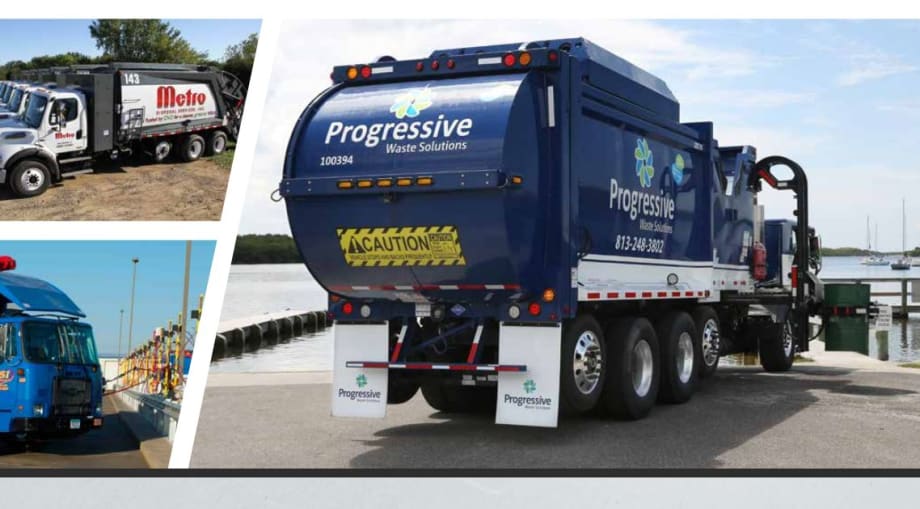
Natural gas is a lighter-than-air fuel which rises and dissipates when leaked, and facilities where natural gas vehicles will be repaired must be capable of functioning in a safe manner.
Photo: McNeilus
6 min to read
Refuse fleets are one of the fastest growing markets for compressed natural gas, primarily because of the significant fuel cost savings that can be realized. The Natural Gas Vehicle Institute offers these key factors refuse fleets need to examine when considering upgrading to CNG.
Refuse fleet operators carefully examine the economics of adding natural gas vehicles to their fleet, taking into consideration the obvious economic factors of fuel cost savings and vehicle procurement costs.
In a fleet where the cost difference between diesel and natural gas ranges from $2 to $3 per diesel gallon equivalent (DGE), vehicles that use approximately 10,000 gallons of fuel per year will save the refuse operator $20,000 to $30,000 per year.
Multiply that savings times the number of vehicles in the fleet, and again by the average life of a refuse vehicle, which is 12 years, and the dollars start to really add up. Even when you consider the incremental cost of a natural-gas-powered refuse truck (according to a report from the Department of Energey, the average incremental cost per CNG vehicle in a 2014 study was $38,200), the economics can play out nicely.
However, the analysis for potentially upgrading a refuse fleet to CNG can’t end with the economics. Here are three sometimes overlooked considerations.
The cost of natural gas fuel has stayed low – about $1.50 -$2.00 per diesel gallon equivalent cheaper than diesel – and relatively stable. This is especially beneficial for fleets that run a lot of miles (80,000-120,000 miles per year is the sweet spot).
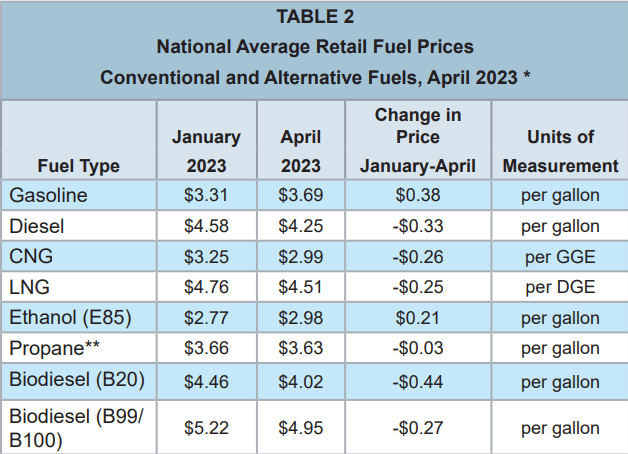
Photo: Clean Cities Alternative Fuel Price Report
Maintenance and Repair Facility Modifications
Virtually all existing maintenance and repair facilities for refuse fleets were originally designed for diesel (or gasoline) powered vehicles. These fuels are heavier-than-air and pool on the ground when leaked. If these facilities are now expected to also accommodate natural gas vehicle repair, they must be evaluated and modified to meet the fire, electrical, mechanical, building and other safety codes for natural gas. Natural gas is a lighter-than-air fuel which rises and dissipates when leaked, and facilities where natural gas vehicles will be repaired must be capable of functioning in a safe manner.
In each facility, the building envelope, as well as the ventilation, lighting, heating, and electrical systems, must be evaluated along with any below-grade surfaces. In addition, functions must be evaluated such as welding and hot work. Maintenance and repair facility evaluations should be performed by a qualified and experienced company.
Otherwise, the refuse fleet may wind up performing modifications that are either inadequate to meet the codes, resulting in disapproval by the authority having jurisdiction, or paying for modifications that are significantly overdesigned and cost more than they should.
As an example, NGVi previously completed a facility evaluation for a large major heavy-duty vehicle dealer who had received an initial evaluation and cost estimate of $800,000 from an inexperienced provider. When NGVi completed its evaluation and made appropriate recommendations, the more realistic cost estimate was $490,000.
The effective maintenance facility evaluation will include not only a report of the recommended modifications to bring the building up to code for NGVs, but a cost estimate of the modifications to be performed. Armed with this information, the refuse fleet will have a fuller understanding of the requirements to upgrade not only the vehicles but the maintenance facility to CNG, and will be able to plan and even analyze costs and payback more accurately.
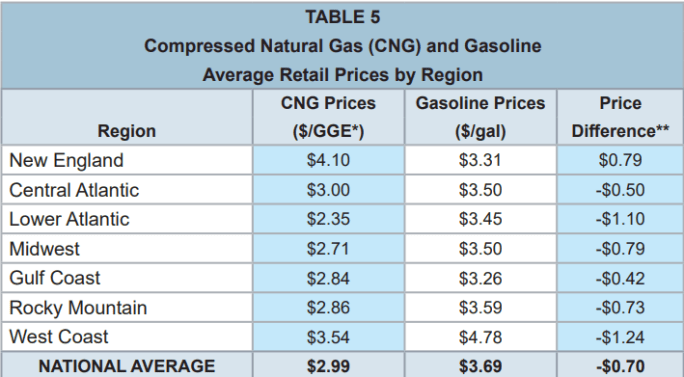
Compressed natural gas (CNG) relative to gasoline
Photo: Clean Cities Alternative Fuel Price Report
Choosing the Best Fueling Option
Some fleets try to make the decision to upgrade to CNG without a clear understanding of what type of fueling they need and what will be most beneficial for them from both an operating standpoint, as well as an economic perspective. Working with an unbiased expert helps refuse fleets review all the fueling options, look forward to project both current and future needs, and arrive at the fueling solution that best meets the fleet’s needs.
Refuse fleets have multiple options when choosing how to fuel their vehicles. While some choose to fuel their vehicles at public CNG stations, many refuse fleets choose to operate their own time-fill fueling stations because refuse fleets usually have ideal characteristics (parked overnight at a central facility) for that type of fueling. Other refuse fleets choose fast-fill fueling stations that they also own and operate — and many refuse fleets have a combination of both.
Time-fill fueling is significantly less costly than fast-fill fueling because the fuel is provided to the vehicles directly from the compressor(s), which usually are set to start up and fuel the vehicles overnight. This means there’s no need for more costly CNG storage, and it’s easier to plan for and accommodate fleet expansion.
Employee Development and Training
Perhaps the most frequently overlooked component of deciding to upgrade to CNG is assessing the employee development and training needs before the upgrade begins. In tandem, many companies recognize the need for technician training, but don’t immediately grasp the necessity to train supervisors, operations personnel, safety managers, risk managers, and others who will be involved in the process of integrating CNG into the refuse fleet. Here are NGVi’s general recommendations:
Every technician — regardless of whether or not they will be repairing NGVs — should take basic NGV safety training which covers the properties and characteristics of the fuel, the components of the CNG fuel system and their serviceability, how to fuel and defuel a vehicle, and the principles for safely working on natural gas vehicles inside a maintenance facility.
More advanced technicians — those who will be conducting the federally mandated CNG fuel system inspections every three years or 36,000 miles or after any fire or accident, should receive CNG Fuel System Inspector training. In addition, NGVi recommends for a second layer of safety and liability protection that all trained technicians receive Fuel System Inspector Certification offered by CSA Group.
And finally, it is essential that technicians who will be diagnosing and repairing heavy-duty NGVs receive training that includes properties of the fuel, safety procedures for CNG, high-pressure lines and fittings, installation requirements of natural gas components, maintenance intervals and procedures unique to NGVs, engine systems and diagnostics, and how to perform basic repair procedures.
While economics are probably the most important factor when considering the upgrade to CNG, refuse fleets that are on the front-end of the decision will have a more complete picture by factoring in the maintenance facility modifications, fueling options, and employee development and training needs. The result will be a more thorough analysis and, ultimately, a smoother transition to the premium fuel — natural gas.
About the author: Annalloyd Thomason is the Co-Founder and CEO of the Natural Gas Vehicle Institute.
This article, originally appeared in the NGVConnection newsletter from the Natural Gas Vehicle Institute (www.ngvi.com), has been edited for accuracy as of Sept. 2023. Used with permission.
Subscribe to Our Newsletter
More Fuel Smarts

Why Diesel Price Relief Efforts May Fall Short
Diesel prices have eased from September’s record high, but doubts about additional Russian supply and limits on dyed-diesel tax relief mean trucking fleets still face expensive fuel. And prices could go higher.
Read More →
Why Small Fuel Savings Matter in Trucking
Can better fuel economy help pay for driver raises? In this podcast, GP Transco explains how small efficiency gains create room to reinvest in its people.
Read More →
How GP Transco Cuts Trucking Fuel Costs, a Tenth of a Gallon at a Time
What’s another tenth of a mile per gallon worth? GP Transco shares how equipment upgrades and driver coaching turn small gains into meaningful fuel savings.
Read More →
Electric Yard Tractors Move Beyond Pilots
Operating-cost savings have overtaken sustainability goals as the leading reason surveyed fleets are adopting battery-electric terminal tractors, according to new NACFE research.
Read More →
Geotab Links Fleet Card to Vehicle Data
The new card combines fuel discounts with telematics-based purchase controls. Geotab’s analysis also points to potential savings from choosing lower-priced fuel stops.
Read More →
Fleet Economics Shape Electric Truck Outlook
ACT Research expects costs, charging infrastructure, and technology improvements to drive zero-emission commercial vehicle adoption as federal regulations and incentives retreat.
Read More →
Wex Adds Cardless Fuel Payments for Over-the-Road Customers
A new fuel card feature for Wex customers offers convenience and security.
Read More →
New California Law Could Shed Light on Electric Truck Prices
Why do battery-electric Class 8 trucks remain so expensive? A California bill signed by Gov. Gavin Newsom would give fleets and state agencies more visibility into what manufacturers charge.
Read More →
How Volvo Updated Its D13 for EPA 2027 [Watch]
Volvo’s updated D13 promises lower emissions without sacrificing performance or fuel economy. Take a closer look at what changed inside the engine in this HDT Spotlight video.
Read More →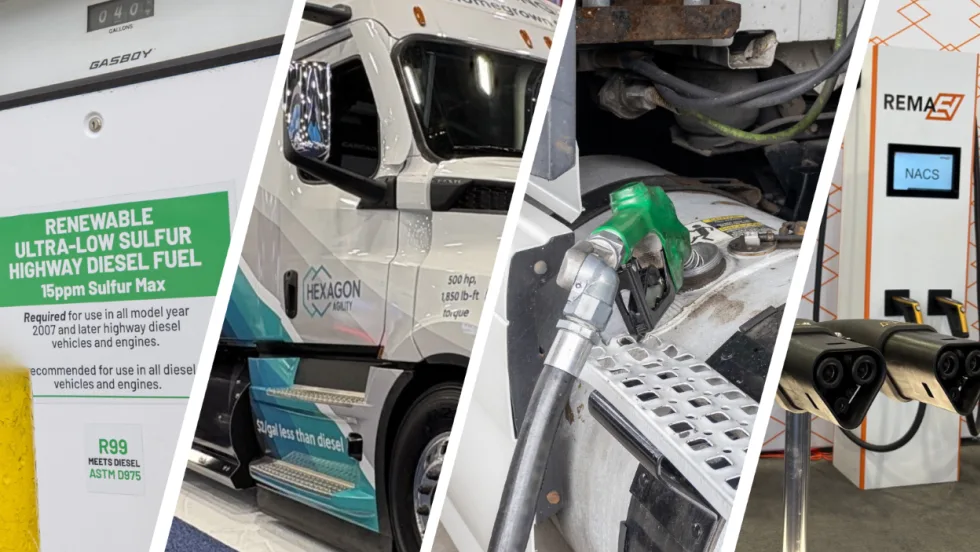
Diesel Price Spike Shortens Payback for Natural Gas Trucks, Report Says
Energy Vision estimates fleets could recover the higher purchase price of an RNG-fueled Class 8 tractor in 1.3 to 2.8 years under current fuel-price scenarios.
Read More →