




The Lowdown on the New Low-Viscosity Oils
Exactly what is this "high-temp, high-shear" viscosity engine oil standard in the works for the next round of EPA emissions standards, and what are engine makers doing to make sure engines will still be well protected?


Kinematic viscosity is what you might envision when thinking of viscosity – gravitational flow. But the new oils will meet viscosity standards measured at high temperatures/high shear conditions.
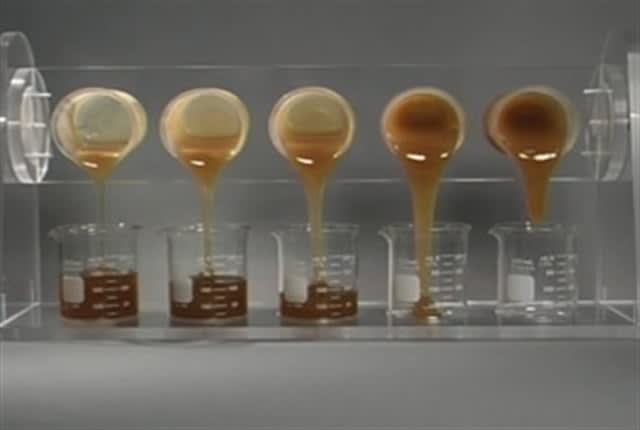
Kinematic viscosity is what you might envision when thinking of viscosity – gravitational flow. But the new oils will meet viscosity standards measured at high temperatures/high shear conditions.
To meet the expected greenhouse gas/fuel efficiency standards that the federal government is in the process of developing, oil companies and engine makers have been busy developing a new standard for engine oils that will provide low viscosity to improve engine efficiency.
"This will be the most robust oil specification we've ever developed," said Greg Shank, executive staff engineer, coordinator fluids technology, for Volvo Powertrain during a technical session at the ATA's Technology and Maintenance Council this week.
The new API category, currently called PC-11, is being developed as the standard for a new generation of low-viscosity engine oils, which on-highway engine manufacturers will be using as part of their EPA 2017 GHG reduction strategies.
Oils have changed a lot over the past 25 years to keep up with emissions technology. For instance, when engine temperatures went up, oil engineers had to increase the thermal stability of the oil. When exhaust gas recirculation started putting more soot into the oil, the oils had to be able to resist becoming thicker because of the soot and resist acid buildup. With selective catalytic reduction and diesel particulate filters, the oil chemistry had to be altered to make sure it didn't plug the DPF or poison the SCR.
It's been a decade since the last time we had a new oil classification, and this time, the engineers are having to nearly start from scratch.
All about viscosity
John Loop, technology manager, engine oils, for Lubrizol, explained that viscosity is how things flow – "the degree to which a fluid resists flow under an applied force," or "the power of resisting a change in the arrangement of the molecules." A solid would have infinite viscosity, he said, A gas, very little.
For the new oil category, it's not just a matter of using a lower-viscosity oil, but one that will maintain its viscosity under high-temp/high-shear conditions.
Kinematic viscosity is what you might envision when thinking of viscosity – gravitational flow. Think of a row of beakers with different oils tipped so they flow into a container. Lower-viscosity oils would flow faster than higher-viscosity oils. Obviously you don't want one that runs like water, but neither do you want one that falls out in one big gelatinous glob.
When you're measuring high-temp/high-shear viscosity, or HTHS, Loop explained, it is measuring the viscosity of the oil as it would be in the engine, where it's being flung around at high temperatures and the molecules in the oil are stressed – deformed, stretched, even sheared.
The HTHS limits are measured in cP, with lower numbers meaning lower viscosity. The new category is expected to limit that range from 2.9 to 3.2 for the GHG version, while the non-GHG version will be at 3.5.
The new oil category
In order to be ready to meet the 2017 model year requirements, the new API category is scheduled to be in place by early 2016. Originally it was planned for January 2016, but that has been pushed back a quarter to the first of April 2016.
Engine makers are currently developing new tests to measure how well the new oils will perform.
Jeremy Dean, supervisor, chemical technology and cleanliness laboratories for Daimler, noted some of the possible concerns about lower-viscosity oils that need to be addressed in the new category:
Scuff and seizure resistance of reciprocating and rotating components such as the cylinder kit, crankshaft, valve train, gear train, oil pump and air compressor
Equivalent wear rates
Equivalent performance of engine seals (internal and external oil leaks)
The category will require oils to pass 20 engine and bench tests. Some are carryover tests from the previous category, but a number of them are brand-new.
Daimler, for instance, is developing a scuffing test, which measures for adhesive wear. Currently, oils are only subject to abrasive wear tests.
Mack is developing a test to check for oxidation control. "Today's oils we believe are borderline at best for the new engines" in this area, Shank said.
The new Mack T-13 test uses an EPA 2010 Mack MP8 500-horsepower engine. It will subject oils to a peak cylinder pressure of 3,000 psi at 1,500 rpm, an oil gallery temperature of 130C and EGR rate increased by about 19 to 20%. Today's oils will "break" after about 300 hours, he said, but you can formulate an oil not to oxidize in this test.
One of the unique things about this category is there will actually be two different sub-categories. One will be backward-compatible with older engines, a 3.5 HTHS oil with additional oxidation control. The one developed for the GHG regs will be in the 2.9 to 3.2 HTHS range. Whether it will be at all backwards-compatible has not yet been determined. Shank said Volvo's position is that it should at least be backwards compatible to EPA 2007 engines.
One area of concern is how the two categories will be differentiated. Indications are that the new HTHS category will be named CK-4. But no consensus has been reached yet on how to communicate to the customer the difference between it and the low-temp/low-shear version.
"Do you do it with a letter? Do you do it with a symbol, like detergent for high-efficiency washers?" said Dan Arcy, global OEM technical manager for Shell Lubricants, in a separate interview at TMC. Arcy is heading up the API committee developing the new oil category.
Another development in the oil category is that originally, there were some concerns about accommodating the use of biodiesel. However, that has been taken off the table for North American oils because the task force learned that there were not as many issues with biodiesel as there were several years ago when this work started, Arcy explained.
Engine changes needed?
At the same time, engine makers are looking at what types of hardware and software changes they may need to make in order to accommodate the new lower-viscosity oils.
For instance, Iner Jorgensen, powertrain technical expert for Paccar, said while bearing materials probably wouldn't change, clearances would be changing. For the valvetrain, advanced diamond-lice coatings are being investigated. Because engine oil pressure at idle drops when the viscosity drops, oil pump output will need to be increased to maintain low idle pressure. And the thinner oil film and clearances will require better filtration.
Dan Nyman, technical advisor-chemical technology for Cummins, said Cummins is researching new part geometry, new part materials, part finish effects, new coating materials, and changing clearances.
He noted that in a test of lower-viscosity oil Cummins did in one of its midrange engines, the engine camshaft showed some pitting on the lobes, the engine oil pump had pitting wear on the oil pump rotor, the camshaft bushing had some abnormal surface texturing change, and all the pistons had heavy deposits around the top land, under the piston crown and oil gallery.
Low-viscosity oils today
Many fleets are already using lower-viscosity oils to save fuel.
Daimler's Dean noted that currently 30-weight oils are allowed in all the company's EPA 2007 or later engines for U.S. and Canadian duty cycles; it just requires a simple software flash to update the engine to the most current engine software. The same oil drain intervals apply. Right now Daimler has approved more than 20 low-viscosity oils from more than 10 oil marketers and it's offered as factory fill in all current engine models.
Cummins prefers 15w-40 in its engines, but says 10W-30 oils can be used in colder climates – IF they meet a minimum HTHS viscosity of 3.5 in addition to meeting API CJ-4.
"This distinction has been important for engine protection but constrains the potential fuel economy gain," Nyman said.
Related article:
The Next Generation of Oils: New API oil category will help meet fuel economy/GHG regs (January 2013 HDT)
More Fuel Smarts

How Volvo Updated Its D13 for EPA 2027 [Watch]
Volvo’s updated D13 promises lower emissions without sacrificing performance or fuel economy. Take a closer look at what changed inside the engine in this HDT Spotlight video.
Read More →
Diesel Price Spike Shortens Payback for Natural Gas Trucks, Report Says
Energy Vision estimates fleets could recover the higher purchase price of an RNG-fueled Class 8 tractor in 1.3 to 2.8 years under current fuel-price scenarios.
Read More →
Calstart Becomes Catalyst Mobility, Reflecting Broader Focus
Calstart is now Catalyst Mobility, reflecting the nonprofit’s growing national role in clean transportation, including zero-emission trucks, infrastructure and incentive programs.
Read More →

Record Diesel Prices Squeeze Trucking Fleets
Average U.S. diesel prices have climbed to nearly $6 a gallon, surpassing the 2022 record as tight refinery capacity and Middle East disruptions keep fuel costs elevated.
Read More →
How Fuel Delivery Shapes Engine Performance
Fuel delivery depends on more than what happens at the injector. For fleet, maintenance and technical professionals, looking at the full path from pump to injector can provide useful context for understanding engine performance.
Read More →
East Coast Port Launches $45M Electric Truck Push
The Port Authority of New York and New Jersey announced millions in incentives for zero-emission drayage trucks, yard tractors, and new charging hubs near the port.
Read More →
California Bill Could Shed Light on Electric Truck Prices
Why do battery-electric Class 8 trucks remain so expensive? A California bill headed to Gov. Gavin Newsom would give fleets and state agencies more visibility into what manufacturers charge.
Read More →
Detroit Opens Orders for EPA 2027 Engines
Detroit isn’t starting from scratch to meet EPA 2027 diesel emissions standards. Its Gen 6 DD13 and DD15 engines keep much of today’s platform while updating the fuel and aftertreatment systems.
Read More →
Zero-Emission Truck Corridor Planned for West Coast
California, Oregon, Washington, British Columbia and Baja California are coordinating plans for truck charging and hydrogen fueling from Canada to Mexico.
Read More →
A Closer Look at Kenworth’s Electric T880E Vocational Truck [Video]
Learn more about Kenworth's T880E battery-electric vocational truck at the Paccar Technical Center, including its range, applications, upfitting considerations, and PTO options, in this HDT Spotlight video.
Read More →