




Economic Watch: Retail Sales Down Again, Inflation in Check
Retail sales in the U.S fell for the third straight month in February, according to new government numbers, pointing to slower economic growth in the first quarter. Separate reports about inflation showed it cooled at both the retail and wholesale levels.

Retail sales in the U.S fell for the third straight month in February, according to new government numbers, pointing to slower economic growth in the first quarter. Separate reports about inflation showed it cooled at both the retail and wholesale levels.
The Commerce Department reported Wednesday that retail sales slipped 0.1% last month, while January’s performance was revised upward to a 0.1% drop from a 0.3% decline. However, last month’s performance marked the first time since April 2012 that retail sales fell for three straight months.
This latest performance was well short of analysts’ expectations of a 0.3% increase for February. Despite the month-over-month drop, retail sales increased 4% over the past year.
So-called “core retail sales,” which exclude autos, gasoline, building materials and food services, moved up 0.1% in February following no change in January.
“Month-to-month comparisons don’t tell the whole story because of seasonal adjustment factors, but the three-month moving average and other year-over-year numbers are better indicators that reflect how sales are really increasing,” said National Retail Federation Chief Economist Jack Kleinhenz. "It’s still too early to draw conclusions about the impact of tax cuts, but extra money in shoppers’ pockets should help as the year goes forward. With consumer confidence and employment growing, economic fundamentals are favorable for spending to expand in the coming months.”
The three-month moving average was also up 4.4% over the same period a year ago. The NRF is forecasting 2018 retail sales to grow between 3.8% and 4.4% compared to 2017.
Analysts at Wells Fargo Securities sounded a similar note: “We remain positive on the consumer this year, even though the first look at consumption in January and February was not what we were expecting.”
It pointed out that consumer confidence surged in February to levels not seen since late 2000, primarily driven by the strengthening job market.
“However, the biggest risk facing consumers is higher inflation, which has the potential to erode purchasing power and keep consumers on the sidelines,” Wells Fargo said, but it noted the new numbers prices appear to be in check.
Retail, Wholesale Inflation Ease a Bit
A Labor Department report released Tuesday showed consumer prices rose 0.2% in February from the month before. The rate is the same when volatile food and energy prices are excluded.
The result was a 2.2% increase in the overall Consumer Price Index (CPI) over the past year, up slightly from January’s year-ago level. It was unchanged at 1.8% when food and energy prices are excluded.
The new figures follow the CPI posting a January hike of 0.5% from the month before, its biggest gain in four years, which raised concerns the U.S. might be in danger of seeing increased long-term inflation.
TD Economics pointed out this report does not does not include the inflationary impact of steel and aluminum tariffs that are set to come into force in the coming days. It estimates the tariffs could push CPI inflation highery by about 0.1 percentage point. “Beyond tariffs, the depreciation of the U.S. dollar also looks to be starting to show up in higher prices for core goods," said Leslie Preston, TD senior economist. "This trend should also contribute to higher core inflation in the coming months, alongside increased government spending which is also expected to raise inflationary pressures.”
She said this also raises a question for the Federal Reserve: If inflation is not rising, but how the forces of tax cuts, spending increases and now tariffs will lift inflation, how quickly the Fed should raise interest rates in response?
“For now, we are comfortable with our view for three [interest rate] hikes this year. But, there is certainly an upside risk to this view, with so many upward forces at play,” Preston said.
Wholesale Prices Increase
Meantime, prices at the wholesale level increased 0.2% in February from the month before, according to a separate Labor Department report, as analysts were expecting a 0.1% rise, following a 0.4% hike in January.
This pushed down the annual rate of increase in the Producer Price Index (PPI) to 2.8% from 3.1% in January.
Excluding food and energy costs, the core PPI also rose 0.2% in February and increased 2.5% over the past 12 months. That was than an expected increase, but still the highest since February 2012. At 2.5%, this is the seventh consecutive reading above 2%.
A similar conclusion can be drawn from the producer price report as it was in yesterday's consumer price report, according to Stifel Chief Economist Lindsey Piegza: While headline inflation continues to run relatively on target, core inflation continues to evade the Federal Open Market Committee's 2% objective.
“From the more hawkish perspective, the persistent ‘strength’ in the headline should bolster the argument to continue to move ahead with additional rate hikes. However, the lack of momentum in the core [rate] will also heighten the argument among the more dovish members that the Fed should remain cautious with no sense of immediacy to hike rates,” she said. “The lack of broad-based price pressure reinforces the lingering skepticism that some officials expressed in January as to the directional trend in prices.”
At this point, according to Piegza, a March rate hike is priced into the market, as it has been since Fed Chair Yellen’s press conference back in December of last year.
“Going forward, however, after the March meeting, should inflation fail to ‘move up’ as the Committee outlined in the January FOMC statement, a further removal of accommodation will be difficult to justify,” she said.
More Fleet Management

What the U.S.-Canada Trade War Means for Trucking
Escalating U.S.-Canada tariffs could disrupt cross-border freight, reduce truck volumes, raise costs, and create new uncertainty for carriers on both sides of the border.
Read More →
What Are Trucking’s Top Concerns for 2026?
The American Transportation Research Institute wants to know what's worrying trucking fleet managers, drivers, and other stakeholders in its annual Industry Issues survey.
Read More →
American Trucking Associations Looks for a New Leader
ATA President and CEO Chris Spear abruptly left his job at the association on August 21, at a pivotal time for the trucking industry.
Read More →
Public Wi-Fi Cybersecurity Risks: How Truck Drivers and Fleets Can Protect Their Data
Public Wi-Fi can expose truck drivers and fleets to credential theft, malware, and other cyber threats. Here’s how to reduce the risk on the road.
Read More →
For Nicky Cupp, Fleet Innovation Starts With Frustration
HDT Truck Fleet Innovator Nicky Cupp turns everyday pain points at Fraley & Schilling into opportunities for better technology and smarter processes.
Read More →
Adam Buttgenbach’s Approach to Electric Trucks: Start With Where They Fit
HDT Truck Fleet Innovator Adam Buttgenbach helped PepsiCo build one of North America’s largest EV fleets by focusing on where electric trucks make operational sense.
Read More →
Deen Albert: Let Automation Do the Math, People Make the Decisions
HDT Truck Fleet Innovator Deen Albert makes sure people are still at the heart of operations at Grand Island Express, even while adopting artificial intelligence tools. AI-assisted dispatch helped boost revenue 25% with the same number of trucks.
Read More →
Trimble’s New AI Agent Takes Aim at Fleet Back-Office Busywork
Arc Agent works across Trimble TMS products to automate repetitive tasks such as freight orders, maintenance, invoices, fuel costs and more.
Read More →
How HDT’s 2026 Truck Fleet Innovators Are Rethinking Fleet Operations
Meet five trucking leaders who are challenging assumptions, solving operational problems, and putting innovative ideas to work.
Read More →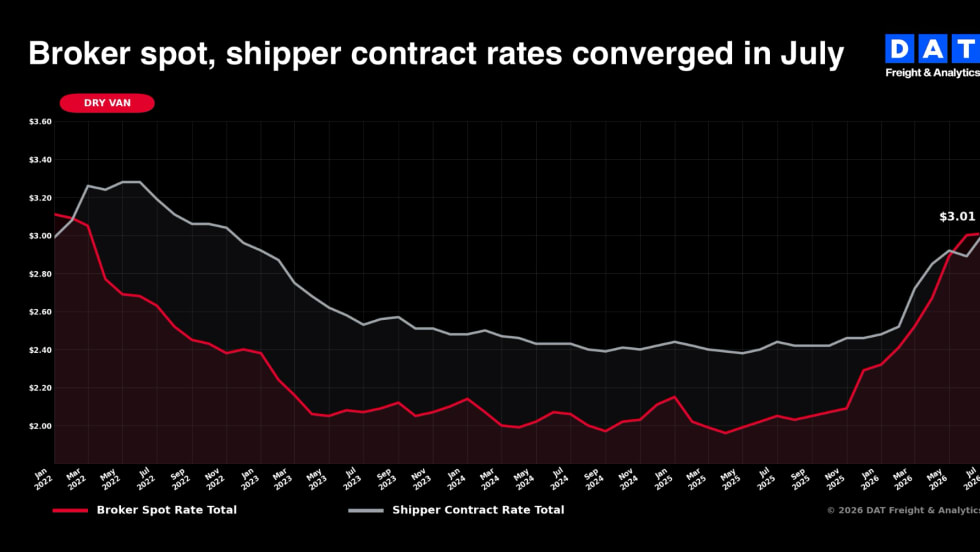
Tight Trucking Capacity Pushes Rates Higher Even as Freight Volumes Fall
“Spot rates moving ahead of contract rates have historically signaled a tightening market, but we haven’t seen a capacity-driven market quite like this one,” said DAT's Dean Croke.
Read More →