





Click here for our analysis of the Trump infrastructure plan
Trucking, Highway Groups Pan Trump Infrastructure Plan
Reaction by trucking and highway interest lobbies to the full reveal of President Trump’s gargantuan infrastructure plan essentially mirror views the groups expressed last month, when some of its contents were leaked and when the plan’s funding goal was ratcheted up in the State of the Union address.
February 13, 2018
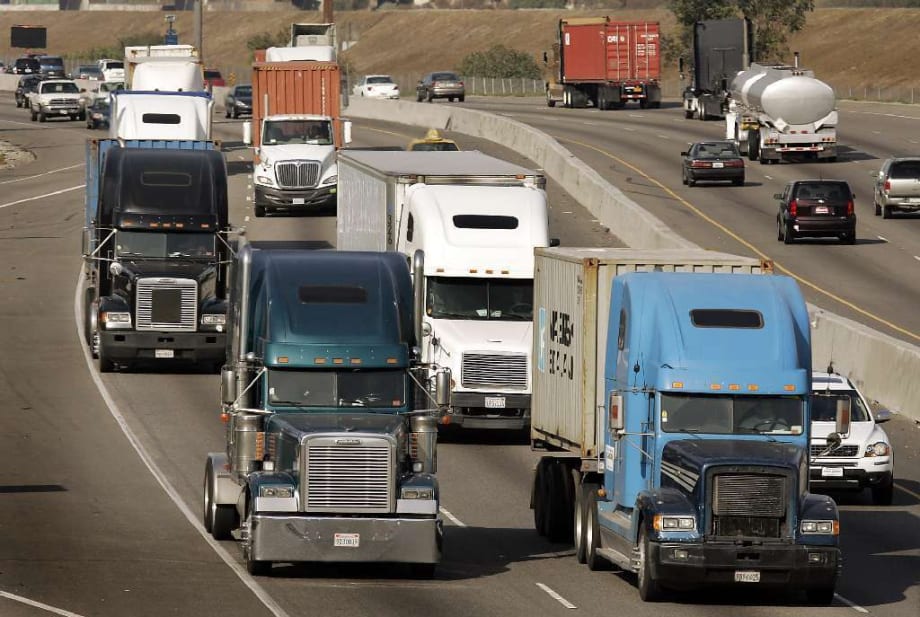
Trucking and highway stakeholder groups are less than thrilled with devils in the details of the gargantuan Trump infrastructure plan. Photo: U.S. Dept. of Transportation
6 min to read
Trucking and highway stakeholder groups are less than thrilled with devils in the details of the gargantuan Trump infrastructure plan. Photo: U.S. Dept. of Transportation
Reaction by trucking and highway interest lobbies to the full reveal of President Trump’s gargantuan infrastructure plan essentially mirror views the groups expressed last month, when some of its contents were leaked and when the plan’s funding goal was ratcheted up in the State of the Union address.
The biggest quibble—and it is one worth north of a trillion dollars— these interest groups have is with how the plan will be paid for. They are highly critical of the mere $200 billion in direct federal investment in all (not just for highways) the president contends is sufficient to stoke the spending of another $1.3 trillion or more in public (including state and local funds) and private investments to improve all of America’s infrastructure.
For example, in a statement released shortly after the plan was rolled out on Deb. 12, American Trucking Associations President and CEO Chris Spear applauded Trump for “kick-starting the debate.”
But he roundly criticized the plan as a proposal that “falls short of the President’s campaign promise to go big and bold, because it lacks the required federal investment. A proposal that relies on fake funding schemes like highway tolls and privatizing rest areas will not generate the revenue necessary to make significant infrastructure improvements.”
ATA: New Tolls a 'Non-Starter'
Spear frankly stressed that “new tolling on existing interstates is a non-starter for our industry. Tolls are ineffective and wasteful, with as much as 33% of revenue being wasted on administrative and overhead costs.
He also called attention to the status of the Highway Trust Fund, which is supposed to hold monies to finance most federal spending for highways and mass transit projects. The fund is meant to be replenished by proceeds from the federal fuel tax and related excise taxes.
“We also have grave concerns with the failure of the Administration’s budget proposal and infrastructure proposal to address the imminent collapse of the Highway Trust Fund,” said Spear. “To be blunt, America is hurtling toward a highway funding cliff. If we continue on this trajectory, the motoring public, the American taxpayer and future generations are going to pay a very steep and unacceptable price.”
If that message to the White House-- and to Capitol Hill-- wasn’t stark enough, Spear added that, “Any infrastructure funding proposal that does not address this situation is unacceptable.”
Highway Trust Fund Back in the Spotlight
Albeit much less forcefully, American Association of State Highway and Transportation Officials also argued the importance of the Highway Trust Fund in light of the Trump infrastructure plan. "State DOT leaders appreciate the president's ongoing interest in, and support for, increased federal investment in infrastructure," said Bud Wright, AASHTO executive director. "We hope the release of the Trump infrastructure plan can be a starting point for a robust conversation on how best to make the critical investments in surface transportation. AASHTO and its members stand ready to work with the Administration and Congress to address the long-term viability of the Highway Trust Fund and to speed the federal review and permitting process."
Like ATA, the Coalition for America’s Gateways and Trade Corridors took issue with the president’s prime-the-pump infrastructure funding model. “Freight network improvements cannot be delivered piecemeal by states and localities – over 77% of the nation’s freight moves between states, requiring a coordinated goods movement strategy and robust funding from the Federal government,” said CAGTC Executive Director Elaine Nessle in a Feb. 13 statement.
“The Commerce Clause of our Constitution authorizes the Federal government to support interstate commerce, accomplished through significant investments to support the movement of goods,” she continued. “We call for a minimum annual Federal investment for freight infrastructure of $2 billion above current levels. However, we are concerned that the White House proposal does not identify investment amounts specific for freight projects and appears to treat all infrastructure alike, which could result in underinvestment in regionally and nationally significant freight infrastructure improvements necessary to sustain American economic growth.”
A Call to Action on TIGER Grants
Nessle also faulted the elimination of programs that support goods movement infrastructure, as was suggested in the President Trump’s FY19 budget request. She said AGTC wants to see Congress and the administration maintain current transportation programs, “especially the bipartisan Transportation Investments Generating Economic Recovery (TIGER) program.” Nessle called the TIGER program “an invaluable tool for goods movement infrastructure, over a total of eight rounds, 42% of total TIGER funding has been awarded to projects with a strong freight component.”
Citing the provision calling for “providing states flexibility to toll existing Interstates,” the Alliance for Toll-Free Interstates called the Trump plan a push for widespread tolling. “Tolls are a wildly inefficient tax, sacrificing money that could go toward construction to corporate profits and administrative costs,” said said Stephanie Kane, ATFI spokesperson. “In addition to the diversion onto secondary roads which causes congestion and public safety issues, tolls will do unimaginable harm to businesses, as shipping and manufacturing prices skyrocket to account for these new costs.
“This plan,” she said, “is not innovative or good policy -- it is simply a nationwide plan for ‘#TrumpTolls.’ The Trump Administration’s infrastructure plan is choosing Wall Street over Main Street. Tolls will take money from hardworking Americans and give huge profits to toll road investors – many of which are foreign companies,” Kane added.
UPS Freight Points Up High Costs of Tolls
“Everyone understands the inefficiencies of toll collection and that a large portion goes to investors instead of road construction, but what they may not be aware of is the impact on the cost of doing business. Companies that move goods, such as UPS, rely upon the unrestricted flow of goods on interstates to move freight throughout the country. Nationwide tolls will dramatically impact the cost of moving goods, and ultimately consumers will pay a higher price,” said Rich McArdle, President of UPS Freight, in the statement issued by ATFI.
Also firmly against elements of the plan is NATSO, the association representing truckstop operators, which flat out announced it will “actively oppose key aspects of the Trump Administration’s new infrastructure proposal.” Specifically, NATSO is concerned about provisions designed to increase interstate tolling and commercialized rest areas.
“Interstate tolls cost the government significantly more to administer and enforce than the existing motor fuels tax,” said NATSO President and CEO Lisa Mullings. “Why would anyone fail to support an increase in the [federal] fuel tax and, at the same time, work to create another type of tax, such as toll roads, that costs more to collect than the fuel tax?”
Mullings also argued that not only do toll roads cost more than the fuel tax for the government to administer, interstate tolls divert traffic to secondary roads. “This diversion not only damages these roads, it increases accident rates.”
NATSO also reiterated its strong opposition to the White House proposal to commercialize rest areas. “We urge the president to reverse his support for rest area commercialization. Commercialization allows the government to hand-pick one company to operate exclusively at the state rest areas; this company behaves as a monopoly simply by virtue of its location on the highway shoulder or median,” Mullings said.
Related: Trump Infrastructure Funding Plan Faces Uphill Climb
More Fleet Management

Sponsored•September 16, 2026
Color Match Smarter: Tools That Restore & Perform
For fleet managers and collision repair professionals keeping heavy-duty trucks on the road, getting the color right the first time isn't just about appearance — it's about efficiency, turnaround time, and bottom-line results. Discover how today's digital color tools are transforming the repair process from guesswork to precision.
Read More →
FMCSA Pauses Biennial-Update Enforcement Amid Motus Transition
Carriers whose updates were due on or after June 1 have more time, while FMCSA works to stabilize its new registration system and warns of phishing sites impersonating its new carrier registration system, Motus.
Read More →
Sponsored•September 14, 2026
2026 Blueprint for Countering Smarter Supply Chain Theft
Cargo theft is no longer just the cost of doing business. It's a multi-billion-dollar criminal enterprise exploiting vulnerabilities across your fleet, drivers, and supply chain.
Read More →


Sponsored•September 1, 2026
How Telematics Improves Visibility, Control, and Performance in Refrigerated Fleets
Explore how telematics help refrigerated fleets improve visibility, uptime, efficiency, compliance, and cargo protection across connected cold chain operations.
Read More →
What the U.S.-Canada Trade War Means for Trucking
Escalating U.S.-Canada tariffs could disrupt cross-border freight, reduce truck volumes, raise costs, and create new uncertainty for carriers on both sides of the border.
Read More →
What Are Trucking’s Top Concerns for 2026?
The American Transportation Research Institute wants to know what's worrying trucking fleet managers, drivers, and other stakeholders in its annual Industry Issues survey.
Read More →
American Trucking Associations Looks for a New Leader
ATA President and CEO Chris Spear abruptly left his job at the association on August 21, at a pivotal time for the trucking industry.
Read More →
Public Wi-Fi Cybersecurity Risks: How Truck Drivers and Fleets Can Protect Their Data
Public Wi-Fi can expose truck drivers and fleets to credential theft, malware, and other cyber threats. Here’s how to reduce the risk on the road.
Read More →
For Nicky Cupp, Fleet Innovation Starts With Frustration
HDT Truck Fleet Innovator Nicky Cupp turns everyday pain points at Fraley & Schilling into opportunities for better technology and smarter processes.
Read More →
Adam Buttgenbach’s Approach to Electric Trucks: Start With Where They Fit
HDT Truck Fleet Innovator Adam Buttgenbach helped PepsiCo build one of North America’s largest EV fleets by focusing on where electric trucks make operational sense.
Read More →