





Related: Seattle's Independent Port Drivers Get More Time to Buy Clean Trucks
Record Year for Intermodal Containers at Nation's Largest Ports
Intermodal cargo is booming at the nation’s ports. The Port of Los Angeles and the Port of Long Beach both reported record levels of cargo. Georgia's Port of Savannah hit its highest annual volume ever, and the Port of New York and New Jersey also shattered its previous annual cargo volume record, set in 2015.
February 8, 2018

Post-Panamax cranes unload intermodal containers at the Port of Savannah's Garden City Terminal. Photo: Georgia Port Authority
4 min to read
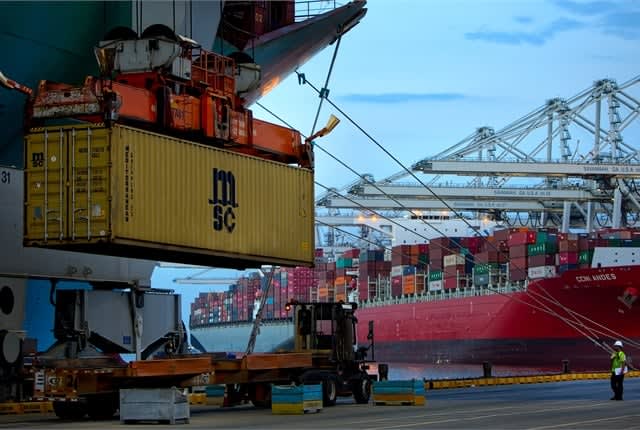
Post-Panamax cranes unload intermodal containers at the Port of Savannah's Garden City Terminal.Photo: Georgia Port Authority
Intermodal cargo is booming at the nation’s ports. The Port of Los Angeles and the Port of Long Beach both reported record levels of cargo. Georgia's Port of Savannah hit its highest annual volume ever, and the Port of New York and New Jersey also shattered its previous annual cargo volume record, set in 2015.
Ports of Los Angeles and Long Beach
The Port of Los Angeles moved more cargo in 2017 than in any time in its 110-year history, racking up 9.34 million TEUs (Twenty-Foot Equivalent Units), a 5.5% increase over 2016’s record-breaking year. It’s the most cargo moved annually by a Western Hemisphere port, according to officials.
Supply chain efficiencies implemented by the Port in 2017 included technology upgrades, like the new “Port Optimizer” digital information portal, which aggregates key cargo data online for better cargo tracking, projections and productivity. Infrastructure upgrades like those completed at TraPac Container Terminal and Yusen Terminals during 2017 continue to boost the port’s ability to service increasingly larger ships, as well as to more efficiently facilitate cargo movement throughout its terminals.
In addition, the Port of Long Beach reported its busiest year ever in 2017, moving 7.54 million TEUs, an increase of more than 11%, despite having to deal with replacing a bankrupt shipping tenant.
Port of New York and New Jersey
Thanks in part to completion of the Bayonne Bridge Navigational Clearance Project last summer, the Port of New York and New Jersey handled 6.7 million TEUs (a 20-foot-long intermodal cargo container), a 5.3% increase over the 6.37 million TEUs handled in 2015.
The record volumes allowed the port to maintain its position as the third largest port in the United States with 15.4% market share and the busiest on the East Coast with a 32% market share.
Part of the increase is due to a booming economy. Another, for ports on the East Coast, is likely larger container ships. Since the widening of the Panama Canal, some ships that previously had to dock on the West Coast and truck their product eastward are now able to deliver to the East Coast instead.
At the Port of New York and New Jersey, the bridge project raised the clearance under the crossing from 151 feet to 215 feet, allowing ships as large as 18,000 TEUs to travel under it to port facilities in Newark, Elizabeth and Staten Island. Following the raising of the bridge, one of the port’s major shipping lines – CMA CGM – began a new service to the port using primarily 14,000-TEU vessels.
Georgia Port Authority
Further south, the Georgia Port Authority reported the Port of Savannah handled more than 4 million TEUs in 2017, the port’s highest annual volume ever and an increase of 11% from last year. For the month of December, GPA handled 323,000 TEUs, up 10.6%, for the busiest in its history.
Georgia recently announced a strategic growth plan for its ports that will allow for 10 million TEUs a year. The GPA’s 2028 Plan calls for 42 ship-to-shore cranes, 200 yard cranes, new RTG lanes and significant intermodal expansion in Savannah. The GPA will soon open its second inland terminal in Northwest Georgia and break ground on the Mason Mega Rail project at Garden City Terminal. Combined, both intermodal projects will open new markets while significantly reducing rail crossings and over the road freight through Savannah, Atlanta and beyond, according to GPA.
The Georgia Port Authority is working on deepening its waters to allow the larger container ships. Savannah's outer harbor dredging will be finished in March, bringing the Savannah Harbor Expansion Project to 50% completion. Deepening the inner harbor should be complete by late 2021, allowing Neo-Panamax vessels to take on more cargo and transit the river with greater scheduling flexibility.
“Savannah is double the size of the next largest port in the region, highlighting Georgia’s growing role as a gateway for American cargo,” GPA Executive Director Griff Lynch told Maritime Executive. “Similarly, there is no deepening project more significant in the nation at this time than the Savannah Harbor Expansion Project.”
Cutting pollution at the ports
Even as cargo is increasing, the ports brag that pollution is dropping.
The Port of New York and New Jersey said even with the increase in cargo volume since 2015, the particulate matter and nitrogen oxide emissions created by port activities have gone down by more than 14% – equivalent to removing at least 104,000 passenger cars off the street per year – due to the port’s Clean Air Strategy environmental programs.
Last summer, the Port of Los Angeles reported that it achieved record clean air gains while moving more cargo than ever in 2016, according to the Port’s 2016 Inventory of Air Emissions. Since the Port’s baseline inventory in 2005, diesel particulate matter (DPM) emissions have fallen 87%, sulfur oxides (SOx) emissions have plummeted 98%, and nitrogen oxide (NOx) emissions have dropped 57%. During the same period, the port moved more than 8.85 million TEUs.
More Fleet Management

Sponsored•September 16, 2026
Color Match Smarter: Tools That Restore & Perform
For fleet managers and collision repair professionals keeping heavy-duty trucks on the road, getting the color right the first time isn't just about appearance — it's about efficiency, turnaround time, and bottom-line results. Discover how today's digital color tools are transforming the repair process from guesswork to precision.
Read More →
FMCSA Pauses Biennial-Update Enforcement Amid Motus Transition
Carriers whose updates were due on or after June 1 have more time, while FMCSA works to stabilize its new registration system and warns of phishing sites impersonating its new carrier registration system, Motus.
Read More →
Sponsored•September 14, 2026
2026 Blueprint for Countering Smarter Supply Chain Theft
Cargo theft is no longer just the cost of doing business. It's a multi-billion-dollar criminal enterprise exploiting vulnerabilities across your fleet, drivers, and supply chain.
Read More →


Sponsored•September 1, 2026
How Telematics Improves Visibility, Control, and Performance in Refrigerated Fleets
Explore how telematics help refrigerated fleets improve visibility, uptime, efficiency, compliance, and cargo protection across connected cold chain operations.
Read More →
What the U.S.-Canada Trade War Means for Trucking
Escalating U.S.-Canada tariffs could disrupt cross-border freight, reduce truck volumes, raise costs, and create new uncertainty for carriers on both sides of the border.
Read More →
What Are Trucking’s Top Concerns for 2026?
The American Transportation Research Institute wants to know what's worrying trucking fleet managers, drivers, and other stakeholders in its annual Industry Issues survey.
Read More →
American Trucking Associations Looks for a New Leader
ATA President and CEO Chris Spear abruptly left his job at the association on August 21, at a pivotal time for the trucking industry.
Read More →
Public Wi-Fi Cybersecurity Risks: How Truck Drivers and Fleets Can Protect Their Data
Public Wi-Fi can expose truck drivers and fleets to credential theft, malware, and other cyber threats. Here’s how to reduce the risk on the road.
Read More →
For Nicky Cupp, Fleet Innovation Starts With Frustration
HDT Truck Fleet Innovator Nicky Cupp turns everyday pain points at Fraley & Schilling into opportunities for better technology and smarter processes.
Read More →
Adam Buttgenbach’s Approach to Electric Trucks: Start With Where They Fit
HDT Truck Fleet Innovator Adam Buttgenbach helped PepsiCo build one of North America’s largest EV fleets by focusing on where electric trucks make operational sense.
Read More →