




Economic Watch: Housing, Industrial Production, E-Commerce Sales Improve
The U.S. housing market improved in October following some ups and downs earlier in the year, while industrial production jumped in part due to increased manufacturing. And e-commerce retail sales continued booming in the third quarter.


The U.S. housing market improved in October following some ups and downs earlier in the year, while industrial production jumped in part due to increased manufacturing. And e-commerce retail sales continued booming in the third quarter.
New home construction surged 13.7% from the month before to an annual rate of 1.29 million units, according to a Commerce Department report Friday. That’s the highest level in a year and better than a consensus estimate from analysts. September’s performance also was revised slightly higher.
The October increase ended three straight months of declines triggered due to shortages of land, labor and even building materials, according to Reuters, which had put a damper on both new home construction and even sales of these homes. The 2.4% increase in total housing starts from the same time a year ago also has been kept lower due to less multi-family home construction.
Construction of new single-family homes, the largest share of the market, saw a 5.3% increase in October from the month before, hitting its highest level in eight months.
Also, the number of building permits issued for all homes, an indicator of future building levels, moved 5.9% higher in October to its highest level since January.
Overall, the “report does point to momentum for new home sales,” according to analysts at Econoday, who noted the housing market started the year off strong but stumbled through the spring and had a flat summer.
Analysts at Wells Fargo Securities said the pace of building came back stronger than before two hurricanes hit the U.S. this summer. The increase in permits issued also bodes well for residential investment in coming months.
This follows another report on the housing market from Thursday that revealed builder confidence in the market for newly built single-family homes rose two points to a level of 70 in November, according to the National Association of Home Builders/Wells Fargo Housing Market Index.
This is the highest reading since March and the second highest on record since July 2005.
“November’s builder confidence reading is close to a post-recession high, a strong indicator that the housing market continues to grow steadily,” said NAHB Chairman Granger MacDonald. “However, our members still face supply-side constraints, such as lot and labor shortages and ongoing building material price increases.”
Two out of the three HMI components registered gains in November. The component gauging current sales conditions rose two points to 77 and the index measuring buyer traffic increased two points to 50. Meanwhile, the index charting sales expectations in the next six months dropped a single point to 77.
“Demand for housing is increasing at a consistent pace, driven by job and economic growth, rising homeownership rates and limited housing inventory,” said NAHB Chief Economist Robert Dietz. “With these economic fundamentals in place, we should see continued upward movement of the single-family housing market as we close out 2017.”
Industrial Production Gains for Second Straight Month
Another report showed industrial production in the U.S. increased strongly in October, better than analysts’ expectations, due in large part to a 1.3% jump in manufacturing.
The Federal Reserve’s gauge showed industrial production rose 0.9% in October from the month before. The measure for utilities rose 2%, while mining output fell 1.3%, as Hurricane Nate caused a sharp but short-lived decline in oil and gas drilling and extraction.
This follows an upwardly revised overall September increase of 0.4% from the previous month and a 0.5% drop in August, earlier reported as a 0.7% decline.
Even so, industrial activity was boosted in October by a return to normal operations after Hurricanes Harvey and Irma suppressed production in August and September. Excluding the effects of the hurricanes, the index for total output advanced about 0.3% in October, and the index for manufacturing advanced about 0.2 percent, according to the Fed.
With modest upward revisions for July through September, industrial production is now estimated to have only edged down 0.3% at an annual rate in the third quarter; the previously published estimate showed a decrease of 1.5%.
Total industrial production has risen 2.9% over the past 12 months, while output in October was 106.1% of its 2012 average. Capacity utilization for the industrial sector was 77%, a rate that is 2.9 percentage points below its 1972 -2016 average.
While the manufacturing output surge is encouraging, it is overstated by the hurricane rebound, according to Tim Quinlan, senior economist at Wells Fargo Securities.
He noted the October jump in manufacturing output was largely attributable to hurricane-related sectors, including a 5.8% increase in chemicals output, a 4% jump in petroleum and coal products, and a 1% percent increase in motor vehicle and parts production.
“The dollar has weakened from its late 2016/early 2017 high, and the broad- based pick-up in global economic growth has created a rising tide for the world’s economies,” Quinlan said. “The improvement in industrial production in the United States has coincided with stronger industrial production growth in other advanced economies and developing economies. With encouraging fundamentals in place, we expect the slow but steady improvement in the U.S. factory sector to continue in the coming months.”
E-Commerce Sales Continue Increasing
Lastly, the Commerce Department reported on Friday that e-commerce retail sales in the U.S., estimated at $107 bilion, increased 3.6% in the third quarter of the year from the second quarter.
While this marks another consecutive quarter of growth, it’s lower than the revised 4.7% increase in the second quarter of the year.
E-commerce retail sales expanded much faster than overall retail sales during the most recent quarter, jumping 15.5% from the same time in 2016. Total retail sales increased less, moving up just 4.3%.
E-commerce retail sales in the third quarter accounted for 9.1% of total retail sales, up from an 8.9% share during the second quarter of 2017 and an 8.2% share in the third quarter of 2016.
More Fleet Management

Enhance Fleet Performance with High-Efficiency Auxiliary Power Units
Drive sustainable cost savings while increasing driver comfort during short- and long-haul logistics operations.
Read More →
Is Your Parts Procurement Process Reactive or Proactive?
Ready to revamp your parts procurement process? Learn how now with “Strategic Parts Purchasing: A Process Checklist”
Read More →
What Trucking Events are Happening in 2026?
Looking for trucking-related conventions, expos, and other events? Heavy Duty Trucking has developed this list of national and larger regional trucking shows and events.
Read More →
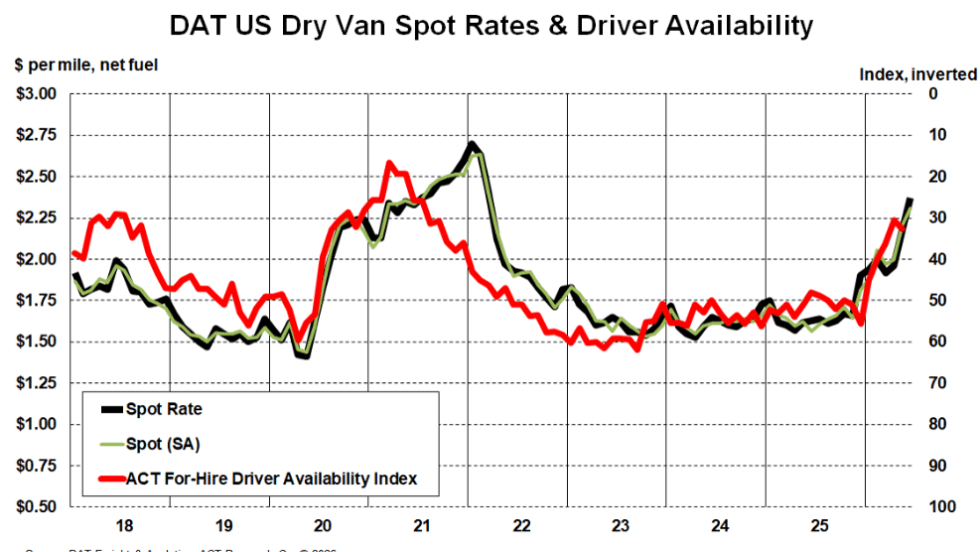
Truckload Rates Keep Rising as Tight Capacity Fuels Freight Market Recovery
Spot and contract rates continued climbing in May and June, not because freight demand is surging, but because fewer trucks and drivers are available.
Read More →
What Geotab's New AI Connector Means for Fleets
Fleets can now ask their usual AI assistants questions about maintenance, safety, fuel use, and vehicle performance, using their live Geotab data, and take action on the answers without leaving their preferred AI tool.
Read More →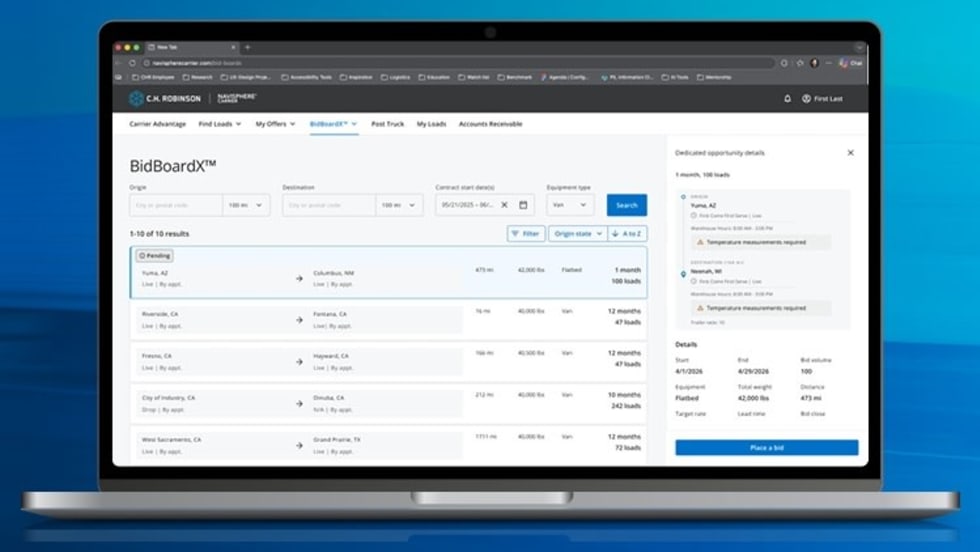
New C.H. Robinson Tool Opens Door to More Predictable Freight
BidBoardX lets carriers search, bid on, and secure committed freight opportunities through a single digital marketplace.
Read More →
New York City's Microhub Project is Delivering Results
Trucking, last-mile delivery companies, and environmental advocates like what they are seeing so far with New York's microhub program.
Read More →
Why Truck Detention Keeps Costing Fleets Time and Money
A 2024 ATRI study found detention affects nearly 40% of truckload stops and costs the industry more than $15 billion annually. Despite the toll on drivers, fleets, and supply chains, the problem remains stubbornly persistent.
Read More →
Time is Running Out to Apply for Exclusive HDT Event
Heavy Duty Trucking Exchange brings fleet managers and suppliers together for the deeper conversations that lead to ideas, partnerships, and solutions. Time is running out to apply for the September event.
Read More →
Amazon Launches Less-Than-Truckload Freight Offering for All Businesses
This launch is the latest addition to Amazon Supply Chain Services, a portfolio of supply chain capabilities from Amazon, including freight, distribution, fulfillment, and parcel shipping.
Read More →