




Related: There's An App for That
PeopleNet and TMW Heads Talk On-Demand Economy at User Conference
The on-demand economy was the focus on day one of PeopleNet and TMW Systems' in.sight Conference, examining how transportation businesses must become increasingly interconnected to keep up with the market.
by Staff
August 14, 2017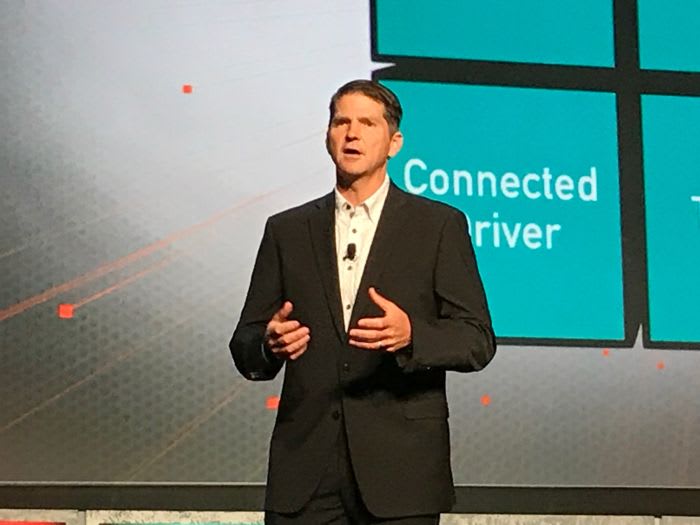
Brian McLaughlin, president of PeopleNet addressing the opening session of the in.sight User Conference + Expo. Photo: Jim Beach
2 min to read
Brian McLaughlin, president of PeopleNet addressing the opening session of the in.sight User Conference + Expo.Photo: Jim Beach
The on-demand economy was the focus on day one of PeopleNet and TMW Systems' in.sight Conference, examining how transportation businesses must become increasingly interconnected to keep up with the market. PeopleNet and TMW are both part of Trimble’s transportation and logistics division.
The message was delivered to an audience of fleet professionals, third-party logistics providers, freight brokers and other transportation industry personnel during the opening general session of the 2017 PeopleNet and TMW Systems in.sight User Conference + Expo in Nashville, Tenn.
TMW president David Wangler and PeopleNet president Brian McLaughlin, emphasized advancements in mobile technology in their opening addresses, connecting the rise of mobile technology with the rise of B2B and B2C eCommerce and the omni channel business model. They explained that as online sales grow and consumer expectations increase, the transportation industry is becoming more reliant on data to deliver products quickly and efficiently.
“Regardless of product category, the on-demand economy is revolutionizing the movement of goods from supplier to end user,” said Wangler. “The digital mobility first offered in early devices has today become the catalyst for the millions of business-critical actions occurring every second.”
The changes from the shift toward an on-demand economy have spurred increased diversification among for-hire carriers, brokers, 3PLs and private fleets, according to Wangler. This has caused transportation businesses to seek technologies that allow near-real time decision making through the use of predictive analytics, and visibility into each step of the order and fulfillment process.
McLaughlin spoke about achieving a connected supply chain to address the competitive challenges associated with an on-demand economy, and how Trimble’s transportation businesses could assist companies looking to capitalize on growth opportunities in the market.
“Trimble is leading the industry in developing innovative solutions that help maximize collaboration among supply chain partners,” said McLaughlin. “The right technology, and the right technology partners can enable supply chain simplicity, precision, and efficiency.”
The in.sight User Conference + Expo continues through Aug. 16, with a schedule of more than 400 educational sessions, technology exhibits from 70 solutions providers, peer to peer roundtable discussions and several networking events.
More Fleet Management

Geotab Links Fleet Card to Vehicle Data
The new card combines fuel discounts with telematics-based purchase controls. Geotab’s analysis also points to potential savings from choosing lower-priced fuel stops.
Read More →
How MFA Helps Protect Trucking Fleets
Multi-factor authentication adds protection when passwords are stolen. Here’s how it works and where fleets should start.
Read More →
How Better Freight Data Helps Trucking Teams Get Ahead of Disruption
Trucking and logistics teams have plenty of data. The problem is getting the right information in front of the right people soon enough to act. Better-connected data can help teams spot trouble earlier and make smarter decisions before small problems become big ones.
Read More →

Trimble: Taking Artificial Intelligence in Trucking Beyond Faster Tasks
At Insight 2026, Trimble executives argued that fleets may need to redesign workflows to get more from AI as it introduced new products and enhancements. AI’s value will depend on how fleets combine automation with their people's knowledge.
Read More →
Sponsored•September 28, 2026
Build a bulletproof fleet: Uniting ELDs and dash cams for total compliance
An ELD can prove compliance, but it cannot always prove what happened on the road. Discover how uniting accurate ELD data with AI-powered dash cam video can help your fleet strengthen compliance, defend against liability, protect drivers and reduce operational costs.
Read More →
Nominations Open for HDT Emerging Leaders
Heavy Duty Trucking is looking for accomplished trucking fleet professionals under 40 who are making an impact and helping lead the industry forward.
Read More →
Why Private Fleets Are Taking More Freight
Private fleets are putting their own trucks on demanding customers and high-cost lanes as companies seek greater control over service, costs, and capacity.
Read More →
Sponsored•September 16, 2026
Color Match Smarter: Tools That Restore & Perform
For fleet managers and collision repair professionals keeping heavy-duty trucks on the road, getting the color right the first time isn't just about appearance — it's about efficiency, turnaround time, and bottom-line results. Discover how today's digital color tools are transforming the repair process from guesswork to precision.
Read More →
FMCSA Pauses Biennial-Update Enforcement Amid Motus Transition
Carriers whose updates were due on or after June 1 have more time, while FMCSA works to stabilize its new registration system and warns of phishing sites impersonating its new carrier registration system, Motus.
Read More →
Sponsored•September 14, 2026
2026 Blueprint for Countering Smarter Supply Chain Theft
Cargo theft is no longer just the cost of doing business. It's a multi-billion-dollar criminal enterprise exploiting vulnerabilities across your fleet, drivers, and supply chain.
Read More →