





Related: Tesla Electric Truck Will Feature Autonomous Driving Technology
More Details Emerge on Tesla Electric Big Rig
Tesla's soon-to-be-unveiled all-electric truck will be a day cab model with a 200- to 300-mile daily operating range, according to a report by Reuters.
August 25, 2017
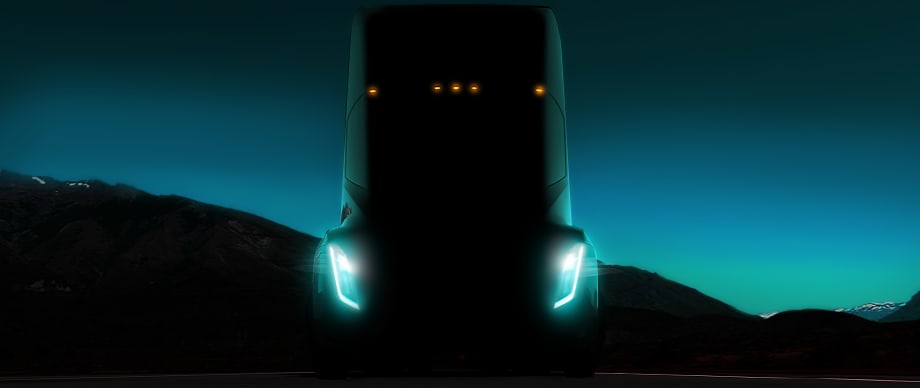
The Reuters News Agency is reporting that Tesla's electric truck will be a day cab model without a sleeper. Photo: Tesla
2 min to read
The Reuters News Agency is reporting that Tesla's electric truck will be a day cab model without a sleeper. Photo: Tesla
CORRECTED -- New details concerning the introduction of Tesla’s all-electric truck, slated for public unveiling are emerging. The new truck will have a working range of 200 to 300 miles, Reuters has learned, a sign that the electric car maker is targeting regional hauling for its entry into the commercial freight market. Tesla has indicated that it will unveil the truck to the public next month, but is being tight-lipped as to when, or where, that public debut will take place.
Scott Perry, chief technology and procurement officer at Ryder System, told Reuters he has met with Tesla and that the new truck will be a day cab model. “I’m not going to count them out for having a strategy for longer distances or ranges, but right out of the gate I think that’s where they’ll start,” Perry said.
The article noted that Tesla’s plan is “consistent with what battery researchers say is possible with current technology,” and said that the company has not said publicly how far its electric truck could travel, what it would cost or how much cargo it could carry.
An article earlier this summer in Wired reported that a pair of Carnegie Mellon University researchers found a battery-powered semi would be limited to a 300-mile range, and that to cover 600 miles without stopping to charge, the truck would need a 14-ton battery.
Reuters also reported earlier this month that Tesla is developing self-driving capability for the big rig.
Sandeep Kar, formerly with industry analysts Frost & Sullivan and now chief technology officer of Fleet Complete, a company that tracks and analyzes fleet and truck movements, told Reuters Tesla CEO that Elon Musk may well have found a sweet spot for the new electric if he can deliver, noting that roughly 30% of U.S. trucking jobs are regional trips of 100 to 200 miles daily. A truck with that range would be able to move freight regionally, such as from ports to nearby cities or from warehouses to retail establishments. “As long as (Musk) can break 200 miles, he can claim his truck is ’long haul’ and he will be technically right,” Kar told Reuters.
Corrected to reflect the fact that we have not been able to ascertain where and when Tesla plans to introduce this truck.
Read more about the latest advancements in electric truck technology in the September issue of Heavy Duty Trucking.
More Fleet Management

Sponsored•September 16, 2026
Color Match Smarter: Tools That Restore & Perform
For fleet managers and collision repair professionals keeping heavy-duty trucks on the road, getting the color right the first time isn't just about appearance — it's about efficiency, turnaround time, and bottom-line results. Discover how today's digital color tools are transforming the repair process from guesswork to precision.
Read More →
FMCSA Pauses Biennial-Update Enforcement Amid Motus Transition
Carriers whose updates were due on or after June 1 have more time, while FMCSA works to stabilize its new registration system and warns of phishing sites impersonating its new carrier registration system, Motus.
Read More →
Sponsored•September 14, 2026
2026 Blueprint for Countering Smarter Supply Chain Theft
Cargo theft is no longer just the cost of doing business. It's a multi-billion-dollar criminal enterprise exploiting vulnerabilities across your fleet, drivers, and supply chain.
Read More →


Sponsored•September 1, 2026
How Telematics Improves Visibility, Control, and Performance in Refrigerated Fleets
Explore how telematics help refrigerated fleets improve visibility, uptime, efficiency, compliance, and cargo protection across connected cold chain operations.
Read More →
What the U.S.-Canada Trade War Means for Trucking
Escalating U.S.-Canada tariffs could disrupt cross-border freight, reduce truck volumes, raise costs, and create new uncertainty for carriers on both sides of the border.
Read More →
What Are Trucking’s Top Concerns for 2026?
The American Transportation Research Institute wants to know what's worrying trucking fleet managers, drivers, and other stakeholders in its annual Industry Issues survey.
Read More →
American Trucking Associations Looks for a New Leader
ATA President and CEO Chris Spear abruptly left his job at the association on August 21, at a pivotal time for the trucking industry.
Read More →
Public Wi-Fi Cybersecurity Risks: How Truck Drivers and Fleets Can Protect Their Data
Public Wi-Fi can expose truck drivers and fleets to credential theft, malware, and other cyber threats. Here’s how to reduce the risk on the road.
Read More →
For Nicky Cupp, Fleet Innovation Starts With Frustration
HDT Truck Fleet Innovator Nicky Cupp turns everyday pain points at Fraley & Schilling into opportunities for better technology and smarter processes.
Read More →
Adam Buttgenbach’s Approach to Electric Trucks: Start With Where They Fit
HDT Truck Fleet Innovator Adam Buttgenbach helped PepsiCo build one of North America’s largest EV fleets by focusing on where electric trucks make operational sense.
Read More →