




More from FTR: Increased Costs Could Mean Less Favorable Trucking Conditions
Analysis: Industrial Activity Points to a Mixed Picture
Recent reports on industrial activity have done little to change FTR's viewpoint on the strength of the U.S. economy or freight demand.
by FTR
August 25, 2017
3 min to read
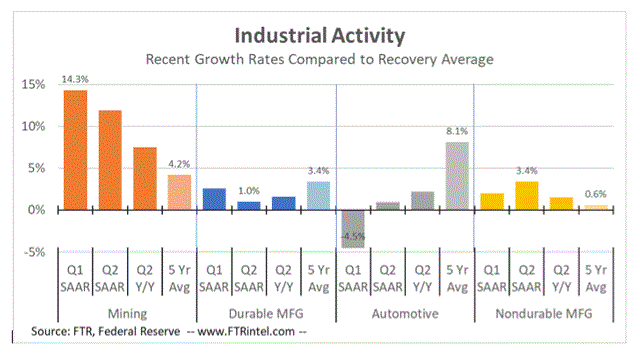
Industrial activity has picked up its pace during 2017 after a stretch of weakness that lasted from mid-2015 until late 2016. Recent reports have done little to change our underlying assumptions of the U.S. economy or freight demand.
Let’s key in on a couple of important segments to trucking and see what sort of movement has occurred during the first half of 2017.
Mining
It is easy to see from the chart above that mining activity was very, very strong early in 2017. This sector includes four important segments: stone/earth, metal, coal, and oil/gas. Not surprisingly, the impetus for growth has come from the oil and gas shale fields. Construction (and especially housing) have been lackluster, metal demand has rebounded some but remains weak, and coal demand turned back up in late 2016 but hasn’t moved much since then.
Durable Manufacturing
Durables are the biggest component of manufacturing and tend to be more cyclical than non-durables (we may not buy a new car during a recession, but we still eat and drive). This segment slowed noticeably during the second quarter – and it remains well below the average growth for this recovery.
Automotive
Automotive (this includes both vehicles and parts) is a big component of durable manufacturing. While we did eke out a gain in the second quarter, you can easily see that we are running well below the recovery average and we had a very negative quarter in Q1. Automotive demand looks to have topped out, and growth in industrial activity or freight demand is not likely to come from this segment.
Non-Durable Manufacturing
Non-durables did see a notable uptick in the second quarter. Surprisingly, this sector has been quite weak during much of this recovery. The three main segments are: food, fuel, and chemicals. Chemicals growth has been weaker than anticipated during this recovery as it seems that a portion of our export activity has dried up. Our abundant natural gas (thanks to fracking) would seem to be a positive since it is a major input into many of the chemical processes, but, as of yet, it has not made a big mark on overall output.
While some industrial activity has shown recent improvement, it is nowhere near the big gains in demand and pricing that we have seen from the spot market over the last year. Contract markets, however, are adjusting more slowly. Can we keep the growth going if the industrial sector doesn’t show further improvement?
One noteworthy item has been the sustained power of this recovery. It has not been overly strong, but it has been historically long. The good news is that there is nothing currently happening that would indicate a serious threat to the continuation of a 2%+ economy. That should give us a reprieve from recession talk for at least another year. After that…stay tuned.
More Fleet Management

How MFA Helps Protect Trucking Fleets
Multi-factor authentication adds protection when passwords are stolen. Here’s how it works and where fleets should start.
Read More →
How Better Freight Data Helps Trucking Teams Get Ahead of Disruption
Trucking and logistics teams have plenty of data. The problem is getting the right information in front of the right people soon enough to act. Better-connected data can help teams spot trouble earlier and make smarter decisions before small problems become big ones.
Read More →
Trimble: Taking Artificial Intelligence in Trucking Beyond Faster Tasks
At Insight 2026, Trimble executives argued that fleets may need to redesign workflows to get more from AI as it introduced new products and enhancements. AI’s value will depend on how fleets combine automation with their people's knowledge.
Read More →

Sponsored•September 28, 2026
Build a bulletproof fleet: Uniting ELDs and dash cams for total compliance
An ELD can prove compliance, but it cannot always prove what happened on the road. Discover how uniting accurate ELD data with AI-powered dash cam video can help your fleet strengthen compliance, defend against liability, protect drivers and reduce operational costs.
Read More →
Nominations Open for HDT Emerging Leaders
Heavy Duty Trucking is looking for accomplished trucking fleet professionals under 40 who are making an impact and helping lead the industry forward.
Read More →
Why Private Fleets Are Taking More Freight
Private fleets are putting their own trucks on demanding customers and high-cost lanes as companies seek greater control over service, costs, and capacity.
Read More →
Sponsored•September 16, 2026
Color Match Smarter: Tools That Restore & Perform
For fleet managers and collision repair professionals keeping heavy-duty trucks on the road, getting the color right the first time isn't just about appearance — it's about efficiency, turnaround time, and bottom-line results. Discover how today's digital color tools are transforming the repair process from guesswork to precision.
Read More →
FMCSA Pauses Biennial-Update Enforcement Amid Motus Transition
Carriers whose updates were due on or after June 1 have more time, while FMCSA works to stabilize its new registration system and warns of phishing sites impersonating its new carrier registration system, Motus.
Read More →
Sponsored•September 14, 2026
2026 Blueprint for Countering Smarter Supply Chain Theft
Cargo theft is no longer just the cost of doing business. It's a multi-billion-dollar criminal enterprise exploiting vulnerabilities across your fleet, drivers, and supply chain.
Read More →
What the U.S.-Canada Trade War Means for Trucking
Escalating U.S.-Canada tariffs could disrupt cross-border freight, reduce truck volumes, raise costs, and create new uncertainty for carriers on both sides of the border.
Read More →