




Spot Reefer Rates Hit 4-Month High as Vans, Flatbeds Slip
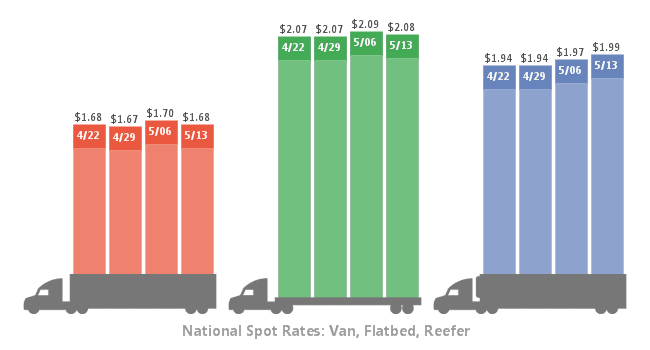
The national average spot rate for refrigerated truckload freight gained 2 cents for the week ending May 13 for $1.99 per mile, the highest weekly average rate in four months, according to new figures released by DAT Solutions and based on its network of load boards.

Graphic: DAT

The national average spot rate for refrigerated truckload freight gained 2 cents for the week ending May 13 for $1.99 per mile, the highest weekly average rate in four months, according to new figures released by DAT Solutions and based on its network of load boards.
The national average van rate was down 2 cents at $1.68 per mile, while the average flatbed rate fell 1 cent to $2.08 per mile. All rates include fuel surcharges.
Overall, the number of load posts edged down 2% last week while truck posts were up 2%. That led to lower or flat load-to-truck ratios with vans remaining and 3.3 to 1 while reefers fell 6% after a nice uptick the previous week, hitting 6.1 to 1. Flatbeds declined 6% to 36.9 to 1.
Nationally, the number of available refrigerated loads declined 1% while truck posts increased 5%. On the top 72 lanes for spot reefer freight, 51 lanes had higher rates last week despite uneven production out of Florida, shipping gaps in California, and a drop in volumes in markets near the Mexican border.
According to DAT, some key reefer lanes to watch are:
Los Angeles-Denver, $2.84 per mile, up 29 cents
Grand Rapids-Cleveland, $3.10 per mile, down 4 cents
McAllen-Dallas, $2.54 per mile, up 3 cents
Atlanta-Chicago, $1.72 per mile, up 18 cents
Elizabeth, New Jersey-Boston, $3.58 per mile, up 23 cents
Miami outbound faded but high demand from Lakeland buoyed rates in Florida. Lakeland-Baltimore surged 40 cents to $2.68 per mile on average. Two reefer markets to watch in California are Fresno, where the average outbound rate jumped 12 cents to $2.14 per mile, and Los Angeles, also up 12 cents, at $2.57 per mile.
Nationally, the number of posted van loads and trucks each increased 1%. No major van markets made big moves, but outbound rates in Houston, $1.76 mile; up 3 cents, and Los Angeles; $2.01 per mile, unchanged, have both improved by 5% over the past month.
The average length of haul in the van market decreased last week, so the larger rate increases were generally on shorter, regional lanes including:
Atlanta-Charlotte: $2.40 per mile, up 23 cents
Philadelphia-Boston: $3.18 per mile, up 16 cents, though return loads are hard to come by and they generally don't pay well
Houston-New Orleans: $2.53 per mile, up 15 cents
Memphis-Indianapolis: $1.89 per mile, up 12 cents
The biggest van rate declines last week were on long-haul lanes. Intermodal companies have also been competing for market share lately with aggressive pricing, which has pushed truckload rates lower on longer lanes that compete with rail, according to DAT.
In the flatbed sector load posts declined 3%, while truck posts increased 3%. Despite this the flatbed load to truck ratio continues to increase well beyond levels from the same time in 2016 and 2015.
Among the more notable flatbed rates there is the Harrisburg, Pennsylvania-Baltimore lane at $3.64 per mile; Atlanta-Memphis at $2.66 per mile, and Rock Island, Illinois-Cleveland at $2.55 per mile.
More Fleet Management

Time is Running Out to Apply for Exclusive HDT Event
Heavy Duty Trucking Exchange connects heavy-duty trucking fleet managers with industry suppliers through one-on-one meetings, small-group discussions, educational sessions, and networking opportunities with both suppliers and other fleet managers.
Read More →
Amazon Launches Less-Than-Truckload Freight Offering for All Businesses
This launch is the latest addition to Amazon Supply Chain Services, a portfolio of supply chain capabilities from Amazon, including freight, distribution, fulfillment, and parcel shipping.
Read More →
Import Cargo Volume to See Year-Over-Year Gain Again in June, Then Remain Below 2025 Levels Into Fall
After July, the report predicts a weakening in import volume as consumer uncertainty remains high and the impact of increasing inflation takes its toll.
Read More →

AUCTION OF EQUITY INTEREST IN HEAVY HAUL TRUCKING COMPANY!!
Mark your calendar: June 30, 2026 (10:00 a.m. PDT). A 37.5% ownership interest in MagnaTrans, LLC, a California limited liability company doing business as Magna Transportation Group, will be sold in an in-person and online auction to the highest bidder or bidders under Article 9 of the Uniform Commercial Code. The Rancho Cucamonga-based heavy haul and over-dimensional trucking company operates across California, Oregon, and Arizona.
Read More →
Volvo Trucks Adds Unattended Over-the-Air Software Update Capabilities
The latest evolution of Volvo’s over-the-air update technology allows software updates to run while trucks are parked, helping fleets keep vehicles current without disrupting operations.
Read More →
How Waste Connections is Using Data, Telematics, and AI
How do you manage and maintain more than 18,000 connected trucks? Data. Lots of it.
Read More →
Why Fleet Data Matters More Than Ever at Waste Connections [Watch]
Waste Connections' Chuck Palmer explains how telematics, predictive maintenance, safety analytics, and AI help keep vehicles on the road and drivers safe in this episode of HDT Talks Trucking.
Read More →
NMFTA Launches Free, Anonymous Cybersecurity Threat Report Portal
Organizations are encouraged to anonymously report freight fraud, cargo crime, and cyber threats while gaining visibility into incidents reported across the transportation sector.
Read More →
AI Can Optimize a Fleet. Can It Replace Human Judgment?
Fleets fear falling behind if they don’t adopt AI quickly enough. They also fear what happens if the technology makes the wrong decision.
Read More →
Jamie Hagen Gets Real About Running a Small Fleet in an Uncertain Economy
Small fleet owner Jamie Hagen says new legal risks, volatile fuel prices, and a changing freight market are forcing small carriers to rethink how they operate — and what they can afford.
Read More →