




Spot Freight Rates Hold as Load Volume Gains Slightly
The final week of any month usually means a bump in freight activity as shippers move goods prior to closing their books. However, the number of loads posted on the DAT network of load boards edged up just 2% for the the week ending April 29, according to DAT Solutions.

Graphic: DAT
Graphic: DAT
The final week of any month usually means a bump in freight activity as shippers move goods prior to closing their books. However, the number of loads posted on the DAT network of load boards edged up just 2% for the the week ending April 29, according to DAT Solutions.
With truck posts rising 8%, load-to-truck ratios fell with the biggest declines seen by reefers, down 13% to 5.8 loads per truck. Flatbeds fell 7% but still at a very healthy 44.5 to 1 level, while vans slipped 4% to 3.4 loads per truck.
While April may have ended quietly, rates rose for all trailer types during the month and load-to-truck ratios were above seasonal norms, signaling a strong start to the second quarter, according to DAT.
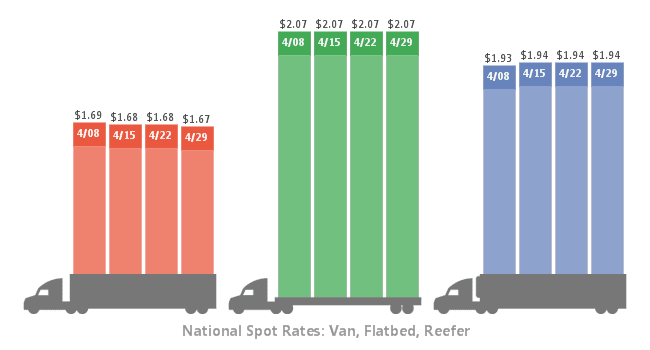
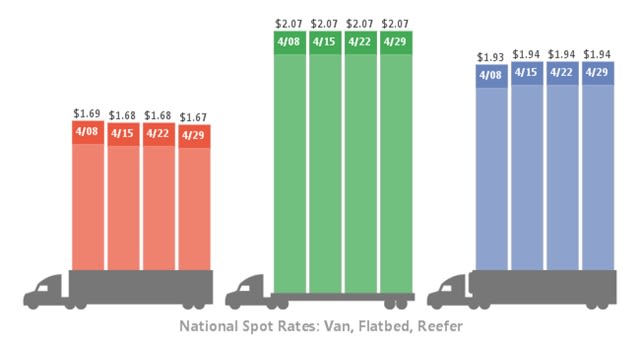
The national average van rate dipped 1 cent to $1.67 per mile, but that rate is still 4 cents higher than the March average while the national reefer rate remained at $1.94 per mile for the third straight week, but that’s 7 cents better than the March average. The average flatbed rate was unchanged at $2.07 per mile throughout April, but 4 cents better than the March average
Reefer load posts declined 5% while truck posts increased 10%. But compared to the same period in 2015 and 2016, reefer load-to-truck ratios are solid.
If you looked at the national average reefer rate, you might think that there wasn’t much happening in the spot market. But there was an influx of produce crossing the Mexican border last week, said DAT, and reefer load-to-truck ratios surged in Nogales, Laredo, and especially McAllen, where volumes soared 64%.
After wildfires interrupted traffic in Florida, produce started moving out of the state again last week. Key outbound lanes there are:
Miami-Northern New Jersey reefer rates were up 17 cents to $2.26 per mile
Lakeland-Baltimore added 24 cents to $2.24 per mile
A higher load count out of the Fresno area was offset by declines farther south in California. In fact, California was behind Texas, Florida, and Georgia for reefer load availability.
DAT said it has been hearing a lot about shipping gaps in California due to delays in planting because of an unusually wet winter, which explains the flat volumes last week. The upside, it believes, is that the best is yet to come, as the multi-year drought is mostly finished, and California produce should be gaining strength in the coming weeks.
Meantime, in the van sector, load posts increased 4% while truck posts increased 8%. On the top 100 van lanes, 50 were down in volume, 41 were up, and 9 were neutral. Most changes were slight, though:
Los Angeles outbound jumped 3 cents to $2.00 per mile
Seattle-Spokane hit $2.48 per mile, up 6 cents
Houston-New Orleans rose 8 cents to $2.28 per mile
Houston-Oklahoma City added 10 cents for $1.91 per mile, a springtime high
Outbound freight volume and rates declined in Philadelphia, $1.68 per mile, down 6 cents, giving up gains made earlier in the month. Philadelphia-Boston tumbled 22 cents to an average of $3.12 per mile.
Finally, in the flatbed market, after a 20% gain last week, the flatbed load-to-truck ratio settled down 2% to 44.5. Flatbed load posts increased 2% while truck posts were up 10%. Initial numbers show the flatbed load to truck ratio in April increased 19% when compared to March and is 102% better than it was in April of 2016.
More Fleet Management

How to Modernize Your TMS Without Replacing It [Podcast]
Before investing in a new transportation management system, take a closer look at what you've already got. AI, cloud technology and better integrations may offer ways to improve your trucking operations without starting over.
Read More →
Could Your Truck's Connected Devices Be a Cybersecurity Risk?
ELDs, telematics systems and driver tablets help fleets operate more efficiently. But every connected device needs protection against cyberattacks.
Read More →
Holiday Freight Meets a Tight Trucking Market
There's no freight boom, but truckload carriers are finding themselves in a stronger position to negotiate rates. And holiday shipping demand could tighten the market further.
Read More →
What Trucking Events are Happening in 2027?
Looking for trucking-related conventions, expos, and other events? Heavy Duty Trucking has developed this list of national and larger regional trucking shows and events.
Read More →
Does Your Trucking Fleet Need a New TMS?
Artificial intelligence and better integrations promise less busywork and more useful data. Can your TMS help your company solve problems? Do you need additional vendors or an upgrade? Or is it time to look for a new platform?
Read More →
Fleet Costs Shape ACT Expo 2027 Agenda
With diesel prices high and operating expenses under pressure, ACT Expo's 2027 agenda emphasizes fuel efficiency, AI, safety and the return on fleet technology investments.
Read More →
Does Your Trucking Fleet Need a New TMS? [Video]
Cloud technology, AI and new integrations are changing what transportation management systems can do. But does taking advantage of those advances mean replacing your existing TMS?
Read More →
Road Ready Becomes Saegic, Launches New Trailer Telematics Gateway
Clarience Technologies is rolling out new hardware and expanding its plans for connecting trailer telematics, maintenance data, and video.
Read More →
Give Your Trucking Fleet a Cybersecurity Walkaround
Your fleet's cybersecurity policies may look good on paper. These seven checks can help you find out whether they’re working.
Read More →
Kodiak Lines Up Fleets for Driverless Trucking
An agreement for 75 trucks, a new Texas freight lane, and progress on safety validation move Kodiak closer to its planned driverless highway launch.
Read More →