




Winter Storm Stalls Freight, Spot Truckload Rates Remain Stable
At times, snow may have kept freight from moving last week but it didn’t prevent shippers from at least trying. The number of available loads on the spot truckload market jumped 8% for the week ending March 18 compared to the previous week, according to DAT Solutions and its network of load boards.

At times, snow may have kept freight from moving last week but it didn’t prevent shippers from at least trying.
The number of available loads on the spot truckload market jumped 8% for the week ending March 18 compared to the previous week, according to DAT Solutions and its network of load boards.
"Winter Storm Stella kept a lot of freight from moving early last week, which stalled volume in markets along the East Coast,” said DAT Market Analyst, Peggy Dorf in the DAT blog. “First, there was a rush to move freight before the storm hit, and then highways were closed, so most freight couldn’t move at all. After roads were clear, there was a rush to catch up, and the pent-up demand drove van rates higher.
The snow was not as deep as expected, so conditions should already be back to normal in most markets, according to Dorf.
Available capacity fell 3.4% as many truckers pulled equipment off the roads in anticipation of bad weather, but once things cleared up it was enough to load to truck ratios higher for all three equipment types. The van ratio increased 23% to its highest point this year at 3.4 loads per truck. Reefers jumped 16% to 6.6 loads per truck and flatbeds moved 5% higher to 37.4 loads per truck.
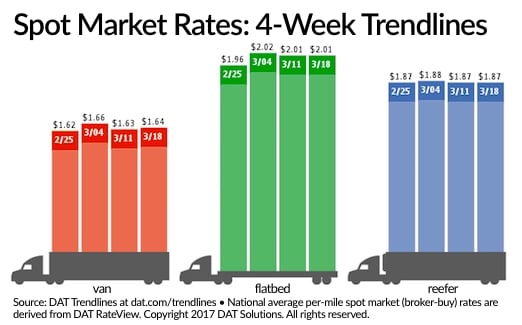
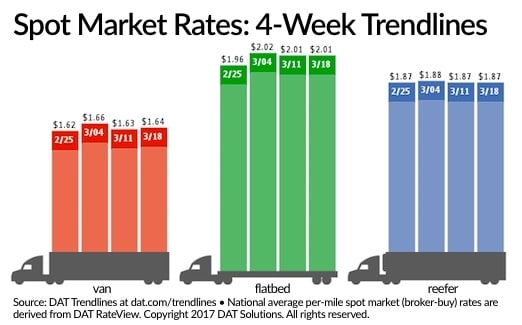
On the freight rate side, only vans increased as a national average compared to the previous week, gaining 1 cent to $1.64 per mile. The reefer rate, $1.87 per mile, and the flatbed rate, $2.01 per mile, were both unchanged. All reported rates include fuel surcharges.
The storm affected van activity in and out of East Coast markets. The average van rate gained 20 cents or more in one week on three lanes in the region:
Buffalo-Allentown, up 22 cents to $2.80 per mile
Allentown-Boston, up 22 cents at $3.19 per mile
Philadelphia-Boston, up 21 cents to $3.27 per mile
The average Allentown outbound rate gained 9 cents to $1.93 per mile, while Philadelphia averaged $1.59 mile, up a penny.
Reefer load posts increased 16% last week. A number of markets in the Southwest saw higher freight volumes and rates, led by Los Angeles; $2.27 per mile, up 4 cents. Central California remained soft, including in Fresno, where volumes declined and the average rate fell 2 cents to $1.81 per mile.
Other key reefer markets rates include:
Green Bay: $2.63 per mile, up 4 cents
McAllen, Texas: $2.08 per mile, up 16 cents
Dallas: $1.73 per mile, up 2 cents
Elizabeth, New Jersey: $1.70 per mile, up 6 cents
The flatbed load-to-truck ratio increased for the seventh week in a row as outbound load volume held steady and available capacity declined 5%.
Big rate swings were likely due to weather:
Charlotte-Roanoke, Virginia was up 37 cents to $2.95 per mile
Harrisburg-Buffalo plunged 76 cents to $2.44 per mile
Cleveland-Grand Rapids, Michigan fell 67 cents to $2.27 per mile
While there was obviously no snow in Houston, freight volumes and rates there continued to climb, and flatbed freight averaged $2.13 per mile, up 3 cents. If you look at all load posts on the DAT network of load boards, with all trailer types combined, Houston is number one so far in 2017, according to the freight matching service provider.
Other regional flatbed markets were up and down:
Phoenix: $1.71 per mile, up 9 cents
Rock Island, Illinois: $2.34 per mile, down 15 cents
Atlanta: $2.22 per mile, down 7 cents
Harrisburg: $2.99 per mile, down 15 cents
More Fleet Management

How to Modernize Your TMS Without Replacing It [Podcast]
Before investing in a new transportation management system, take a closer look at what you've already got. AI, cloud technology and better integrations may offer ways to improve your trucking operations without starting over.
Read More →
Could Your Truck's Connected Devices Be a Cybersecurity Risk?
ELDs, telematics systems and driver tablets help fleets operate more efficiently. But every connected device needs protection against cyberattacks.
Read More →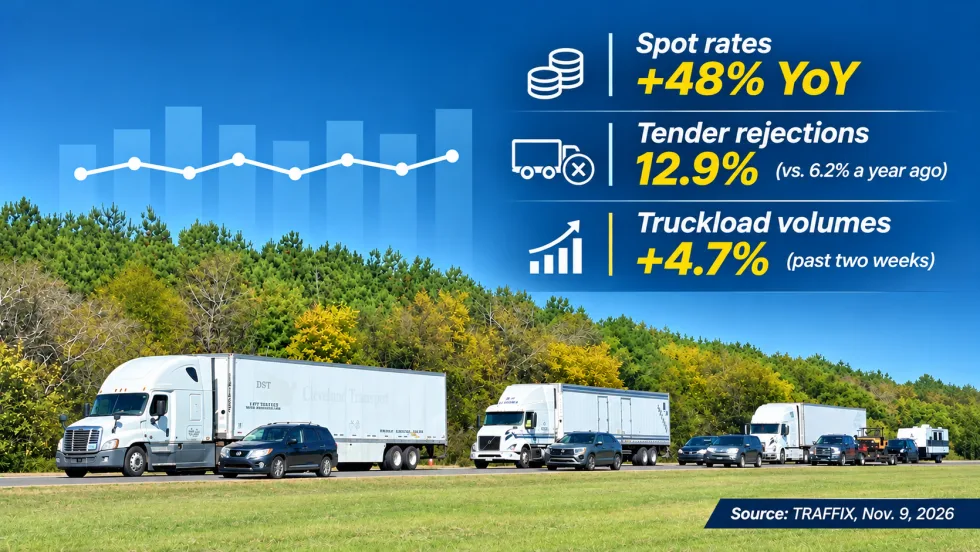
Holiday Freight Meets a Tight Trucking Market
There's no freight boom, but truckload carriers are finding themselves in a stronger position to negotiate rates. And holiday shipping demand could tighten the market further.
Read More →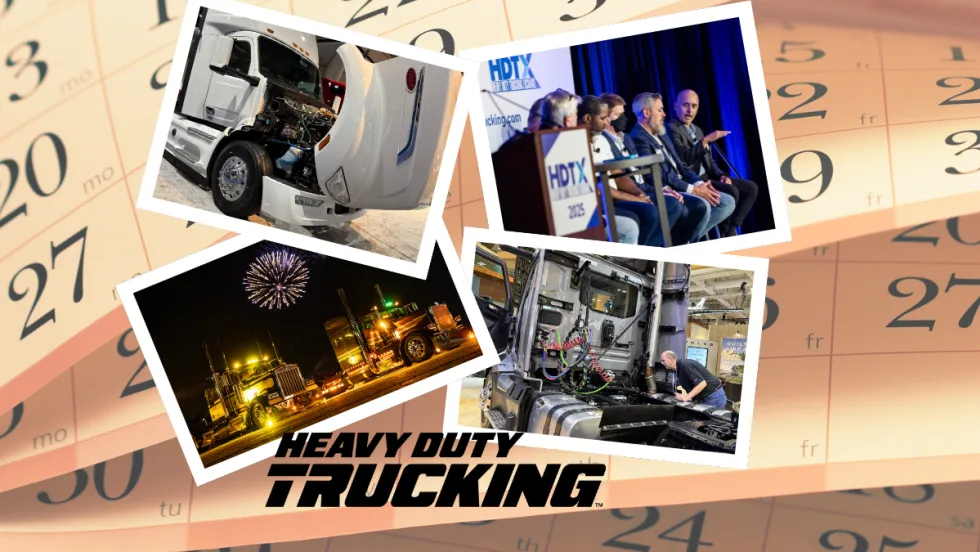
What Trucking Events are Happening in 2027?
Looking for trucking-related conventions, expos, and other events? Heavy Duty Trucking has developed this list of national and larger regional trucking shows and events.
Read More →
Does Your Trucking Fleet Need a New TMS?
Artificial intelligence and better integrations promise less busywork and more useful data. Can your TMS help your company solve problems? Do you need additional vendors or an upgrade? Or is it time to look for a new platform?
Read More →
Fleet Costs Shape ACT Expo 2027 Agenda
With diesel prices high and operating expenses under pressure, ACT Expo's 2027 agenda emphasizes fuel efficiency, AI, safety and the return on fleet technology investments.
Read More →
Does Your Trucking Fleet Need a New TMS? [Video]
Cloud technology, AI and new integrations are changing what transportation management systems can do. But does taking advantage of those advances mean replacing your existing TMS?
Read More →
Road Ready Becomes Saegic, Launches New Trailer Telematics Gateway
Clarience Technologies is rolling out new hardware and expanding its plans for connecting trailer telematics, maintenance data, and video.
Read More →
Give Your Trucking Fleet a Cybersecurity Walkaround
Your fleet's cybersecurity policies may look good on paper. These seven checks can help you find out whether they’re working.
Read More →
Kodiak Lines Up Fleets for Driverless Trucking
An agreement for 75 trucks, a new Texas freight lane, and progress on safety validation move Kodiak closer to its planned driverless highway launch.
Read More →