




Port of LA Hosts Live Platooning Demonstration
Private and public transportation partners conducted a partially automated truck platooning demonstration in California Wednesday at the Los Angeles Port complex and along the Interstate 110 freeway.
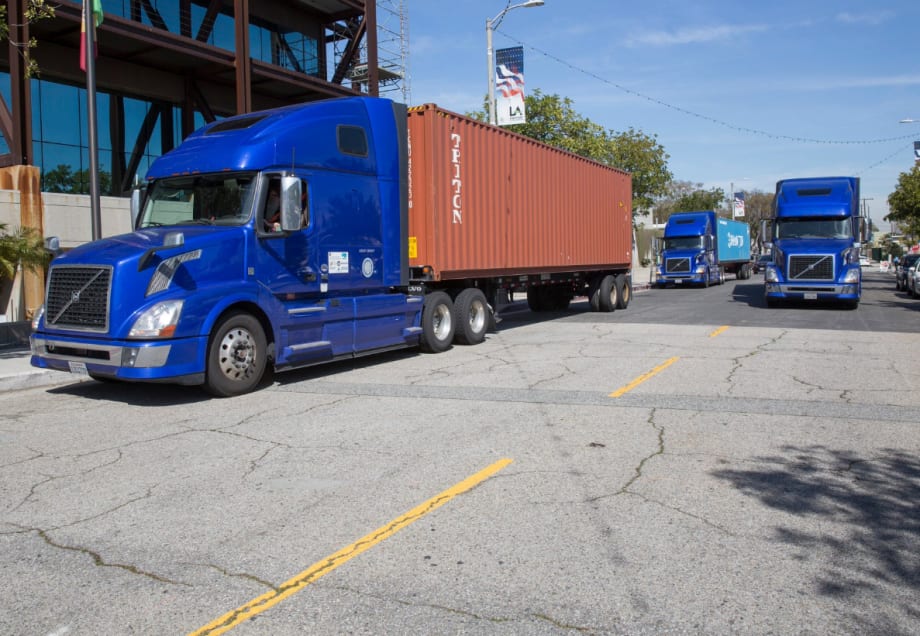
Photo via Port of Los Angeles Twitter
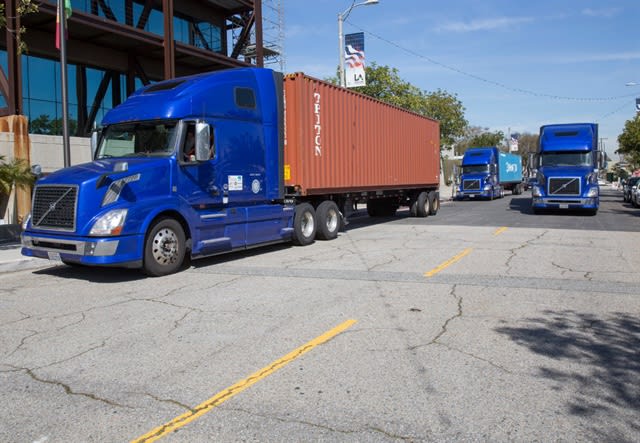
Photo via Port of Los Angeles Twitter
Private and public transportation partners conducted a partially automated truck platooning demonstration in California Wednesday at the Los Angeles Port complex and along the Interstate 110 freeway.
The Cooperative Adaptive Cruise Control system on display offered a first-hand look at platooning technology in a real-world setting. Platooning technology has the potential to impact safety, transportation system capacity and emissions reductions, note demo organizers.
In the demonstration, trucks used the technology to follow in closer proximity, using forward-looking sensors and vehicle-to-vehicle communication to maintain automated speed and spacing. CACC was developed by the University of California, Berkeley Partners for Advanced Transportation Technology (PATH), in coordination with Volvo Trucks of North America.
“Once again California is leading the nation in advanced technology,” said Malcolm Dougherty, Caltrans director. “Today we saw a demonstration of a truck technology that promises to improve California’s existing freight system by enhancing truck safety and increasing capacity on existing highways.”
The demonstration simulated real world conditions with three trucks driving 50 feet apart at 55 mph while hauling cargo containers, similar to those used at the port and at industrial centers throughout Los Angeles County. The demonstration also included vehicles cutting in front of the platooning trucks to demonstrate how the system can handle traffic.
CACC is an enhanced version of Adaptive Cruise Control, capable of closer and more accurate control of the gap and differences between trucks than conventional ACC. In addition to improving fuel economy for the platooning vehicles, CACC could also reduce congestion and increase the capacity of dedicated truck lane facilities, according to CalTrans.
“Our technology planning and traffic simulation work suggests connected vehicle and truck platooning technologies may eventually facilitate the ability to operate up to 50% more trucks on these lanes – essentially giving the capacity equivalent of a third lane of freeway in each direction,” said Mark Jensen of Cambridge Systematics, a CACC partner.
In the spring, PATH plans to test truck driver preferences among multiple gap settings on Bay Area freeways and simulate impacts on traffic and energy savings on the 710 corridor in Southern California.
“This technology will become available for use in the coming years, and when it does it should be embraced due to its numerous benefits,” said Steve Shladover, PATH representative.
Related: Self-Driving Trucks and the Platooning Stepping Stone: How Soon?
More Fleet Management

How MFA Helps Protect Trucking Fleets
Multi-factor authentication adds protection when passwords are stolen. Here’s how it works and where fleets should start.
Read More →
How Better Freight Data Helps Trucking Teams Get Ahead of Disruption
Trucking and logistics teams have plenty of data. The problem is getting the right information in front of the right people soon enough to act. Better-connected data can help teams spot trouble earlier and make smarter decisions before small problems become big ones.
Read More →
Trimble: Taking Artificial Intelligence in Trucking Beyond Faster Tasks
At Insight 2026, Trimble executives argued that fleets may need to redesign workflows to get more from AI as it introduced new products and enhancements. AI’s value will depend on how fleets combine automation with their people's knowledge.
Read More →

Build a bulletproof fleet: Uniting ELDs and dash cams for total compliance
An ELD can prove compliance, but it cannot always prove what happened on the road. Discover how uniting accurate ELD data with AI-powered dash cam video can help your fleet strengthen compliance, defend against liability, protect drivers and reduce operational costs.
Read More →
Nominations Open for HDT Emerging Leaders
Heavy Duty Trucking is looking for accomplished trucking fleet professionals under 40 who are making an impact and helping lead the industry forward.
Read More →
Why Private Fleets Are Taking More Freight
Private fleets are putting their own trucks on demanding customers and high-cost lanes as companies seek greater control over service, costs, and capacity.
Read More →
Color Match Smarter: Tools That Restore & Perform
For fleet managers and collision repair professionals keeping heavy-duty trucks on the road, getting the color right the first time isn't just about appearance — it's about efficiency, turnaround time, and bottom-line results. Discover how today's digital color tools are transforming the repair process from guesswork to precision.
Read More →
FMCSA Pauses Biennial-Update Enforcement Amid Motus Transition
Carriers whose updates were due on or after June 1 have more time, while FMCSA works to stabilize its new registration system and warns of phishing sites impersonating its new carrier registration system, Motus.
Read More →
2026 Blueprint for Countering Smarter Supply Chain Theft
Cargo theft is no longer just the cost of doing business. It's a multi-billion-dollar criminal enterprise exploiting vulnerabilities across your fleet, drivers, and supply chain.
Read More →
What the U.S.-Canada Trade War Means for Trucking
Escalating U.S.-Canada tariffs could disrupt cross-border freight, reduce truck volumes, raise costs, and create new uncertainty for carriers on both sides of the border.
Read More →