




For-Hire Freight Movements Remain Steady
While the amount of freight moved by the nation’s for-hire transportation sector was unchanged in January from December, according to a new Transportation Department report, it did manage a slight increase from the same time a year ago.

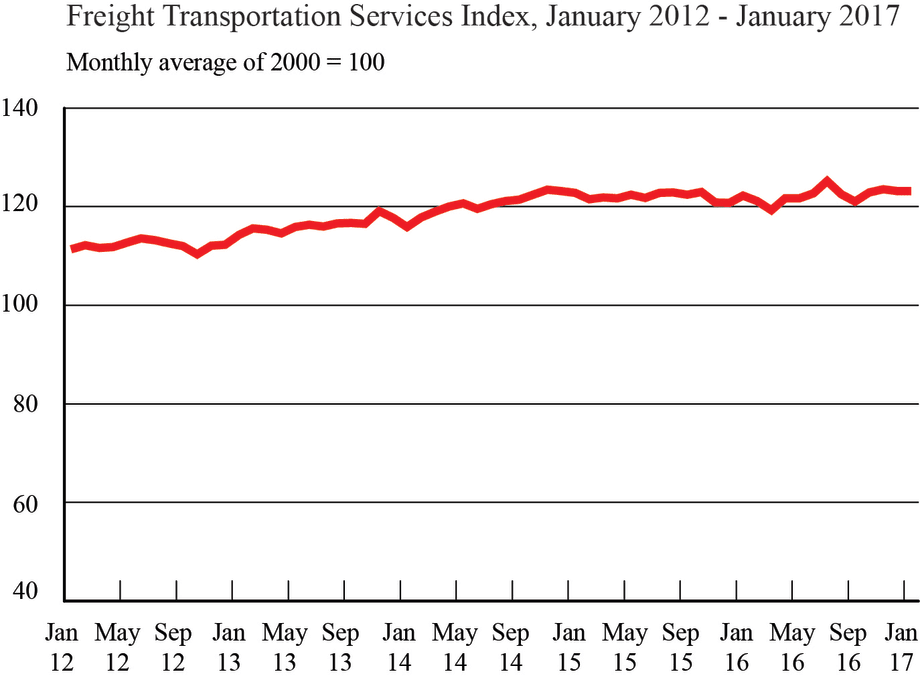
The Freight Transportation Services Index, Jan. 2012 - Jan. 2017. Graphic: U.S. DOT
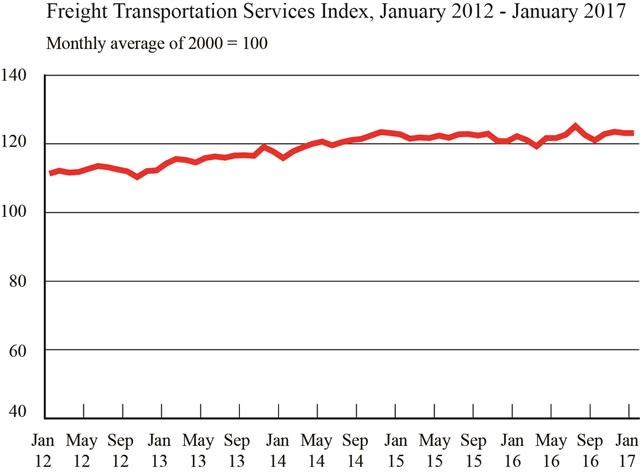
The Freight Transportation Services Index, Jan. 2012 - Jan. 2017.Graphic: U.S. DOT
While the amount of freight moved by the nation’s for-hire transportation sector was unchanged in January from December, according to a new Transportation Department report, it did manage a slight increase from the same time a year ago.
The Freight Transportation Services Index (TSI) remained at 123.2, but that’s up 0.8% from January 2016, and just 1.6% below the all-time high level of 125.2 hit in July 2016.
The December index was revised to 123.2 from 124.7 in last month’s release as a result of fewer actual air freight ton-miles than forecast.
The Freight TSI measures the month-to-month changes in for-hire freight shipments by mode of transportation in tons and ton-miles, which are combined into one index. The index measures the output for-hire trucking, rail, inland waterways, pipelines and air freight.
In January, there were increases in air freight, water, and rail carloads, while trucking, pipeline, and rail intermodal declined. The January steadiness in Freight TSI took place against a background of mixed signals in other economic indicators, according to the report, including growth in employment, personal income and manufacturing while housing starts fell by 2.6%.
The January Freight TSI remained in the same narrow range that has continued for two and a half years. Since the index reached 121.1 for the first time in August 2014, it has with only two exceptions fluctuated between a low of 120.5 and a high of 123.5, slightly above the January level. They were in March 2016, when the index dropped to a three-year low of 119.3, and July 2016, when it reached a new peak of 125.2.
The index dropped 3.4% in the two months after reaching that peak, then rose 2.1% in the following two months to reach 123.5 in November 2016, its highest point since reaching the July high. The level this past January is 0.2% below the November 2016 index but is 30.1% above the April 2009 low during the most recent recession.
According to the Transportation Department there is a clear relationship between economic cycles and the Freight TSI, along with its separate gauge that measures passenger transportation in the U.S.
More Fleet Management

How MFA Helps Protect Trucking Fleets
Multi-factor authentication adds protection when passwords are stolen. Here’s how it works and where fleets should start.
Read More →
How Better Freight Data Helps Trucking Teams Get Ahead of Disruption
Trucking and logistics teams have plenty of data. The problem is getting the right information in front of the right people soon enough to act. Better-connected data can help teams spot trouble earlier and make smarter decisions before small problems become big ones.
Read More →
Trimble: Taking Artificial Intelligence in Trucking Beyond Faster Tasks
At Insight 2026, Trimble executives argued that fleets may need to redesign workflows to get more from AI as it introduced new products and enhancements. AI’s value will depend on how fleets combine automation with their people's knowledge.
Read More →

Build a bulletproof fleet: Uniting ELDs and dash cams for total compliance
An ELD can prove compliance, but it cannot always prove what happened on the road. Discover how uniting accurate ELD data with AI-powered dash cam video can help your fleet strengthen compliance, defend against liability, protect drivers and reduce operational costs.
Read More →
Nominations Open for HDT Emerging Leaders
Heavy Duty Trucking is looking for accomplished trucking fleet professionals under 40 who are making an impact and helping lead the industry forward.
Read More →
Why Private Fleets Are Taking More Freight
Private fleets are putting their own trucks on demanding customers and high-cost lanes as companies seek greater control over service, costs, and capacity.
Read More →
Color Match Smarter: Tools That Restore & Perform
For fleet managers and collision repair professionals keeping heavy-duty trucks on the road, getting the color right the first time isn't just about appearance — it's about efficiency, turnaround time, and bottom-line results. Discover how today's digital color tools are transforming the repair process from guesswork to precision.
Read More →
FMCSA Pauses Biennial-Update Enforcement Amid Motus Transition
Carriers whose updates were due on or after June 1 have more time, while FMCSA works to stabilize its new registration system and warns of phishing sites impersonating its new carrier registration system, Motus.
Read More →
2026 Blueprint for Countering Smarter Supply Chain Theft
Cargo theft is no longer just the cost of doing business. It's a multi-billion-dollar criminal enterprise exploiting vulnerabilities across your fleet, drivers, and supply chain.
Read More →
What the U.S.-Canada Trade War Means for Trucking
Escalating U.S.-Canada tariffs could disrupt cross-border freight, reduce truck volumes, raise costs, and create new uncertainty for carriers on both sides of the border.
Read More →