



Newly released figures show the value of cross-border freight moved between the U.S. and its neighbors directly to the north and south increased in November for the only the second time in nearly two years, but trucking had the smallest gain.
 MENU
MENU SEARCH
Newly released figures show the value of cross-border freight moved between the U.S. and its neighbors directly to the north and south increased in November for the only the second time in nearly two years, but trucking had the smallest gain.

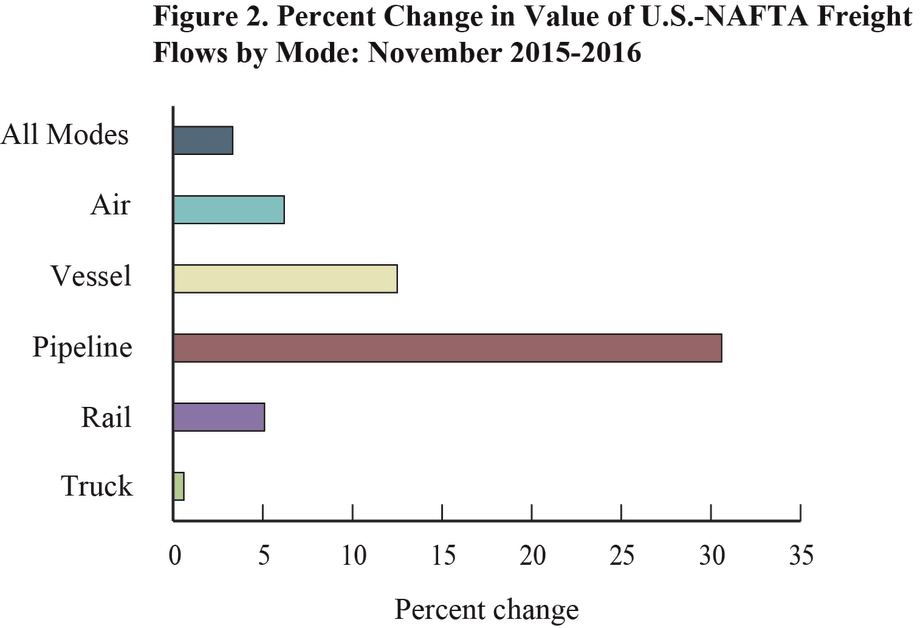
Percent change in value of U.S.-NAFA freight flows by mode in November 2016 compared to November 2015. Graphic: U.S. DOT
Newly released figures show the value of cross-border freight moved between the U.S. and its neighbors directly to the north and south increased in November for the only the second time in nearly two years, but trucking had the smallest gain.
According to the U.S. Transportation Department, $91.1 billion in freight moved between here and North American Free Trade Agreement partners Canada and Mexico, a 3.3% increase from November 2015. This follow declines in September and October and a small hike in August, the first year-over-year improvement since December 2014.
The overall November gain was seen in all five major transportation modes with trucking seeing the smallest hike, just 0.6%. The value of commodities moving by pipeline increased 30.6%; vessel by 12.5%; air by 6.2%, and rail by 5.1%. These five modes carried 85.1% of the total value of U.S.-NAFTA freight flows.
Trucks carried 64.5% of U.S.-NAFTA freight and continued to be the most heavily utilized mode for moving goods to and from both U.S.-NAFTA partners.
Trucks accounted for $30.7 billion of the $49.8 billion of imports, or 61.6%, and $28 billion of the $41.3 billion of exports, or 67.8%. Rail remained the second largest mode by value, moving 15.3% of all U.S.-NAFTA freight.
From November 2015 to November 2016, the value of U.S.-Canada freight flows increased by 2.2% to $46.1 billion as the value of freight on three modes increased from a year earlier. The value of freight carried on pipeline increased by 30.1%, reflecting the increased value of mineral fuels, especially crude oil. Air increased by 6.3%, and rail by 0.6%.
Truck decreased by 0.1% and vessel by 3.3%. During this 12-month period, much of the mineral fuel freight between Texas and Canada shifted from vessel to pipeline as the value of mineral fuel shipments carried by vessel between Texas and Canada decreased while the value of pipeline shipments rose. Texas-Canada mineral fuel trade made up about 15.6% of all U.S.-Canada mineral fuel shipments in November 2016.
Trucks carried 59% of the value of the freight to and from Canada while rail carried 16%. The top commodity category transported between the two counties by all modes was vehicles and parts, of which $5 billion, or 56.6%, moved by truck.
Meantime, to the south, the value of U.S.-Mexico freight flows increased by 4.5% to $45 billion in November from a year earlier as the value of freight on all five major modes increased.
The value of goods moved by pipeline increased by 37.3%, vessel by 20.6%, rail by 10.6%, air by 6%, and truck by 1.2%.
Trucks carried 70.1% of the value of the freight to and from Mexico while rail carried 14.6%. The top commodity category transported between the U.S. and Mexico by all modes in November 2016 was electrical machinery, of which $8.5 billion, or 92.6%, moved by truck.

The American Transportation Research Institute will examine driver coaching, regulatory impacts — including the "Beyond Compliance" concept —and weather disruptions that shape trucking operations.
Read More →
Fleet Advantage's Brian Antonellis says it's time for fleets to get back to the fundamentals of good maintenance practices. And that includes replacing older, inefficient equipment.
Read More →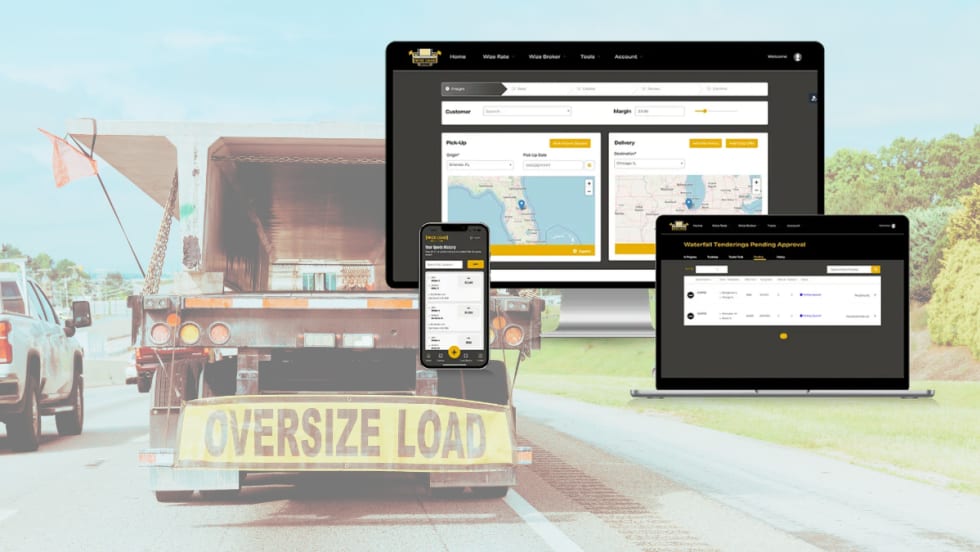
Load matching for flatbed, lowbed, oversize and overweight loads can't be automated like basic van freight, but Truckstop.com is adding more high-tech tools to help.
Read More →
An expanded Trucker Path and Truckstop.com integration brings more freight opportunities into the TruckLoads app while emphasizing security and network quality.
Read More →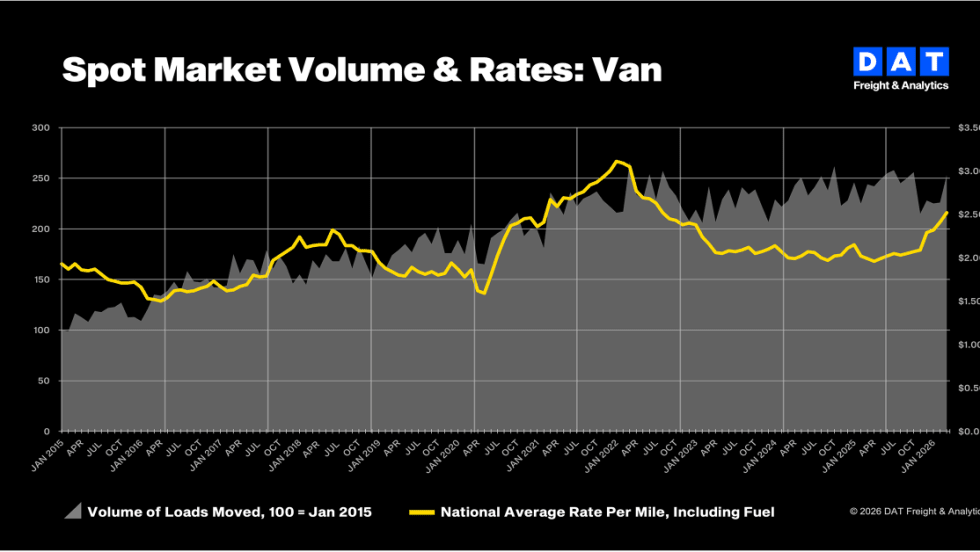
Strong March freight demand combined with a spike in fuel costs pushed both spot and contract truckload rates to their highest levels in more than two years.
Read More →
Everyone’s talking about AI — but is your transportation management system actually built for it?
Read More →
Being part of KTG will allow Sharp to expand and improve its services.
Read More →
The Fair Compensation for Truck Crash Victims Act would increase insurance requirements for interstate motor carriers by nearly seven times.
Read More →
Strong freight rates push TCI to 10.2, but FTR expects fuel-price volatility to skew March results.
Read More →
C.H. Robinson is waiving fees on fuel cards and cash advances for April and May, aiming to help carriers offset rising diesel costs tied to geopolitical instability.
Read More →