




Cross-Border Truck Freight Value Falls Again
Trucking and two other freight transportation modes carried less U.S. freight by value with North American Free Trade Agreement (NAFTA) partners Canada and Mexico in October 2016 compared to the same time a year earlier, according to a new Transportation Department report.


U.S.-NAFTA freight value percent change from previous year over the last 24 months. Graphic: U.S. DOT
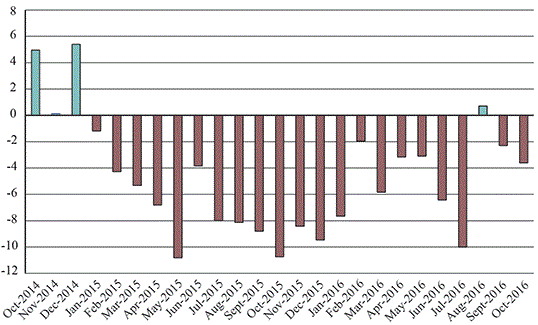
U.S.-NAFTA freight value percent change from previous year over the last 24 months.Graphic: U.S. DOT
Trucking and two other freight transportation modes carried less U.S. freight by value with North American Free Trade Agreement (NAFTA) partners Canada and Mexico in October 2016 compared to the same time a year earlier, according to a new Transportation Department report.
This happened as total cross-border freight moved by all modes fell by 3.6% to $93.2 billion, marking the 21st monthly drop out of the past 22 months beginning in January 2015. The only increase since was a hike of 0.7% this past August.
The value of commodities moved by truck decreased 6.1%, vessel by 7% and air by 12.7%. The value of freight carried on pipeline and rail increased 21.8% and 6.2%, respectively
Trucks carried 65.3% of U.S.-NAFTA freight and continued to be the most heavily used mode for moving goods to and from both U.S.-NAFTA partners. Trucks accounted for $31.9 billion of the $50.3 billion of imports, or 63.4%, and $29 billion of the $42.9 billion of exports, or 67.6%. Rail remained the second largest mode by value, moving 15.8% of all U.S.-NAFTA freight.
U.S.-Canada Freight Falls 2.5 Percent
From October 2015 to October 2016, the value of U.S.-Canada freight flows fell 2.5% to $46.5 billion due to decreases in the value of goods moved by vessel, down 31.1%, air 8.8% lower and truck down 3.1%. The value of freight carried on pipeline and rail increased 21.7% and 2.5%, respectively.
During this 12-month period, much of the mineral fuel freight between Texas and Canada shifted from vessel to pipeline as the value of mineral fuel shipments carried by vessel between Texas and Canada decreased while the value of pipeline shipments rose, according to the report. Texas-Canada mineral fuel trade made up about 25.5% of all U.S.-Canada mineral fuel shipments in October 2016.
The top commodity category transported between the U.S. and Canada by all modes was vehicles and parts, of which $5.2 billion, or 56.9%, moved by truck and $3.8 billion, or 40.8%, moved by rail.
Trucks carried 60.8% of the value of the freight to and from Canada. Rail carried 16.1% followed by pipeline, 9.2%; air, 4.6%; and vessel, 2.9%. The surface transportation modes of truck, rail and pipeline carried 86% of the value of total U.S.-Canada freight flows.
U.S.-Mexico Freight Falls Nearly 5 Percent
The value of U.S.-Mexico freight flows fell 4.7% to $46.6 billion in October compared to a year earlier due to decreases in the value of goods moved by air, down 18%, and truck 8.5% lower. The value of freight carried on three modes increased: pipeline, by 23.6%; rail by 10.4%; and vessel by 6.9%.
Trucks carried 69.9% of the value of the freight to and from Mexico. Rail carried 15.4% of the value of freight to and from Mexico followed by vessel, 7.9%; air, 3.1%; and pipeline, 0.8%. The surface transportation modes of truck, rail and pipeline carried 86% of the value of total U.S.-Mexico freight flows.
The top commodity category transported between the U.S. and Mexico by all modes in October 2016 was electrical machinery, of which $8.7 billion, or 92.1%, moved by truck.
Cross-border freight movements between the U.S. and Canada, as well as with Mexico, have both been hurt by a strong U.S. dollar for more than the past year, which makes U.S. produced goods more expensive outside the country. Also, the sharp drop in the price of oil that began nearly two years ago has pushed the value of freight movements between the three NAFTA countries lower.
More Fleet Management

How to Modernize Your TMS Without Replacing It [Podcast]
Before investing in a new transportation management system, take a closer look at what you've already got. AI, cloud technology and better integrations may offer ways to improve your trucking operations without starting over.
Read More →
Could Your Truck's Connected Devices Be a Cybersecurity Risk?
ELDs, telematics systems and driver tablets help fleets operate more efficiently. But every connected device needs protection against cyberattacks.
Read More →
Holiday Freight Meets a Tight Trucking Market
There's no freight boom, but truckload carriers are finding themselves in a stronger position to negotiate rates. And holiday shipping demand could tighten the market further.
Read More →
What Trucking Events are Happening in 2027?
Looking for trucking-related conventions, expos, and other events? Heavy Duty Trucking has developed this list of national and larger regional trucking shows and events.
Read More →
Does Your Trucking Fleet Need a New TMS?
Artificial intelligence and better integrations promise less busywork and more useful data. Can your TMS help your company solve problems? Do you need additional vendors or an upgrade? Or is it time to look for a new platform?
Read More →
Fleet Costs Shape ACT Expo 2027 Agenda
With diesel prices high and operating expenses under pressure, ACT Expo's 2027 agenda emphasizes fuel efficiency, AI, safety and the return on fleet technology investments.
Read More →
Does Your Trucking Fleet Need a New TMS? [Video]
Cloud technology, AI and new integrations are changing what transportation management systems can do. But does taking advantage of those advances mean replacing your existing TMS?
Read More →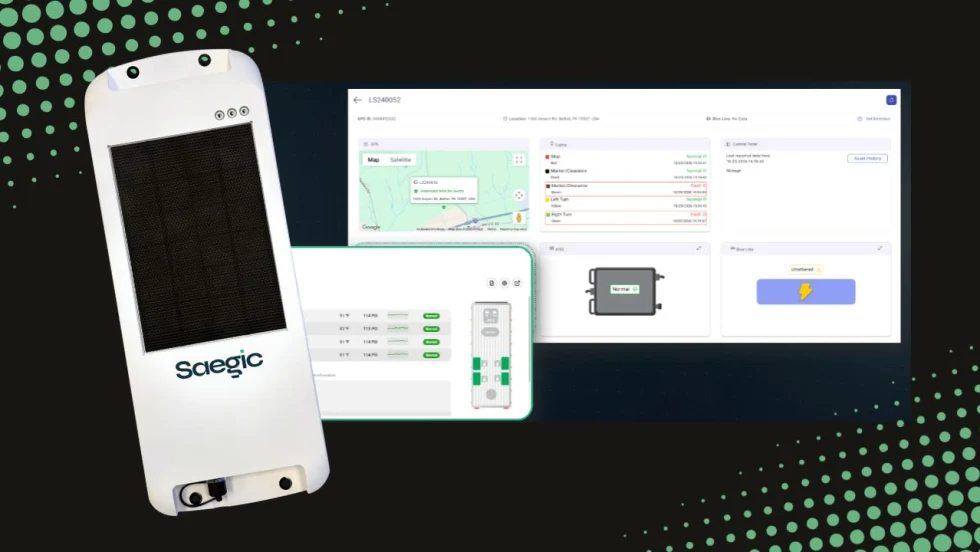
Road Ready Becomes Saegic, Launches New Trailer Telematics Gateway
Clarience Technologies is rolling out new hardware and expanding its plans for connecting trailer telematics, maintenance data, and video.
Read More →
Give Your Trucking Fleet a Cybersecurity Walkaround
Your fleet's cybersecurity policies may look good on paper. These seven checks can help you find out whether they’re working.
Read More →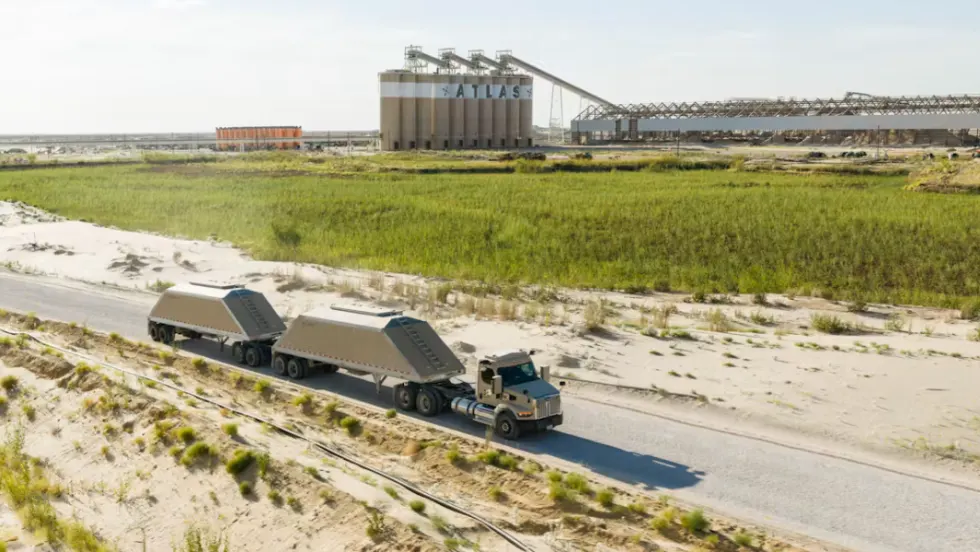
Kodiak Lines Up Fleets for Driverless Trucking
An agreement for 75 trucks, a new Texas freight lane, and progress on safety validation move Kodiak closer to its planned driverless highway launch.
Read More →