




Spot Truckload Rates Steady as Available Freight Increases
While there were slightly more loads and trucks on the spot market during the week ending Oct. 22, according to DAT Solutions and its network of load boards, rates moved little from the week before.

While there were slightly more loads and trucks on the spot market during the week ending Oct. 22, according to DAT Solutions and its network of load boards, rates moved little from the week before.
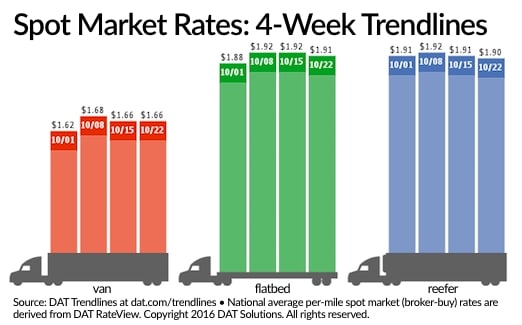
With the number of posted loads up 1.5% and available truck capacity up 2.5% compared to the week before there was little movement in national average spot rates. The reefer and flatbed rate each slipped 1 cent to $1.90 per mile and $1.91 per mile, respectively, while the average van rate held steady at $1.66 per mile. All rates include fuel surcharges.
Load-to-truck ratios also were mixed with the van ratio down 6% to 2.7 to 1, reefers up 2% to 5.9 to 1, and flatbeds up 6% to 15.6 to 1
Van Load Availability Edges Higher
Van load availability slipped 3% and truck posts increased 4% last week, which caused the load-to-truck ratio to dip. The Southeast felt the greatest effects of Hurricane Matthew. Outbound rates from Charlotte returned to pre-storm norms, down 22 cents to $1.90/mile last week. Other top van markets by region:
West: Los Angeles, $2.06 per mile, unchanged
South Central: Dallas, $1.54 per mile, up 2 cents
Midwest: Chicago, $2.00 per mile, up 1 cent
Northeast: Buffalo, $2.01 per mile, up 3 cents
Reefers Rates Trending Higher Near the Mexican Border
Northern harvests are wrapping up but cross-border Mexican produce is ramping up. That led to more loads and higher rates in border markets like McAllen, Texas, up 7 cents to $1.76 mile. Nationally, the number of reefer load posts rose 2% and truck posts increased 1% last week.
According to DAT, there are also some other key reefer lanes to keep in mind such as:
Ontario, California-Phoenix, dropped 4 cents to an average of $2.82 pwe mile
Long-haul reefer freight from the West Coast trended down. For example, Ontario-Chicago lost 14 cents to $1.64/mile
Grand Rapids, Michigan, outbound fell 6 cents to $2.92 pe mile
Reefer rates declined last week in the Southeast, as post-hurricane relief was no longer as urgent. The average outbound rate from Atlanta lost 7 cents to $2.26 per mile, and Atlanta-Lakeland, Florida was off 9 cents to $2.86/mile.
On the flatbed side of the market, there was little unusual activity except that load posts increased 6.6% as truck posts held steady.
All this happened as the national average price of diesel was unchanged from the previous week at $2.48 per gallon.
DAT also noted in the wake of Hurricane Matthew, freight patterns before and after the storm are worth remembering for the next weather event.
“There was a surge in available van freight before the storm and a slump during the hurricane itself. Then there was another surge in freight to bring in relief supplies, DAT said. “While most roads are open again, it’s likely that normal business was still disrupted last week because rates and volumes were down. Flatbed freight was up in the Southeast, though, which means rebuilding efforts are underway.”
More Fleet Management

Does Your Trucking Fleet Need a New TMS?
Artificial intelligence and better integrations promise less busywork and more useful data. Can your TMS help your company solve problems? Do you need additional vendors or an upgrade? Or is it time to look for a new platform?
Read More →
Fleet Costs Shape ACT Expo 2027 Agenda
With diesel prices high and operating expenses under pressure, ACT Expo's 2027 agenda emphasizes fuel efficiency, AI, safety and the return on fleet technology investments.
Read More →
Does Your Trucking Fleet Need a New TMS? [Video]
Cloud technology, AI and new integrations are changing what transportation management systems can do. But does taking advantage of those advances mean replacing your existing TMS?
Read More →
Road Ready Becomes Saegic, Launches New Trailer Telematics Gateway
Clarience Technologies is rolling out new hardware and expanding its plans for connecting trailer telematics, maintenance data, and video.
Read More →
Give Your Trucking Fleet a Cybersecurity Walkaround
Your fleet's cybersecurity policies may look good on paper. These seven checks can help you find out whether they’re working.
Read More →
Kodiak Lines Up Fleets for Driverless Trucking
An agreement for 75 trucks, a new Texas freight lane, and progress on safety validation move Kodiak closer to its planned driverless highway launch.
Read More →
ITS Logistics Settles Religious Harassment Case
The Nevada-based logistics firm agreed to pay more than $396,000 to settle a religious harassment charge involving an employee's Jewish identity.
Read More →
Your Trucks Are Busy. That Doesn’t Mean They’re Winning.
High utilization doesn’t always mean strong margins. Looking beyond the current load can help fleets make better dispatch decisions and get more value from each truck’s time.
Read More →
Why This Trucking Recovery Is Different
Freight demand remains sluggish, but rising costs and tougher enforcement have taken enough capacity out of the market to change the outlook for motor carriers.
Read More →
Platform Science Adds Dispatch and Safety Tools
Four additions to PS Fleet help fleets monitor loads, manage driver coaching, share truck locations and adjust video system settings.
Read More →