




SmartDrive Expands Transportation Intelligence Suite
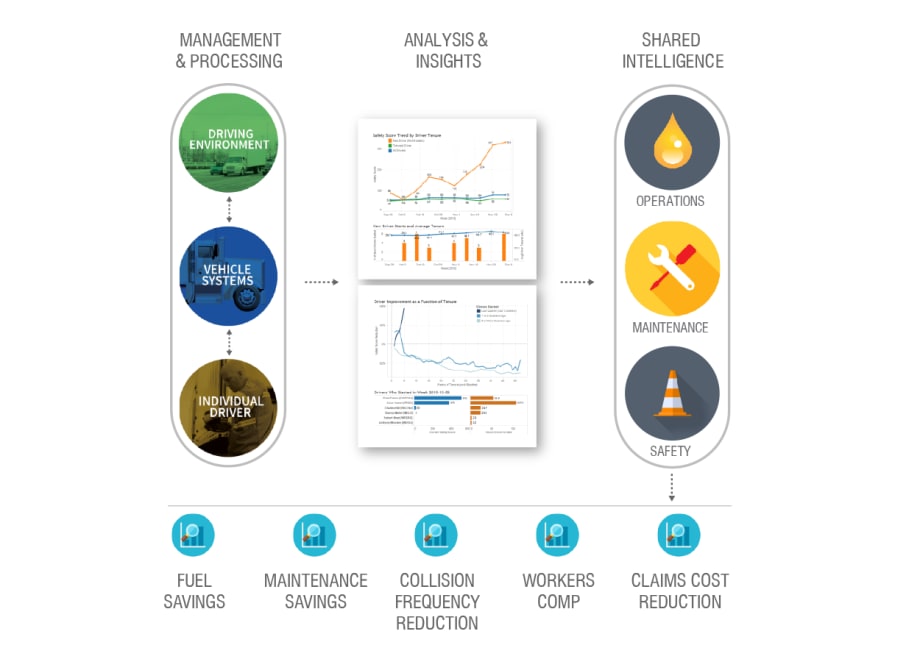
SmartIQ Segmentation is an expansion of its SmartDrive's Transportation Intelligence Suite that enables fleets to optimize strategies based on relevant and predictive performances differences across driver and vehicle segments
Screenshot via SmartDrive
Screenshot via SmartDrive
SmartDrive Systems has introduced SmartIQ Segmentation, an expansion of its Transportation Intelligence Suite that enables fleets to optimize strategies based on relevant and predictive performances differences across driver and vehicle segments.
SmartIQ Segmentation brings together several different data sources on and off the vehicle to create performance comparisons across driver segments, such as "collision" vs. "non-collision" drivers; the top distracted drivers compared to the broader driver population; and drivers with years of experience compared to those with only a few.
According to the company, SmartIQ Segmentation helps fleets design and customize programs, incentives and management engagement in order to be more effective in reaching specific driver groups and potentially lower costs.
"SmartDrive's analysis shows that collision drivers have twice as many near collisions, consume over seven percent more fuel and rank higher in every category of distraction,” said Steve Mitgang, CEO of SmartDrive. “Fleets need this information not as an interesting data point, but as actionable insights based on the performance of their own driver population.”
With SmartIQ Segmentation, fleets now have the ability to:
Develop more relevant training programs and onboarding strategies that are tuned to specific driver needs, such as collision propensity, actual distracted driving and years of CDL experience
Lower fuel costs by understanding the relationship between specific driver attributes like driving tenure and fuel consumption
Design bonus and reward programs that can improve multiple performance metrics concurrently
Reduce turnover by identifying the performance indicators of drivers who leave and those who stay
Direct management resources to those opportunities likely to have the highest impact and deliver greatest value to the business
SmartIQ Segmentation is available as a SmartIQ Pro Pack and includes performance dashboards and visualizations that can be filtered by pre-defined driver segments or by customized segments created through SmartDrive's Transportation Intelligence services team.
These graphical dashboards include KPIs and metrics, and are also easily configured to specific fleet needs. A broad range of metrics can be analyzed, including:
Demographic—age, gender, tenure with company and CDL license years
Behavioral:
Risk—collision rate, near-collision rates and types, distraction rates and types, SmartIQ Safety Score;
Driving performance—speeding, close following, unsafe lane departures, U-turns, running a red light, running a stop sign and tampering
Fuel consumption—overall, city MPG, highway MPG
Geographic—state, city, zip and GPS location
"We've made it easy for fleets to take action with performance metrics and prescriptive insights that can be accessed in our easy to use platform or exported to their own intelligence solution,” said Mitgang. “Now, by bringing fleets' own back-office data into the mix, fleets can take another leap forward in optimizing efficiency."
More Fleet Management

How MFA Helps Protect Trucking Fleets
Multi-factor authentication adds protection when passwords are stolen. Here’s how it works and where fleets should start.
Read More →
How Better Freight Data Helps Trucking Teams Get Ahead of Disruption
Trucking and logistics teams have plenty of data. The problem is getting the right information in front of the right people soon enough to act. Better-connected data can help teams spot trouble earlier and make smarter decisions before small problems become big ones.
Read More →
Trimble: Taking Artificial Intelligence in Trucking Beyond Faster Tasks
At Insight 2026, Trimble executives argued that fleets may need to redesign workflows to get more from AI as it introduced new products and enhancements. AI’s value will depend on how fleets combine automation with their people's knowledge.
Read More →
Build a bulletproof fleet: Uniting ELDs and dash cams for total compliance
An ELD can prove compliance, but it cannot always prove what happened on the road. Discover how uniting accurate ELD data with AI-powered dash cam video can help your fleet strengthen compliance, defend against liability, protect drivers and reduce operational costs.
Read More →
Nominations Open for HDT Emerging Leaders
Heavy Duty Trucking is looking for accomplished trucking fleet professionals under 40 who are making an impact and helping lead the industry forward.
Read More →
Why Private Fleets Are Taking More Freight
Private fleets are putting their own trucks on demanding customers and high-cost lanes as companies seek greater control over service, costs, and capacity.
Read More →
Color Match Smarter: Tools That Restore & Perform
For fleet managers and collision repair professionals keeping heavy-duty trucks on the road, getting the color right the first time isn't just about appearance — it's about efficiency, turnaround time, and bottom-line results. Discover how today's digital color tools are transforming the repair process from guesswork to precision.
Read More →
FMCSA Pauses Biennial-Update Enforcement Amid Motus Transition
Carriers whose updates were due on or after June 1 have more time, while FMCSA works to stabilize its new registration system and warns of phishing sites impersonating its new carrier registration system, Motus.
Read More →
2026 Blueprint for Countering Smarter Supply Chain Theft
Cargo theft is no longer just the cost of doing business. It's a multi-billion-dollar criminal enterprise exploiting vulnerabilities across your fleet, drivers, and supply chain.
Read More →
What the U.S.-Canada Trade War Means for Trucking
Escalating U.S.-Canada tariffs could disrupt cross-border freight, reduce truck volumes, raise costs, and create new uncertainty for carriers on both sides of the border.
Read More →