




New Jersey to Hike Diesel Fuel Tax by 27 Cents
New Jersey lawmakers have approved a bipartisan deal that not only raises fuel taxes in the Garden State for the first time in three decades, it substantially hikes them— by 23 cents per gallon for gasoline and by 27 cents for diesel.

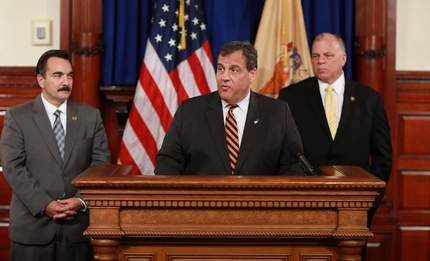
Gov. Christie speaking at announcement of fuel-tax deal with Assembly Speaker Vincent Prieto (left) and State Senate President Steve Sweeney (right) looking on. Photo: New Jersey Governor’s Office/Tim Larsen
Gov. Christie speaking at announcement of fuel-tax deal with Assembly Speaker Vincent Prieto (left) and State Senate President Steve Sweeney (right) looking on. Photo: New Jersey Governor’s Office/Tim Larsen
New Jersey lawmakers have approved a bipartisan deal that not only raises fuel taxes in the Garden State for the first time in three decades, it substantially hikes them— by 23 cents per gallon for gasoline and by 27 cents for diesel.
The New Jersey Senate and Assembly both passed the bill on Oct. 7 and Gov. Chris Christie (R) is expected to sign it within the month, resulting in the first fuel-tax increase for the state since 1988.
The compromise measure was crafted by Christie and the leaders of the Democratic-controlled legislature, Senate President Stephen Sweeney (D-Gloucester) and Assembly Speaker Vincent Prieto (D-Hudson) to replenish the state’s Transportation Trust Fund. The TTF was drained as of early this summer, leading the governor to halt all non-emergency roadwork on July 8.
The New Jersey Motor Truck Association said on Oct. 11 that the gasoline tax increase should go into effect on Nov. 1 while the diesel hike will be implemented in two stages starting next year: The first increase will come on January 1 and the second on July 1.
NJMTA said in a statement that its lobbying effort “was able to get a delayed implementation on diesel as many of our members operate with contracts. Unfortunately, the delay in passage reduced the deal from six months to two-and-a-half months’ notification.”
The exact amount for each stage has not been determined yet, NJMTA noted. “Per the bill, the first increase on January 1, 2017 would be 70%, or approximately 18.9 cents, and on July 1 [it would be] approximately 8.1 cents. The initial rate will be determined by a survey of the statewide price on July 1, 2016 and adjusted quarterly thereafter.” The association added that is seeking confirmation of those exact amounts.
It has been estimated that the higher fuel taxes will account for about $1.2 billion of the $2 billion earmarked annually for the TTF by Christie. Under the governor’s plan, the state will borrow the rest. The bipartisan deal includes measures to offset the resulting higher fuel costs with other tax cuts.
In a press release, Christie said the agreement reflected the need for “a reliable, dedicated source of revenue” for the TTF “and a compromise that includes the first broad-based tax relief for New Jersey residents since 1994.”
Thus, the bill also slices the state’s sales tax from 7% to 6.6%; increases its Earned Income Tax Credit from 30% to 35%; raises income tax exemptions for retirees; and provides other tax relief such as eliminating the estate tax.
While fuel taxes are now expected to fund $16 billion of highway and rail projects over the next eight years, those tax cuts sought by Christie did not sit well with Moody’s Investor Services, per a Bloomberg report.
The rating agency gave the scheme a “credit negative” outlook, contending the tax offsets will result in a $1 billion drop in the state’s general fund by 2021.
"The net effect of the revenue package is credit negative because it will strain the state’s operating budget amid rapidly rising pension contributions and below-average revenue growth," stated Moody’s in a release.
More Fleet Management

Color Match Smarter: Tools That Restore & Perform
For fleet managers and collision repair professionals keeping heavy-duty trucks on the road, getting the color right the first time isn't just about appearance — it's about efficiency, turnaround time, and bottom-line results. Discover how today's digital color tools are transforming the repair process from guesswork to precision.
Read More →
FMCSA Pauses Biennial-Update Enforcement Amid Motus Transition
Carriers whose updates were due on or after June 1 have more time, while FMCSA works to stabilize its new registration system and warns of phishing sites impersonating its new carrier registration system, Motus.
Read More →
2026 Blueprint for Countering Smarter Supply Chain Theft
Cargo theft is no longer just the cost of doing business. It's a multi-billion-dollar criminal enterprise exploiting vulnerabilities across your fleet, drivers, and supply chain.
Read More →


How Telematics Improves Visibility, Control, and Performance in Refrigerated Fleets
Explore how telematics help refrigerated fleets improve visibility, uptime, efficiency, compliance, and cargo protection across connected cold chain operations.
Read More →
What the U.S.-Canada Trade War Means for Trucking
Escalating U.S.-Canada tariffs could disrupt cross-border freight, reduce truck volumes, raise costs, and create new uncertainty for carriers on both sides of the border.
Read More →
What Are Trucking’s Top Concerns for 2026?
The American Transportation Research Institute wants to know what's worrying trucking fleet managers, drivers, and other stakeholders in its annual Industry Issues survey.
Read More →
American Trucking Associations Looks for a New Leader
ATA President and CEO Chris Spear abruptly left his job at the association on August 21, at a pivotal time for the trucking industry.
Read More →
Public Wi-Fi Cybersecurity Risks: How Truck Drivers and Fleets Can Protect Their Data
Public Wi-Fi can expose truck drivers and fleets to credential theft, malware, and other cyber threats. Here’s how to reduce the risk on the road.
Read More →
For Nicky Cupp, Fleet Innovation Starts With Frustration
HDT Truck Fleet Innovator Nicky Cupp turns everyday pain points at Fraley & Schilling into opportunities for better technology and smarter processes.
Read More →
Adam Buttgenbach’s Approach to Electric Trucks: Start With Where They Fit
HDT Truck Fleet Innovator Adam Buttgenbach helped PepsiCo build one of North America’s largest EV fleets by focusing on where electric trucks make operational sense.
Read More →