




Spot Market Rates, Volume Rebound from Last Week
The spot truckload market finished August on a higher note as rates and the number of available loads moved higher during the week ending Sept. 3, according to DAT Solutions and its network of load boards.

The spot truckload market finished August on a higher note as rates and the number of available loads moved higher during the week ending Sept. 3, according to DAT Solutions and its network of load boards.
Helping this was an 8.4% increase in the number of available loads while truck posts fell 2.5% compared to the week before. During the period the national average cost of diesel was unchanged from the week before at $2.41 per gallon.
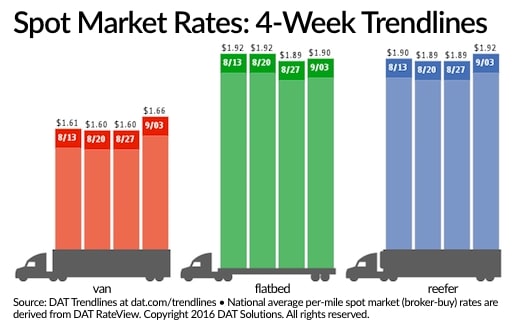
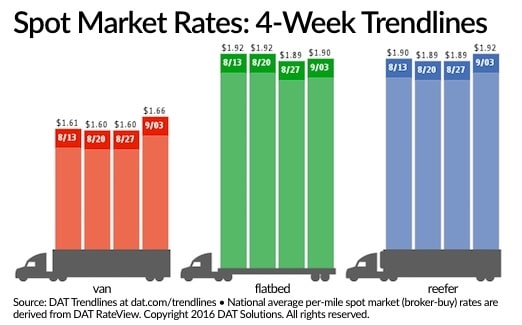
The national average van rate gained 6 cents, the reefer rate added 3 cents and the flatbed rate picked up a penny after a mostly lackluster month. All reported rates include fuel surcharges.
Load-to-truck ratios got a healthy boost, an indication that the higher rates may outlast end-of-month and pre-holiday pressure, according to DAT.
Van load posts increased 13% and truck posts fell 2% for a load-to-truck ratio of 3.2 to 1, the highest ratio since July. The spike in freight volume pushed the national average van rate to $1.66 mile and its best showing out of the previous four weeks.
In the Midwest, a 4% increase in freight volume sparked an 8 cents per-mile jump to $1.99 per mile on outbound lanes from Chicago. Rates out of Columbus averaged $1.90 mile, up 6 cents. Van volumes and rates were strong in the Southeast with Charlotte gaining 6 cents to $1.94 per mile, Atlanta up 4 cents to $1.87 per mile and Memphis adding 4 cents to $1.86 per mile.
Other top-paying markets by region:
West: Los Angeles, $2.02 per mile, up 2 cents
South Central: Houston, $1.50 per mile, up 3 cents
Northeast: Allentown, Pennsylvania, $2.09 per mile, up 10 cents
In the reefer sector, the number of load posts increased 11% last week while capacity declined 2%. That boosted the reefer load-to-truck ratio 14% to 6.6 loads per truck. The national average reefer rate clocked in at $1.92 per mile, its best performance in the past four weeks, that including a 1-cent increase in the fuel surcharge.
In California, average outbound rates were generally strong including a 5 cents jump in the rate from Los Angeles at $2.46 per mile. Idaho potato harvests led to higher volumes out of Twin Falls but outbound rates slipped leading up to the Labor Day weekend, according to DAT,
Several key reefer-freight lanes remained strong:
Atlanta-Lakeland, Florida; $2.84 per mile, up 6 cents
Elizabeth, New Jersey-Boston; $3.55 per mile, down 3 cents
Chicago outbound; $2.35 per mile, up 14 cents
Meantime, the number of flatbed load posts was steady while truck posts declined 4%. That pushed the load-to-truck ratio up 4% to 10.1 loads per truck. The national average flatbed moved up to $1.91 per mile due entirely to a hike in the fuel surcharge.
More Fleet Management

2026 Blueprint for Countering Smarter Supply Chain Theft
Cargo theft is no longer just the cost of doing business. It's a multi-billion-dollar criminal enterprise exploiting vulnerabilities across your fleet, drivers, and supply chain.
Read More →
How Telematics Improves Visibility, Control, and Performance in Refrigerated Fleets
Explore how telematics help refrigerated fleets improve visibility, uptime, efficiency, compliance, and cargo protection across connected cold chain operations.
Read More →
What the U.S.-Canada Trade War Means for Trucking
Escalating U.S.-Canada tariffs could disrupt cross-border freight, reduce truck volumes, raise costs, and create new uncertainty for carriers on both sides of the border.
Read More →

What Are Trucking’s Top Concerns for 2026?
The American Transportation Research Institute wants to know what's worrying trucking fleet managers, drivers, and other stakeholders in its annual Industry Issues survey.
Read More →
American Trucking Associations Looks for a New Leader
ATA President and CEO Chris Spear abruptly left his job at the association on August 21, at a pivotal time for the trucking industry.
Read More →
Public Wi-Fi Cybersecurity Risks: How Truck Drivers and Fleets Can Protect Their Data
Public Wi-Fi can expose truck drivers and fleets to credential theft, malware, and other cyber threats. Here’s how to reduce the risk on the road.
Read More →
For Nicky Cupp, Fleet Innovation Starts With Frustration
HDT Truck Fleet Innovator Nicky Cupp turns everyday pain points at Fraley & Schilling into opportunities for better technology and smarter processes.
Read More →
Adam Buttgenbach’s Approach to Electric Trucks: Start With Where They Fit
HDT Truck Fleet Innovator Adam Buttgenbach helped PepsiCo build one of North America’s largest EV fleets by focusing on where electric trucks make operational sense.
Read More →
Deen Albert: Let Automation Do the Math, People Make the Decisions
HDT Truck Fleet Innovator Deen Albert makes sure people are still at the heart of operations at Grand Island Express, even while adopting artificial intelligence tools. AI-assisted dispatch helped boost revenue 25% with the same number of trucks.
Read More →
Trimble’s New AI Agent Takes Aim at Fleet Back-Office Busywork
Arc Agent works across Trimble TMS products to automate repetitive tasks such as freight orders, maintenance, invoices, fuel costs and more.
Read More →