




FTR Conference: Expect a Freight Recovery, Just Not a Big One
While a recovery for freight and the overall U.S. economy is in the cards for the fourth quarter of the year, those attending the first sessions of the FTR Transportation Conference in Indianapolis on Wednesday were also told by experts they should not expect a huge boom.


FTR economist Noel Perry said it would be prudent to prepare for the possibiilty of a recession. Photo: Evan Lockridge
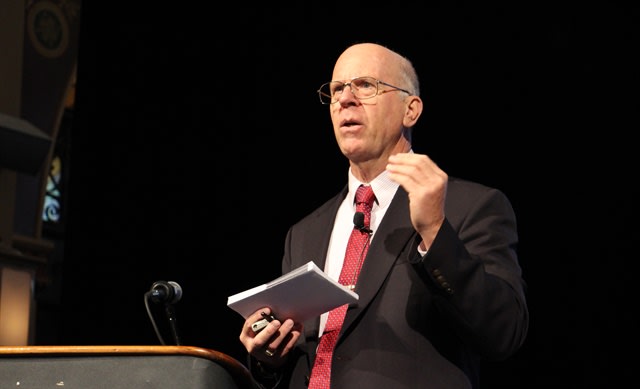
Daniel Meckstroth, chief economist with the Manufacturers Alliance for Productivity and Innovation, expects a fourth-quarter spike in production.Photo: Evan Lockridge
While a recovery for freight and the overall U.S. economy is in the cards for the fourth quarter of the year, those attending the first sessions of the FTR Transportation Conference in Indianapolis on Wednesday were also told by experts they should not expect a huge boom.
Daniel Meckstroth, chief economist with the industry group the Manufacturers Alliance for Productivity and Innovation (MAPI), said that after a long while July shows “the first indication that the manufacturing inventory-to-sales ratios are falling” after higher levels hurt freight shipments earlier in the year. The July level is also the lowest in about two years.
“In the future, we are going to get a spike in production, I think is going to occur in the fourth quarter … not only in the manufacturing sector but [also] in the U.S. economy,” he said.
The reason, Meckstroth said, is that inventory cycles, such as the high one manufacturing has experienced lately, are usually short. When they are over, you typically see a spike in production.
High inventories have been a drag on economic activity as well as freight movements, but now they are coming into closer balance. This results not only in better sales of manufactured goods but others as well, resulting in an improvement in the general economy.
Helping this along is the ever-resilient U.S. consumer, who accounts for about 70% of all U.S. economic activity. Meckstroth said “consumers are keeping us out of a recession.” How are they doing it? Because, as he put it, “we are in a jobs boom, with the percentage of new jobs being adding being much faster than overall economic expansion.”
“It’s new jobs creating new income…that’s what’s propelling the U.S. economy right now.”
However, there are still other problems lingering that will keep both trucking and the economy from seeing better times.
According to Meckstroth, a strong U.S. dollar is a problem, because it makes export goods produced here more expensive overseas. He also pointed to figures showing the physical volume (as opposed to dollar volume) of world trade has slowed dramatically, depressing U.S economic growth.
“If you go back 20 years before the last recession, trade was growing two to three times the rate of the global economy. Now it’s growing slower than the growth of the global economy,” he said. “We’re not seeing globalization anymore. We’re seeing deglobalization.”
In other words, expect only “modest” growth, or as he called it “the new normal” in both the economy and trucking.

FTR economist Noel Perry said it would be prudent to prepare for the possibiilty of a recession.Photo: Evan Lockridge
Even then it may not last for long, according to Noel Perry, FTR’s transportation economist.
As he explained it, the current recovery from recession is one of the longest since 1950 and it has been one of the weakest. Perry said there is a 30% to 40% probability an economic recession will hit in the next two or three years.
“You should prepare for that,” he told those listening and warned those who don’t do so at their own peril. “It’s like saying, it ain’t gonna snow tomorrow, but I know it’s gonna snow sometime in the next month, so I better get my snow blower out of the garage, put gas in it and make sure it starts. Well, I’m telling you the same thing about a recession.”
The reason he (and others) see a recession in the next two or three years is simply the growth of the overall economy has slowed.
According to Perry, if there is a recession, trucking can expect to see business decline by 5% to 6%, with rates falling about the same. For comparison, in the last recession the declines were much larger, around 15% – meaning the next recession, if it happens, will be much milder.
More Fleet Management

Geotab Links Fleet Card to Vehicle Data
The new card combines fuel discounts with telematics-based purchase controls. Geotab’s analysis also points to potential savings from choosing lower-priced fuel stops.
Read More →
How MFA Helps Protect Trucking Fleets
Multi-factor authentication adds protection when passwords are stolen. Here’s how it works and where fleets should start.
Read More →
How Better Freight Data Helps Trucking Teams Get Ahead of Disruption
Trucking and logistics teams have plenty of data. The problem is getting the right information in front of the right people soon enough to act. Better-connected data can help teams spot trouble earlier and make smarter decisions before small problems become big ones.
Read More →

Trimble: Taking Artificial Intelligence in Trucking Beyond Faster Tasks
At Insight 2026, Trimble executives argued that fleets may need to redesign workflows to get more from AI as it introduced new products and enhancements. AI’s value will depend on how fleets combine automation with their people's knowledge.
Read More →
Build a bulletproof fleet: Uniting ELDs and dash cams for total compliance
An ELD can prove compliance, but it cannot always prove what happened on the road. Discover how uniting accurate ELD data with AI-powered dash cam video can help your fleet strengthen compliance, defend against liability, protect drivers and reduce operational costs.
Read More →
Nominations Open for HDT Emerging Leaders
Heavy Duty Trucking is looking for accomplished trucking fleet professionals under 40 who are making an impact and helping lead the industry forward.
Read More →
Why Private Fleets Are Taking More Freight
Private fleets are putting their own trucks on demanding customers and high-cost lanes as companies seek greater control over service, costs, and capacity.
Read More →
Color Match Smarter: Tools That Restore & Perform
For fleet managers and collision repair professionals keeping heavy-duty trucks on the road, getting the color right the first time isn't just about appearance — it's about efficiency, turnaround time, and bottom-line results. Discover how today's digital color tools are transforming the repair process from guesswork to precision.
Read More →
FMCSA Pauses Biennial-Update Enforcement Amid Motus Transition
Carriers whose updates were due on or after June 1 have more time, while FMCSA works to stabilize its new registration system and warns of phishing sites impersonating its new carrier registration system, Motus.
Read More →
2026 Blueprint for Countering Smarter Supply Chain Theft
Cargo theft is no longer just the cost of doing business. It's a multi-billion-dollar criminal enterprise exploiting vulnerabilities across your fleet, drivers, and supply chain.
Read More →