




Truckload Linehaul Rates Remain Soft, Intermodal Rates Continue Steep Drop
Truckload linehaul rates in June were nearly the same as the month before, but they are still below levels from a year ago, while there seems to be no end to the recent drop in rates for intermodal shipments.

Truckload linehaul rates in June were nearly the same as the month before, but they are still below levels from a year ago, while there seems to be no end to the recent drop in rates for intermodal shipments.
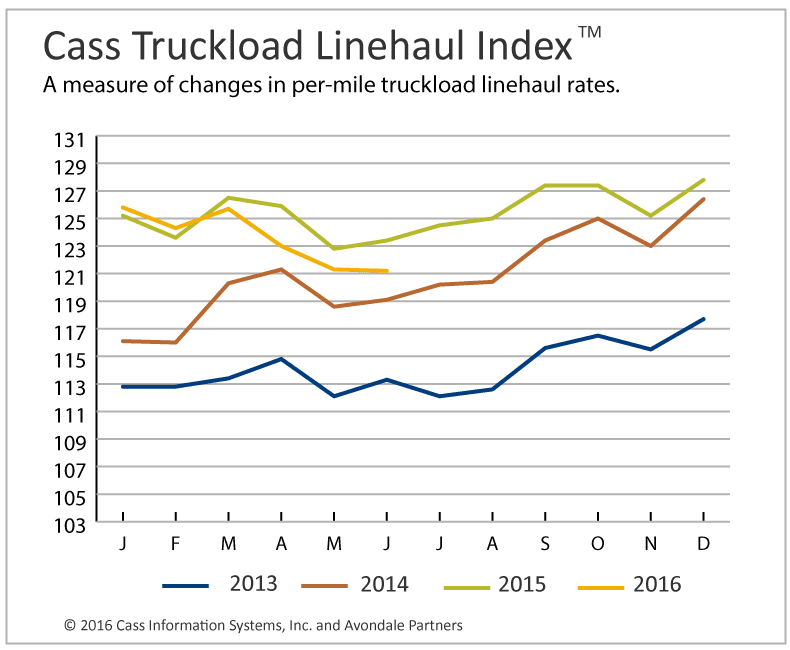
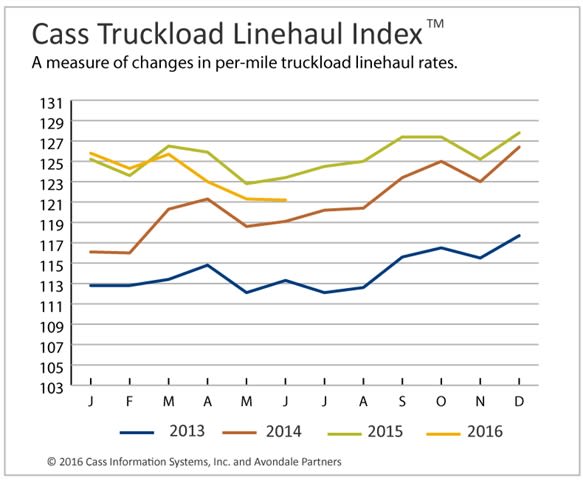
The Cass Truckload Linehaul Index fell another 1.8% year-over-year, after falling 2.3% and 1.2% in April and May, respectively, representing four consecutive months of year-over-year declines.
The index, which posted a reading of 121.2 in June, its lowest level since August 2014, fell 0.1% from May, the third straight monthly drop.
Analysts at the investment firm Avondale Partners, which provides analysis of the index, have further adjusted their pricing forecast range downward for the remainder of 2016 to a 1% to a 3% decline.
The report says several factors continue to contribute to the excess capacity that has caused rates to drop, including driver pay increases, overall fleet growth, reduction in carrier bankruptcies and an easing of the controversial 34-hour restart rule.
The index is an indicator of market fluctuations in per-mile truckload pricing, isolating the linehaul component of full truckload costs from other components, such as fuel and accessorials, providing a look at trends in baseline truckload prices.
Meantime, Cass Intermodal Index fell another 1.5% year over year in June, representing 18 consecutive months of year-over-year declines. Its reading of 121.1 also represents a 4.3% drop in June from May and is at its lowest level since January 2011.
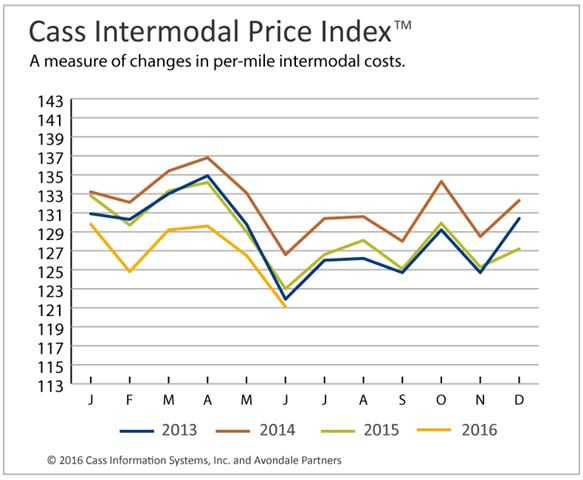
Historically, there is a "high degree of correlation between truckload and intermodal pricing," said analysts with Avondale Partners. As contract rates for trucking continue to lose strength and move further into negative territory, “[this] would imply even more potential weakness for intermodal pricing."
The Cass Intermodal Price Index is a measure of market fluctuations in per-mile U.S. domestic intermodal costs that includes all costs associated with the move, such as linehaul, fuel and accessorials.
Data within both measures is derived from actual freight invoices paid on behalf of clients of payment processor Cass Information Systems, which totaled $25 billion in 2015.
Surprisingly, the figures follow a report from the day before showing freight shipments and expenditures edged up in June after three months of lackluster performance, hitting their highest levels of the year, according to the Cass Freight Index – but it remains unclear whether this is part of a larger trend.
More Fleet Management

Can You Beat Our Trucking Trivia Challenge?
Test your truck knowledge with 19 trivia questions from Heavy Duty Trucking Exchange. Can you keep up with the fleet pros?
Read More →
BeyondTrucks Adds Rules Checks to Dispatch
New Compatibility Engine checks driver qualifications, equipment requirements and fleet policies before loads are dispatched.
Read More →
Diesel Prices Hijack Trucking’s Worry List
ATRI’s annual survey finds cautious optimism about freight, but diesel costs, litigation, and insurance continue to squeeze fleets. Drivers have different priorities on several issues.
Read More →
Nomination Deadline Extended for HDT Emerging Leaders
Just a few more days to nominate accomplished trucking fleet professionals under 40 who are making an impact and helping lead the industry forward for the HDT Emerging Leaders award. Deadline extended to October 20!
Read More →
What Will ATA’s New Leader Bring to Trucking's Table?
Incoming President and CEO Mark Colson’s record in Alabama offers clues about his priorities and approach following Chris Spear’s abrupt departure as the head of the American Trucking Associations.
Read More →
Volvo, Waabi Start Commercial Autonomous Operations in Texas
Volvo VNL Autonomous trucks, powered by the Waabi Driver, are hauling freight directly to third-party facilities for a customer in Texas.
Read More →
Samsara Launches Custom AI Agent Builder
Agent Studio lets fleets create AI tools for hours-of-service monitoring, reporting and driver support, including agents that communicate by phone.
Read More →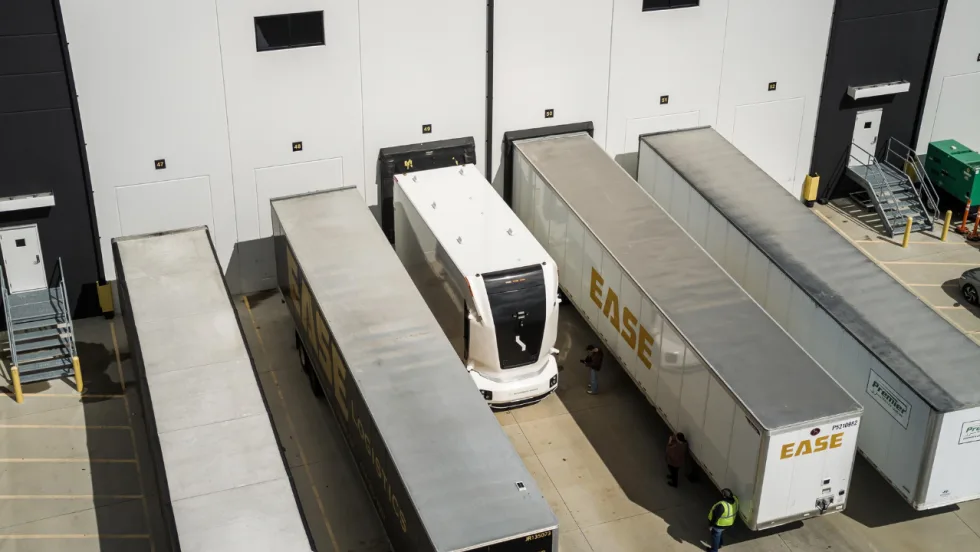
Einride Driverless Electric Trucks Begin Daily Freight Operations in Ohio
Two cabless electric trucks are hauling freight between EASE Logistics facilities in Marysville, Ohio, as part of a multi-state truck automation project.
Read More →
Geotab Links Fleet Card to Vehicle Data
The new card combines fuel discounts with telematics-based purchase controls. Geotab’s analysis also points to potential savings from choosing lower-priced fuel stops.
Read More →
How MFA Helps Protect Trucking Fleets
Multi-factor authentication adds protection when passwords are stolen. Here’s how it works and where fleets should start.
Read More →