




Truck Ramming Again Recognized as Terrorist Threat
The massacre by truck in Nice, France on July 14 raises anew the question of what can be done to prevent low-tech but devastating truck-ramming assaults of people gathered along or near a roadway.


Truck used to kill pedestrians in Nice, France on July 14, shown after the driver was killed by police gunfire. Image via Twitter
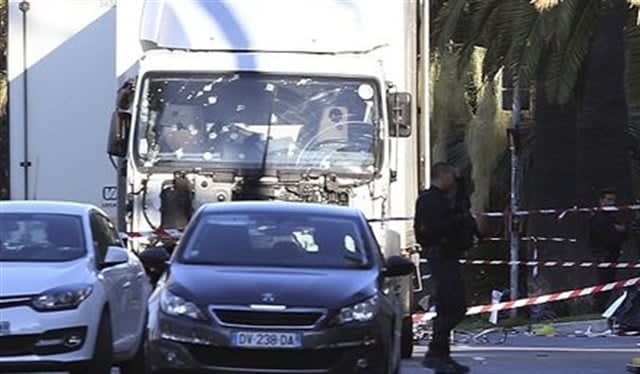
Truck used to kill pedestrians in Nice, France on July 14, shown after the driver was killed by police gunfire. Image via Twitter
The massacre by truck that killed at least 84 persons, including two Americans, and wounded over 200 others in Nice, France, on July 14 raises anew the question of what can be done to prevent low-tech but devastating truck-ramming attacks.
The attack came out of nowhere as revelers were gathered on the seaside Promenade des Anglais in the famed resort city of Nice to view Bastille Day fireworks. The medium-duty cabover had been rented by the perpetrator, Mohamed Lahouaiej Bouhlel, a 31-year old Tunisian immigrant. several days before.
At about 10:45 pm on July 14, Bouhlel drove the truck onto the thoroughfare and began plowing through the crowd. He kept driving and swerving into people for over a mile and began firing on police officers from the cab. The police returned fire, killing Bouhlel while he was still behind the wheel. Found in the cab was a small arsenal, including an automatic pistol, a cartridge clip, several cartridges, and a Kalashnikov and an M16 rifle.
On this side of the Atlantic, the governor of New York, Andrew Cuomo, was quick to react, issuing a statement early the next day that outlined immediate steps that were being taken to guard against any such assault, especially in New York City.
Cuomo ordered state law enforcement officials to “step up security at high-profile locations” around the state, including airports, bridges, tunnels and mass transit systems.
“The Department of Homeland Security and Emergency Services’ Office of Emergency Management Watch Center will be on heightened alert, monitoring world events,” the governor said in a statement. “DHSES regional staff have all been notified to maintain a heightened state of awareness at mass gathering events.”
He added that the New York State Police and Joint Task Force Empire Shield (which conducts Homeland Security operations) have deployed additional troops in the New York metropolitan region.
New York City is no stranger to attack by truck. The first attempt by terrorists to destroy the World Trade Center, back in 1993, also used a rented truck. In it was placed a homemade 1,500-pound urea-nitrate bomb. The truck was parked in an underground garage and when the bomb exploded, it blew a hole five stories deep and half-a-football field wide. Six people were killed and another thousand were injured by the blast.
Other infamous truck bombings perpetuated against Americans were the assault on the Marine barracks in Lebanon in 1983 and the 1995 attack on the Alfred P. Murrah Federal Building in Oklahoma City by Timothy McVeigh that left 168 dead.
Explosives in vehicles can be detected and vehicular proximity to buildings can be controlled. But preventing a truck, or a car, for that matter, from being unleashed as a lethal battering ram anywhere people are gathered is a far more difficult feat.
Yet the threat of vehicular ramming is not new. The Department of Homeland Security addressed it as far back as 2010 in a public document released to law enforcement and first-responder personnel.
“Terrorists overseas have suggested conducting vehicle ramming attacks — using modified or unmodified vehicles — against crowds, buildings, and other vehicles,” advised DHS. “Such attacks could be used to target locations where large numbers of people congregate, including sporting events, entertainment venues, or shopping centers.”
The agency went on to say that “vehicle ramming offers terrorists with limited access to explosives or weapons an opportunity to conduct a homeland attack with minimal prior training or experience.”
DHS also discussed “indicators” to be aware of that might point to an imminent vehicle-ramming attack. “Although a single indicator may not be suspicious, one or more might indicate a ramming attack is being developed, based on the specific facts or circumstances.” The agency soberly noted that “a ramming attack can be conducted with little to no warning.”
Here are the indicators cited by DHS:
Unusual modifications to commercial motor vehicles, heavy equipment, passenger cars, and sports utility vehicles (SUVs), such as homemade attempts to reinforce the front of the vehicle with metal plates
The purchase, rental, or theft of large or heavy-duty vehicles or equipment, if accompanied by typical indicators such as nervousness during the purchase, paying in cash, or lack of familiarity with the vehicle’s operations
Commercial motor vehicles or heavy equipment being operated erratically, at unusual times, or in unusual locations, particularly in heavy pedestrian areas
Attempts to infiltrate closed areas where traffic usually moves, but where crowds are gathered, such as for street festivals or farmers’ markets
A vehicle operator’s apparent unfamiliarity with commercial motor vehicle or heavy equipment operation.
Clearly, the attack at Nice has signaled that everyone from police officers to motorists to pedestrians must keep foremost in mind that the next lone-wolf terrorist attack may well come from behind the wheel of the nearest vehicle. It's also obvious that the means of preventing such an assault are extremely limited.
"Absent intelligence, the same way you can't stop someone from shooting into a crowd, there isn't a magic way to stop someone from driving into a crowd," said NYPD Deputy Commissioner John Miller, per a New York Daily News report. "What we seek to do is minimize that threat in pedestrian malls like Times Square, where you have the largest crowds."
CORRECTION: Story corrected 9:35 a.m. EDT 7/18/2016; date of the truck attack on the World Trade Center was incorrect.
More Fleet Management

Nomination Deadline Extended for HDT Emerging Leaders
Just a few more days to nominate accomplished trucking fleet professionals under 40 who are making an impact and helping lead the industry forward for the HDT Emerging Leaders award. Deadline extended to October 20!
Read More →
What Will ATA’s New Leader Bring to Trucking's Table?
Incoming President and CEO Mark Colson’s record in Alabama offers clues about his priorities and approach following Chris Spear’s abrupt departure as the head of the American Trucking Associations.
Read More →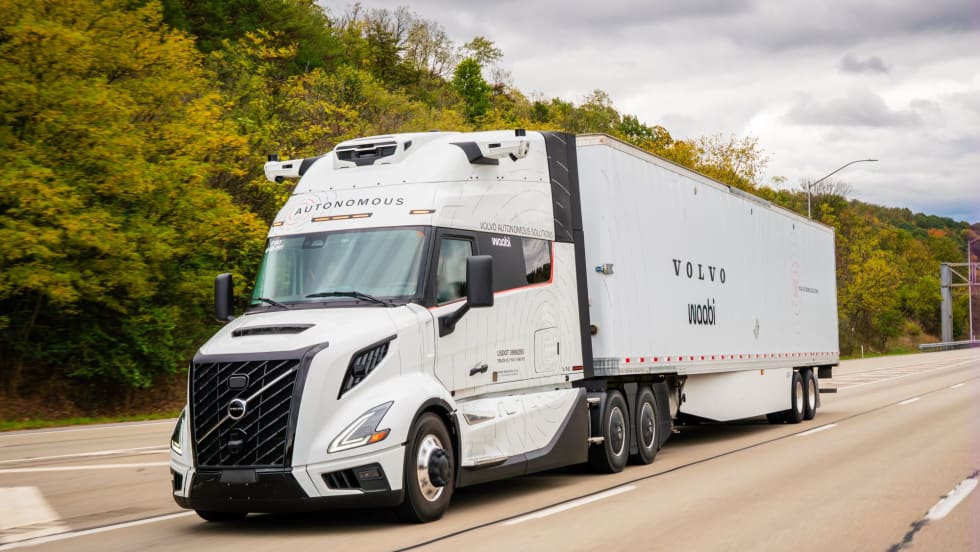
Volvo, Waabi Start Commercial Autonomous Operations in Texas
Volvo VNL Autonomous trucks, powered by the Waabi Driver, are hauling freight directly to third-party facilities for a customer in Texas.
Read More →
Samsara Launches Custom AI Agent Builder
Agent Studio lets fleets create AI tools for hours-of-service monitoring, reporting and driver support, including agents that communicate by phone.
Read More →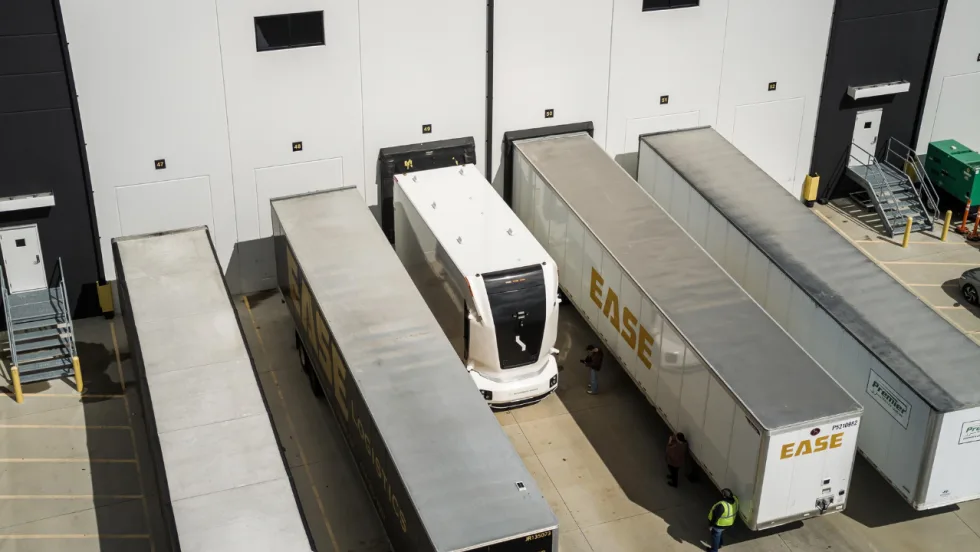
Einride Driverless Electric Trucks Begin Daily Freight Operations in Ohio
Two cabless electric trucks are hauling freight between EASE Logistics facilities in Marysville, Ohio, as part of a multi-state truck automation project.
Read More →
Geotab Links Fleet Card to Vehicle Data
The new card combines fuel discounts with telematics-based purchase controls. Geotab’s analysis also points to potential savings from choosing lower-priced fuel stops.
Read More →
How MFA Helps Protect Trucking Fleets
Multi-factor authentication adds protection when passwords are stolen. Here’s how it works and where fleets should start.
Read More →
How Better Freight Data Helps Trucking Teams Get Ahead of Disruption
Trucking and logistics teams have plenty of data. The problem is getting the right information in front of the right people soon enough to act. Better-connected data can help teams spot trouble earlier and make smarter decisions before small problems become big ones.
Read More →
Trimble: Taking Artificial Intelligence in Trucking Beyond Faster Tasks
At Insight 2026, Trimble executives argued that fleets may need to redesign workflows to get more from AI as it introduced new products and enhancements. AI’s value will depend on how fleets combine automation with their people's knowledge.
Read More →
Build a bulletproof fleet: Uniting ELDs and dash cams for total compliance
An ELD can prove compliance, but it cannot always prove what happened on the road. Discover how uniting accurate ELD data with AI-powered dash cam video can help your fleet strengthen compliance, defend against liability, protect drivers and reduce operational costs.
Read More →